First Seen
2023-05-10T21:03:33+00:00
simple-description (llama3.2-vision_11b)
The meme is a humorous commentary on the reaction to a news article or event, using the phrase "I find your lack of faith disturbing" from Star Wars, to express frustration with people who are not reacting to a situation in the way the creator expects. The meme is a sarcastic response to people who are not reacting to a news article or event in the way the creator expects, implying that they are not taking the situation seriously or are not reacting in a way that is expected. The text that appears in the image is "I find your lack of faith disturbing" and "I am the one who will bring order to the galaxy".
detailed-analysis (gemma3-27b-vision)
Okay, let's break down this meme using the requested theoretical frameworks. It's a complex image with a lot going on, so we'll try to be thorough.
Visual Description
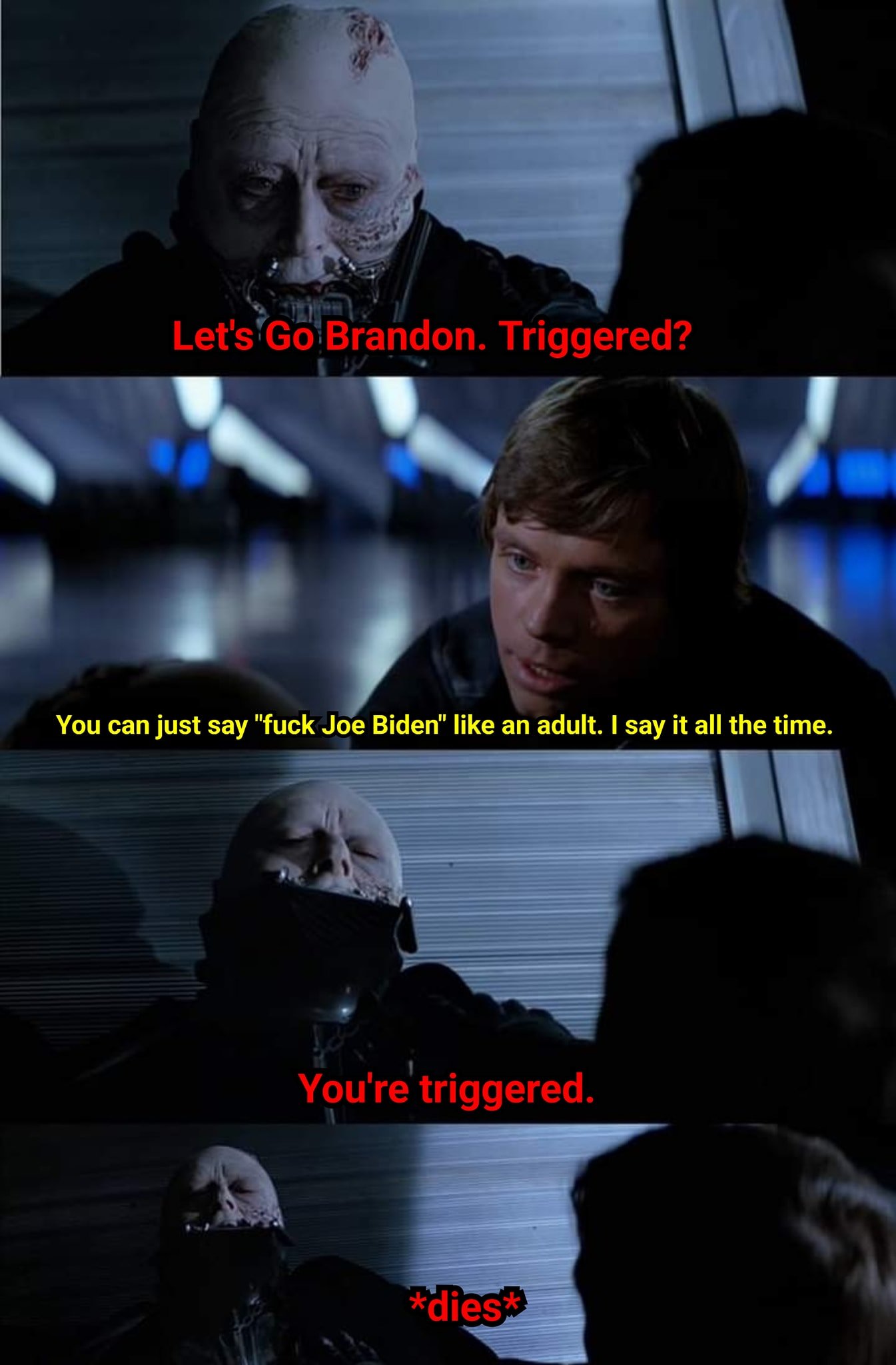
The image is a still from the movie Star Wars: Return of the Jedi depicting a confrontation between Luke Skywalker and Darth Vader. Luke is in a defensive stance, while Vader is towering over him. The scene is dimly lit with the blue hues typical of the film's special effects. Overlaying the scene are red, capitalized text bubbles with specific phrases. The meme text frames the scene with modern, politically-charged slang like "Let's Go Brandon" and "You're triggered." Darth Vader appears to be uttering the phrase "You're triggered." Finally, at the bottom, in small letters, is the word "dies". The use of a popular movie scene with current political and internet language is a common tactic in meme creation, aiming for ironic juxtaposition and relatable humor.
Foucauldian Genealogical Discourse Analysis
This meme immediately lends itself to a Foucauldian reading. The core of this image plays with the discourse surrounding political polarization and internet subcultures.
- Discipline and Power: The scene from Star Wars establishes a power dynamic between Vader and Luke. The meme leverages this existing power dynamic to reflect a sense of dominance and a perceived silencing of opposition. Saying someone is "triggered" is a way of claiming a rhetorical victory, positioning oneself as unaffected and the other as emotionally vulnerable.
- Genealogy of "Triggered": The term “triggered,” once used clinically to describe trauma responses, has been appropriated and weaponized in online spaces, becoming a pejorative used to dismiss any expression of disagreement or emotional response. The meme’s use of the term, within the context of a scene of physical dominance, is an example of this appropriation and its function in establishing a power dynamic. The meme is not examining the original meaning but has mutated the original concept.
- Discourse and Subjectivation: The meme contributes to the shaping of subjects within the online political discourse. By framing opposition as "triggered," it reinforces a narrative that any emotional response to a certain position is invalid or weak. This contributes to a climate where robust debate is stifled and individuals are categorized into opposing camps. The meme creates a subject position defined by the ability to remain "untriggered."
Critical Theory
Applying Critical Theory, specifically a Frankfurt School perspective, we can see how the meme participates in the culture industry and reinforces existing power structures.
- Commodification of Rebellion: The meme appropriates a dramatic scene from a major cultural product (Star Wars) and repurposes it for partisan political commentary. This echoes Adorno and Horkheimer's critique of the culture industry: even dissent is incorporated into the system of mass culture, neutralized, and ultimately serves to maintain the status quo.
- One-Dimensional Man: The meme embodies a simplification of complex issues and reduces dialogue to emotional reactions (“triggered”). This aligns with Marcuse's concept of "one-dimensional man," where critical thinking is suppressed, and individuals are conditioned to accept dominant ideologies. The message is not about issues but a feeling.
- Dominance and Resistance: The meme frames the political opponent as emotionally weak (“triggered”), reinforcing a sense of dominance. This plays into a broader pattern of dehumanization that underpins power imbalances.
Marxist Conflict Theory
From a Marxist perspective, this meme can be seen as a manifestation of ideological struggle and the reinforcement of class divisions.
- False Consciousness: The meme's simplistic portrayal of political opposition contributes to “false consciousness”. It distracts from material conditions and power structures, framing the conflict as solely about emotional responses rather than underlying economic or social inequalities. The meme is not about resolving or addressing issues; it simply creates division.
- Hegemony and Counter-Hegemony: The meme reflects a specific hegemonic ideology seeking to delegitimize opposing viewpoints. By branding opponents as “triggered,” it seeks to silence dissent and maintain the status quo. The meme attempts to normalize a particular interpretation of political discourse while dismissing alternative views.
- Class and Ideology: Though not explicitly about economic class, the meme functions within a broader ideological framework that pits different social groups against each other. This distracts from shared material interests and reinforces divisions that benefit those in power.
Postmodernism
This meme embodies several key tenets of postmodernism:
- Intertextuality: The meme relies heavily on intertextuality—the combination of a scene from Star Wars with contemporary internet slang. This blurring of cultural references is a hallmark of postmodern aesthetics.
- Simulation and Hyperreality: The meme is not about a real conflict; it's a simulation of conflict. The emotional reaction (“triggered”) is amplified and divorced from its original context. The meme exists as a hyperreal representation of political discourse.
- Deconstruction of Meaning: The meme subverts the original meaning of the Star Wars scene and the term “triggered.” It uses irony and juxtaposition to challenge traditional interpretations.
- Loss of Grand Narratives: The meme reflects a skepticism towards overarching narratives and ideologies. It replaces meaningful debate with emotional reactions and slogans.
Queer Feminist Intersectional Analysis
While the meme doesn't explicitly address issues of gender, sexuality, or intersectionality, we can analyze how its underlying dynamics intersect with these concerns.
- Emotional Labor and Gender: The framing of "triggered" often relies on a gendered expectation that women (and those marginalized) should be less emotional or should manage their emotions in certain ways. The meme's use of "triggered" reinforces this expectation.
- Silencing Marginalized Voices: Labeling someone as "triggered" can be a way to dismiss their legitimate concerns or experiences. This silencing disproportionately affects marginalized groups who are already less likely to be heard.
- Power Dynamics and Oppression: The power dynamic in the Star Wars scene mirrors broader power imbalances in society. The meme's framing of "triggered" reinforces these imbalances by positioning the opponent as weak or vulnerable.
- Intersectionality: The meme may be used to dismiss the concerns of people with multiple marginalized identities, reinforcing systemic oppression.
In conclusion, this seemingly simple meme is a complex cultural artifact that reflects broader social, political, and ideological trends. It's a fascinating example of how memes can be used to reinforce existing power structures, silence dissenting voices, and shape public discourse.
simple-description (llama3.2-vision)
The meme is a humorous take on the infamous "I find your lack of faith... " line from the Star Wars movie "A New Hope". The image shows a scene from the movie with a character's line edited to say "I find your lack of faith... in the election of Joe Biden". The text at the top reads "Let's Go Brandon" (a popular meme referring to a phrase that is actually "Let's Go, Brandon!", which is a phrase used to express frustration or annoyance). The text at the bottom says "You can just say 'f*** Joe Biden' like an adult. I say it all the time."
tesseract-ocr
i) 8% By od “ Ce ee | has = = f ms. > a - 4 Z ‘ " \ 7. : A i You can just say "fuck Sty 1S T(eToMm Lcelae-(e (Ulam rae =) ‘ - ! a am vr