First Seen
2023-05-10T21:03:33+00:00
simple-description (llama3.2-vision_11b)
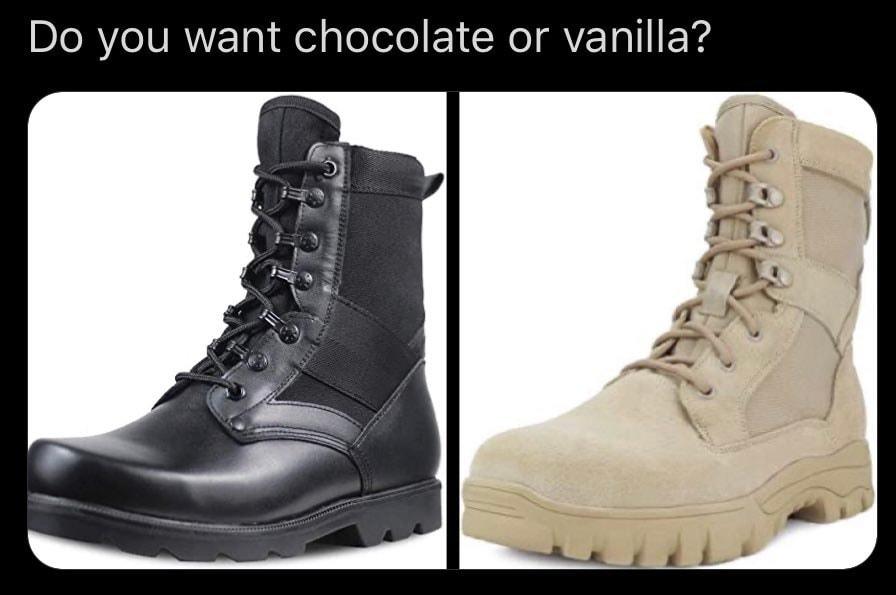
This meme is a humorous take on the classic "Do you want chocolate or vanilla?" question, but with a twist that's relatable to the Anti-Reactionary category. The image shows two boot options, with the text "Do you want chocolate or vanilla?" above them. However, the boots are actually a pair of military-style boots, implying that the question is actually asking about the type of boot one wants to wear, rather than a dessert. The meme is poking fun at the idea that people can be so particular about their boots, just like they are about their desserts.
detailed-analysis (gemma3-27b-vision)
Okay, here's an analysis of the image, broken down into sections as requested, with explanations of how each theoretical framework might apply. I'll flag sections where a framework doesn't really make sense given the image.
Image Description
The image features a side-by-side comparison of two military-style combat boots.
- Left Boot: Black, glossy, appears to be made of leather or a similarly polished synthetic material. It has laces, metal eyelets, and a robust rubber sole with deep treads.
- Right Boot: Tan/beige/sand color, appearing to be made of suede or a similar textured material. Similar lacing, eyelets, and a robust sole as the black boot, though the tread pattern seems slightly different.
- Text: Above the boots is the question "Chocolate or vanilla?". This is obviously a framing/comparative device, implying a choice between the two boots based on color.
Foucauldian Genealogical Discourse Analysis
This is a highly relevant area to apply to the image. Foucault's work concerns how discourses shape our understanding of the world, and the power relations embedded within them.
- Discourse of Masculinity/Military: The boots immediately invoke a discourse of military service, adventure, ruggedness, and traditionally masculine ideals. Combat boots aren't just footwear; they signify preparedness, action, and a certain type of identity.
- Genealogy of the Boot: Tracing the history of the combat boot reveals a genealogy tied to military technology, evolving design based on battlefield needs, and its eventual adoption into civilian fashion as a symbol of rebelliousness or practicality. The boot's form isn’t neutral—it embodies a history of conflict, power, and the practicalities of traversing difficult terrain.
- The "Chocolate/Vanilla" Frame: This is crucial. By framing the choice as "chocolate or vanilla," the image reduces the boots to simple preferences. This erases the complex historical, material, and cultural contexts of the boots and their association with masculinity, militarism, and potentially even violence. The framing actively normalizes, and flattens the semiotics of this kind of footwear.
- Power Relations: The discourse of the boot is linked to power - both military/political and the power of cultural symbolism. The image can be seen as a micro-exercise of power, subtly reinforcing a certain image of masculinity and the normalization of militaristic aesthetics.
Critical Theory
Critical Theory, particularly stemming from the Frankfurt School, focuses on exposing power structures and challenging ideologies.
- Commodification of Identity: The image highlights how identity is increasingly tied to commodities. The boots aren't merely functional items; they represent a lifestyle, an attitude, a desired self-image. The question of “chocolate or vanilla” promotes a consumerist mindset, reducing choices to aesthetic preferences.
- Instrumental Rationality: The boots are examples of technology developed for a specific purpose (military effectiveness). Critical theorists might argue that this focus on efficiency and functionality contributes to a larger societal trend of reducing everything to its usefulness, potentially devaluing other qualities like beauty or ethical considerations.
- Mass Culture & Ideology: The image itself is a product of mass culture (advertising, social media). It contributes to the dissemination of certain ideologies (e.g., idealization of military strength, promotion of consumerism).
- Critique of the Aesthetic: While not overtly oppressive, the image reinforces a certain aesthetic – a preference for ruggedness and "toughness" that can be seen as culturally dominant and potentially exclusionary.
Marxist Conflict Theory
While not a primary lens, some Marxist analysis is possible.
- Production & Labor: The boots represent the product of labor. A Marxist analysis would examine the conditions under which these boots were produced – the labor practices, the exploitation of workers, and the profit margins involved.
- Commodity Fetishism: Consumers may become fixated on the aesthetic appeal or symbolic value of the boots, obscuring the exploitative conditions of their production.
- Symbol of Class/Status: The boots might signify a certain socioeconomic status or alignment with a particular group (e.g., veterans, outdoor enthusiasts). However, this link is relatively weak in this image.
Postmodernism
Postmodernism could be applied, but is less central than Foucauldian or Critical Theory.
- Simulacra & Simulation: The image presents the boots as signs of masculinity and adventure, potentially disconnecting them from any "real" experience. It’s a simulation of a certain lifestyle, presented as a consumer choice.
- Deconstruction of Meaning: The “chocolate/vanilla” framing deliberately deconstructs the serious connotations of the boots. It deliberately trivializes the symbolism, creating a playful but potentially unsettling effect.
- Irony & Playfulness: The image is fundamentally playful, using a seemingly mundane comparison (chocolate/vanilla) to present a potentially loaded symbol.
Queer Feminist Intersectional Analysis
This is the least applicable framework, but a subtle reading is possible:
- Gender Performance: Historically, combat boots have been heavily associated with masculinity. Choosing a particular boot could be seen as a performance of gender, reinforcing or challenging traditional gender norms.
- Exclusionary Aesthetics: The image primarily appeals to a masculine aesthetic, potentially excluding those who do not identify with that aesthetic.
- Intersectional Dimensions: The image doesn’t explicitly address intersectionality, but it’s important to consider how factors like race, class, and ability might intersect with gender in relation to this imagery. (e.g., the military has a complex history of exclusion and discrimination). However, this requires significant extrapolation and isn't immediately present in the image itself.
Let me know if you'd like me to elaborate on any of these points, or explore a specific theoretical framework in more detail!
simple-description (llama3.2-vision)
This meme is a play on the classic "do you want chocolate or vanilla?" question, but with a twist. It features two images of military boots, one in a dark, shiny black color and the other in a light, beige color. The text above the images reads "Do you want chocolate or vanilla?" but the answer is actually "black boots" and "tan boots", implying that the question is actually about the color of the boots.
tesseract-ocr
Do you want chocolate or vanilla? © a le me. | Tee 1X: ye 2 w es a ~ ne Xi —ia os @ 4°