First Seen
2023-05-10T21:03:33+00:00
simple-description (llama3.2-vision_11b)
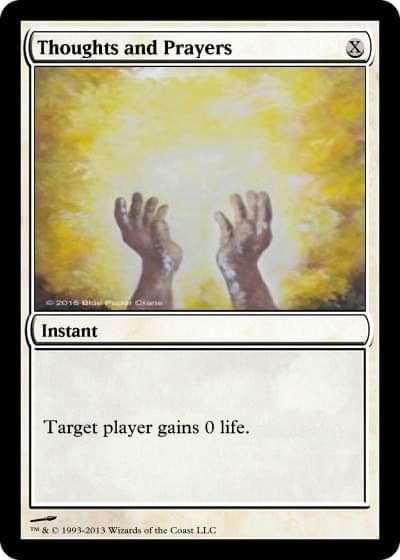
This meme is a screenshot of a Magic: The Gathering card that reads "Thoughts and Prayers" with a blank image of two hands in a prayer-like gesture. The meme is a satirical commentary on the common response to tragic events, where people often express "thoughts and prayers" without actually doing anything to help.
detailed-analysis (gemma3-27b-vision)
Okay, here's an analysis of the Magic: The Gathering card "Thoughts and Prayers" through the lenses you requested. I will omit sections that don't readily apply. Because this is an intentionally provocative card, there's a lot to unpack, and I'll try to be thorough.
Visual Description
The card depicts a blurry, intensely bright golden/yellow background that feels like intense light or possibly fire. Centered in the frame are a pair of hands, palms upturned, raised towards the light. The hands appear bruised or marked, suggesting prior suffering or damage. The overall effect is one of desperate pleading or supplication, set against a potentially destructive or overpowering backdrop. It evokes a sense of helplessness or futile hope. The image is deliberately low-resolution and almost impressionistic, amplifying the emotional impact rather than offering concrete detail. The card's color scheme is dominated by gold and yellow, symbolizing hope, divinity, but also potentially caution or disease.
Foucauldian Genealogical Discourse Analysis
This card lends itself heavily to Foucault's concepts of power/knowledge and discourse. The phrase "Thoughts and Prayers" has become, in contemporary Western culture, a shorthand for symbolic gestures offered instead of concrete action in response to tragedy. Foucault would ask: What discourse does this card contribute to? It's a discourse of performative empathy—acts that appear to offer support but ultimately serve to reinforce existing power structures.
- Genealogy: The card isn't about genuine compassion; it's a genealogy of a response. It traces the evolution of a societal habit: the offering of platitudes when faced with overwhelming problems. This "response" functions to absolve the speaker of responsibility. It's a way to say you care without doing anything.
- Power/Knowledge: The card illustrates how "thoughts and prayers" as a response produce a specific kind of knowledge. It frames problems as fundamentally spiritual rather than material. It suggests that the solution lies in individual belief/sentiment rather than in systemic change. This reinforces the power of those who benefit from the status quo. The "gain 0 life" mechanic in the game itself is a perfect reflection of this—a gesture with no material impact.
- Discipline: The card can be viewed as disciplinary in that it promotes the idea that internal emotional labor (thinking good thoughts, offering prayers) is sufficient to address external problems. This discourages questioning the systems causing the problem.
Critical Theory
This card is a potent example of the type of object that Critical Theory analyzes. It engages with concepts like ideology, alienation, and the reproduction of social norms.
- Ideology: The card actively participates in the propagation of a specific ideology—one that values symbolic gestures over substantive change. It suggests that individual piety or hope can resolve complex socio-political issues.
- Commodity Fetishism: (though stretching the application slightly) The card itself is a commodity—a collectible item. The irony is that this collectible item highlights a situation where "value" is assigned to empty symbolism. The card’s meaning is inherently tied to real-world events and the critique of performative activism.
- False Consciousness: The card, in its cultural context, can be seen as contributing to a "false consciousness"—a state where people are unaware of the true sources of their oppression and accept the ideology that justifies it. The card embodies the idea that "thoughts and prayers" are enough—a belief that obscures the need for systemic change.
Marxist Conflict Theory
The card resonates strongly with Marxist concepts.
- Class Struggle: The situation the card alludes to (often mass shootings, natural disasters, social injustices) disproportionately affects marginalized communities and those lower down the socioeconomic hierarchy. The card, by prioritizing symbolic responses, obscures the underlying material conditions (poverty, inequality, lack of access to resources) that contribute to these struggles.
- Ideology & False Consciousness: The emphasis on "thoughts and prayers" functions as a form of ideological control, diverting attention from the exploitative relationships and power dynamics at the root of societal problems. It keeps the focus on individual morality rather than systemic change.
- Alienation: Those offering "thoughts and prayers" are alienated from the actual needs and suffering of those affected. The gesture is disconnected from any meaningful action.
Postmodernism
The card exhibits certain postmodern characteristics:
- Deconstruction of Meaning: The card deconstructs the traditional meaning of "thoughts and prayers." It isn't offering genuine solace; it's commenting on the emptiness of the phrase in a contemporary context.
- Irony and Parody: The card is a deliberate parody of sincere gestures of compassion. It's ironic that a card meant to represent support actually highlights the lack of it.
- Meta-Commentary: The card is a meta-commentary on the culture surrounding tragedy, social media activism, and the performative nature of empathy. It's about the representation of support, not the support itself.
Queer Feminist Intersectional Analysis
This is where the analysis becomes particularly layered:
- Intersectional Vulnerability: Those most impacted by the situations the card references (mass shootings, systemic oppression, etc.) are often marginalized communities—particularly queer, trans, and people of color. The card's critique extends to how "thoughts and prayers" disproportionately fail to address the specific vulnerabilities of these groups. It's easy to offer platitudes, but much harder to dismantle the systemic biases that make them targets of violence and discrimination.
- Emotional Labor: The card highlights the disproportionate amount of emotional labor expected of marginalized communities – constantly having to educate others, advocate for change, and heal from trauma while being met with empty gestures. The card calls out how "thoughts and prayers" can be a way for privileged individuals to avoid taking responsibility.
- Silencing and Erasure: Often, "thoughts and prayers" are used to end the conversation, rather than to begin it. This silences the voices of those most affected and erases the need for substantive action. The card implicitly points to this silencing.
- Performativity: Queer and feminist theory critique the concept of performativity—the idea that social constructs are created and maintained through repeated actions. The card is a commentary on the performance of empathy—the act of appearing to care without actually doing anything.
Let me know if you'd like any of these sections expanded or explored in more detail. This card is a really rich text for analysis!
simple-description (llama3.2-vision)
This meme is a joke image featuring a card from the popular trading card game Magic: The Gathering. The card is titled "Thoughts and Prayers" and has a humorous, ironic message that reads "Target player gains 0 life." The image is likely meant to be humorous and satirical, commenting on the common phrase "thoughts and prayers" being offered in response to a tragedy or disaster.
tesseract-ocr
Thoughts and Prayers & £ . i f \ Py Ya Target player gains 0 life.