First Seen
2023-05-10T21:03:33+00:00
simple-description (llama3.2-vision_11b)
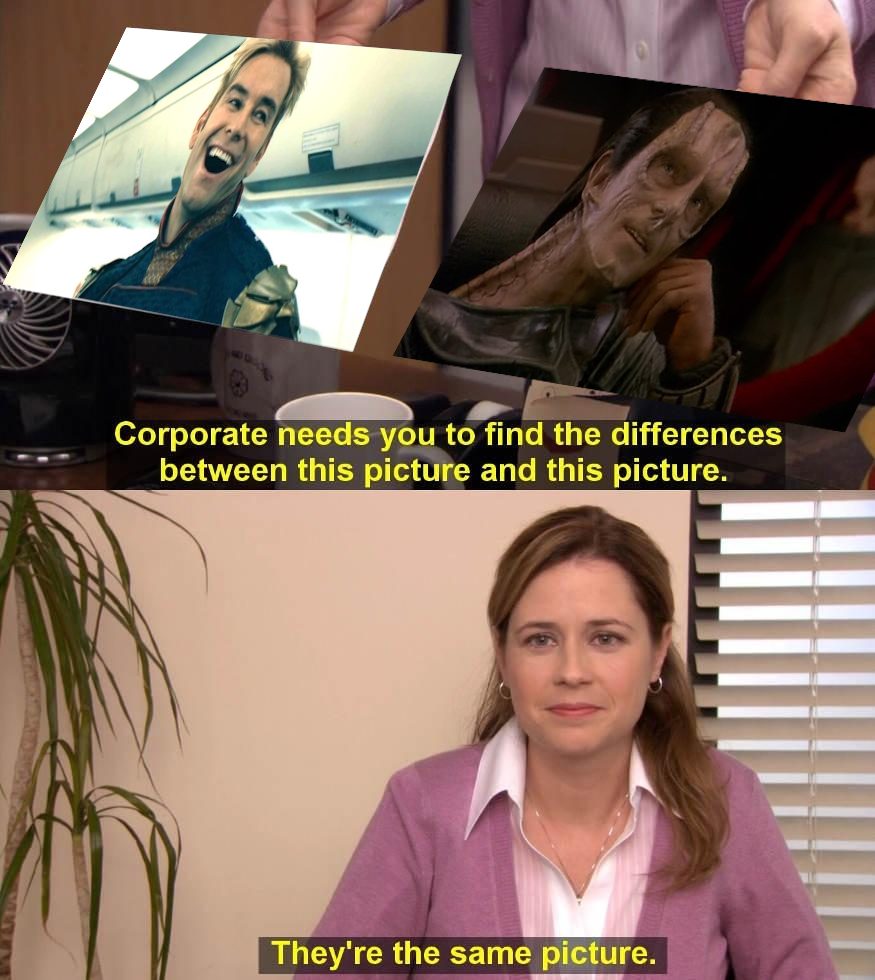
The meme is a comparison between a photo of a man with a shocked expression and a screenshot from the movie "Star Wars: The Empire Strikes Back" featuring a character with a similar expression. The text "They're the same picture" is displayed at the top of the image, implying that the two images are identical. The meme is likely used to humorously comment on the absurdity of a situation where two seemingly unrelated images are being compared.
detailed-analysis (gemma3-27b-vision)
Okay, here's an analysis of the image, broken down into the sections you requested. As you’ll see, some sections are more applicable than others given the content.
Visual Description
The image is a meme constructed using a still from the US television show The Office. The primary subject is Erin Hannon (played by Ellie Kemper) sitting at a desk in a beige office environment. She is wearing a lilac or lavender blazer over a white shirt and necklace, and her expression is one of weary exasperation.
Above and behind her are two images presented in rectangular frames, appearing as if presented to her as part of a task. The first image is of Tom Cruise in a pilot uniform in front of a fighter jet. The second is a close-up of a reptile – a gecko or iguana – showing its textured skin and eye.
Text overlays the image. Above the pictures it states, “Corporate needs you to find the differences between this picture and this picture.” Below Erin, it reads "They're the same picture.” The background includes a potted plant. The visual setup clearly points to a frustrating exercise in pointless detail-seeking.
Foucauldian Genealogical Discourse Analysis
This image is powerfully indicative of Foucauldian themes. The “Corporate” directive to find differences, when none exist, represents a discourse of power/knowledge. Corporate, as an institution, establishes a system of evaluation and control. This evaluation isn't about actual difference, but about disciplining the subject (Erin/the viewer) through a seemingly objective task. The purpose is not to arrive at a 'truth' but to create a system where the subject perpetually attempts to conform to arbitrary standards.
The 'task' itself is a micro-power dynamic – seemingly small, but contributing to the larger construction of subjecthood. It's a demonstration of how power operates not through repression (direct force) but through producing subjects who internalize and participate in their own control. The fact that the pictures are identical exposes the absurdity of the exercise, suggesting that the system of control is detached from any meaningful reality.
Critical Theory
From a critical theory perspective, the image is a commentary on the alienation inherent in modern bureaucratic structures. The task assigned by “Corporate” is a prime example of instrumental rationality— a focus on efficiency and control that disregards intrinsic value or meaning. Erin’s expression communicates the disenchantment that results when individuals are reduced to cogs in a machine, their labor devoted to pointless exercises.
The meme implicitly critiques the dehumanizing effects of corporate culture, where the pursuit of productivity and profit overshadows genuine connection and purpose. The task's futility suggests that the system is divorced from reality and operates on its own self-serving logic.
Marxist Conflict Theory
While not explicitly focused on class struggle, the meme can be interpreted through a Marxist lens. "Corporate" represents the ruling class or the dominant ideology, imposing arbitrary demands on the worker (Erin). The pointless task symbolizes the exploitation of labor— the worker’s time and energy are consumed for the benefit of the corporation, with no real productive outcome.
The meme critiques the power imbalance between capital (Corporate) and labor. The directive isn’t about meaningful contribution but about maintaining control and extracting effort, even if it's utterly meaningless. Erin’s deadpan response can be seen as a subtle form of resistance against this exploitation.
Postmodernism
The image plays with the concept of simulacra and simulation as described by Jean Baudrillard. The task of finding differences where none exist highlights the idea that reality has become replaced by signs and symbols. The act of comparison, the focus on minute details, and the ultimate realization of sameness point to a world where meaning is increasingly elusive and arbitrary.
The meme is also inherently meta – it's a commentary on representation itself. The use of a screenshot from a sitcom, combined with the overlaid text, creates a layer of ironic distance. The meme isn’t just about a situation; it is a constructed representation of that situation, emphasizing the mediated nature of our experience.
Queer Feminist Intersectional Analysis
This section is the least directly applicable, but some threads can be traced. The image can be read as a commentary on the ways in which women in corporate settings are often asked to perform endless, demeaning tasks – to prove their competence through meaningless exercises while being simultaneously undervalued. Erin’s reaction—a subtle subversion of expectations—can be viewed as a form of resistance against patriarchal structures.
The demand for difference can also be seen as a demand for performative work - the expectation that individuals, particularly those marginalized by traditional power structures, will always need to perform their value, even when no actual difference exists. Erin's refusal to play along hints at a rejection of this expectation.
Let me know if you'd like any of these analyses expanded further or if you'd like me to focus on a specific theoretical framework in more detail.
simple-description (llama3.2-vision)
This meme is a comparison between two images of characters from different movies/TV shows. The top image shows a character from the movie "Guardians of the Galaxy" (Peter Quill/Star-Lord) with a ridiculously exaggerated and goofy expression. The bottom image shows a character from the movie "Aliens" (David) with a similar, albeit more sinister, expression. The text above the images reads, "They're the same picture," implying that the characters are identical, when in fact they are not.
tesseract-ocr
- i - ah : . ff ry : > I , = ~ = | . S ud , 4 f i > : : |) i Corporate needs you to find the differences a between this picture and this picture. \ I \ y \ ae 4 \ ) - ad 5 ij \ ih \ = ~f_ 4 ¥ , \ 4 1 y \/ " BU acm ere ean , af