First Seen
2023-05-10T21:03:33+00:00
simple-description (llama3.2-vision_11b)
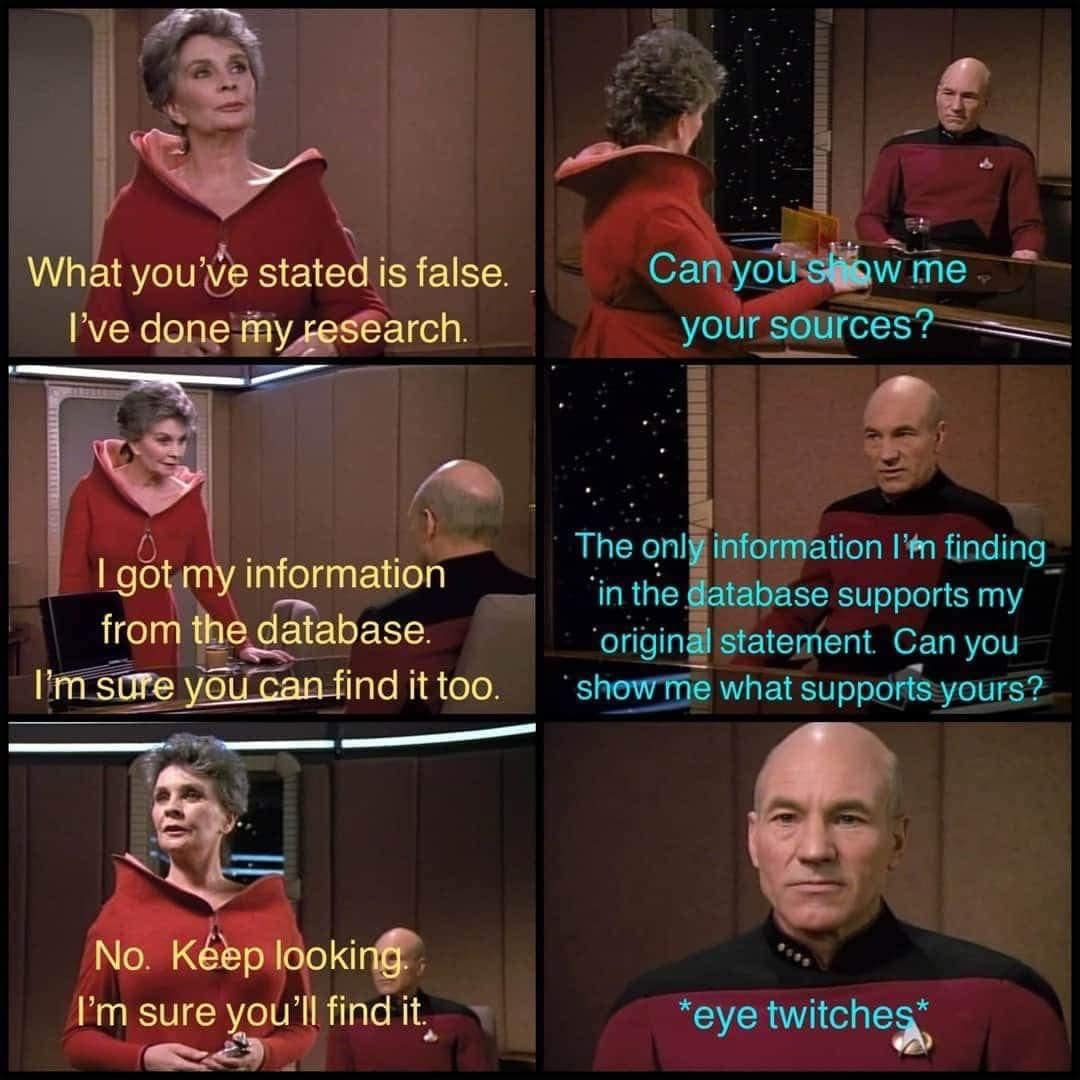
The meme is a screenshot from the TV show Star Trek: The Next Generation, featuring a character's sarcastic response to a question about her research on a sensitive topic. The character, Deanna Troi, is responding to Captain Jean-Luc Picard's question about her research on a sensitive topic, and her response is a tongue-in-cheek comment about the nature of the question. The meme is a humorous commentary on the challenges of research and the importance of being transparent in one's research.
detailed-analysis (gemma3-27b-vision)
Okay, here's an analysis of the Star Trek meme, broken down into sections based on the requested theoretical frameworks. The meme depicts a terse exchange between Commander Riker and Captain Picard about the validity of a statement. It's ripe for theoretical dissection!
Visual Description
The meme is comprised of four panels arranged in a grid. Each panel shows a close-up of a Star Trek: The Next Generation character during a conversation.
- Panel 1: Commander Riker, animated and assertive, with a determined expression, emphatically states, “What you’ve stated is false. I’ve done my research.”
- Panel 2: Picard, calmly and pointedly, asks, “Can you show me your sources?”
- Panel 3: Picard, still composed, asserts, “The only information I’m finding in the database supports my original statement. Can you show me what supports yours?”
- Panel 4: Riker, visibly frustrated (and, according to the caption, experiencing an "eye twitch"), repeats, “No. Keep looking. I’m sure you’ll find it.”
The image quality is consistent, and the color grading and composition evoke the original TV show aesthetic. The format lends itself to a common meme structure – a setup and punchline delivered through escalating conflict.
Foucauldian Genealogical Discourse Analysis
This meme is extremely fruitful for a Foucauldian analysis.
- Discourse and Power/Knowledge: The exchange centers entirely on discourse – the ways knowledge is constructed and validated. Picard’s insistence on sourcing (“Show me your sources”) immediately introduces a regime of truth. He's not challenging the content of Riker's statement initially, but rather how Riker has legitimized it. Sourcing is a key power mechanism, defining who gets to speak authoritatively and what counts as knowledge.
- The Archive/Database: The "database" becomes a powerful symbol for the archive – the system by which knowledge is stored, organized, and accessed. Picard claims authority because his research aligns with what's already recorded and deemed legitimate within that archive. Riker's insistence that the information must be out there (even without evidence) reinforces the idea that the archive is complete and holds all truth.
- Genealogy of Truth: We can see this as a miniature genealogy of “truth.” Picard is demanding that Riker trace the lineage of his claim – where did it originate? What evidence supports it? Riker’s stubborn refusal and belief that the information must exist suggests that some claims are based on faith or intuition, rather than on verifiable evidence. His eye twitch suggests the strain of maintaining a claim without the backing of a legitimate discourse.
- Power Relations: The exchange isn’t just about truth; it’s about a power struggle. Picard, as Captain, holds institutional power, and he leverages the demand for sourcing to reinforce that power. He's saying, “I set the terms of what counts as valid knowledge here.”
Critical Theory
This meme is applicable to Critical Theory, specifically its critique of the structures of power that uphold dominant ideologies.
- Hegemony: The insistence on the “database” as the source of truth can be seen as a manifestation of cultural hegemony. The database (representing institutions like academia, media, or government) has become the accepted authority, and questioning its validity is often seen as radical or even illogical.
- Ideology: The meme exposes how easily “knowledge” can be presented as objective and neutral when it's actually constructed and shaped by specific interests and ideologies. The database isn't a neutral repository of facts; it's a curated collection that reflects certain perspectives and biases.
- Rationalization & Bureaucracy: The demand for “sources” and the reliance on a central database can be linked to the rationalizing forces of bureaucracy. Bureaucracy emphasizes rules, procedures, and documentation as a means of control and efficiency. The meme satirizes this tendency by highlighting the absurdity of prioritizing procedure over substance.
Postmodernism
The meme fits neatly into a postmodern framework.
- Rejection of Metanarratives: The scene implicitly challenges the notion of a single, universal "truth." Riker's insistence that the information must be out there, despite lack of evidence, reflects a faith in a larger, overarching narrative. Picard, by demanding sourcing, deconstructs that narrative, emphasizing the localized, contingent nature of knowledge.
- Simulacra and Simulation: The "database" itself can be seen as a simulacrum – a copy without an original. It's a representation of knowledge, but it's increasingly detached from any direct experience or objective reality.
- Deconstruction: Picard’s interrogation is a clear act of deconstruction. He’s challenging the underlying assumptions of Riker’s statement and exposing the instability of its claims.
Critical Theory, Marxist Conflict Theory
While many applications of this meme are already covered, we can connect it to Marxist Conflict Theory through its implications of power dynamics.
- Ideological Control: The "database" represents the dominant ideology, controlled by those in positions of power (those who curate and maintain the database). Picard, as a representative of that power, demands adherence to the established order.
- Class Struggle: While subtle, Riker's insistence on the validity of his research despite a lack of evidence can be seen as a form of resistance to the established order. He's claiming a different way of knowing, one that isn't sanctioned by the dominant ideology.
- Material Conditions of Knowledge: The database itself is a material condition of knowledge – it requires resources, infrastructure, and expertise to create and maintain. Those who control these resources have the power to shape what counts as knowledge.
Queer Feminist Intersectional Analysis
While not immediately obvious, an intersectional lens can also be applied, although it requires a bit more interpretive reach.
- Epistemic Violence: The demand for "sources" can be seen as a form of epistemic violence – the silencing or discrediting of marginalized voices and ways of knowing. Historically, marginalized communities have often been excluded from the creation and preservation of knowledge, and their experiences and perspectives have been dismissed or ignored. Picard, in demanding sources, reinforces the standards of knowledge that have historically excluded these voices.
- Power Imbalance: The power dynamic between Picard and Riker is also relevant. As a white male Captain, Picard holds institutional power, while Riker, though a high-ranking officer, is in a subordinate position. This power imbalance can influence the validation of knowledge.
- Challenging Dominant Narratives: Riker’s persistence, even without evidence, can be seen as a refusal to conform to dominant narratives. This refusal can be interpreted as a form of resistance against oppressive systems.
I hope this detailed breakdown of the meme is helpful! Let me know if you'd like me to elaborate on any of these theoretical frameworks or explore other potential interpretations.
simple-description (llama3.2-vision)
This meme is a humorous exchange between Captain Jean-Luc Picard and a character from the Star Trek: The Next Generation series, Deanna Troi. The conversation starts with Deanna saying "What you've said is false. I've done my research" and Picard responding "I don't think so. What are you talking about?" Deanna then says "I've done my research, I've found it" and Picard says "I don't think so. What sources did you use?" The conversation then ends with Deanna saying "I've done my research, I've found it" and Picard saying "I don't think so. What sources did you use?" and Deanna saying "I've done my research, I've found it".
tesseract-ocr
VECO ol Rostcttexe SN So Can Ye me. ~ AV Me le) at Hise: =i 8 8 Ne] Te) Cer ae s — eS | a ee | (oa Te onl etn Deas el Bee sels a the database supports my be NSEC ‘original statement Can you I'mM-sO¥e youcan find ittoo. showme what suppofts-yours? — <i ; No. Kéep elect rie Mun e=T0 Le RVOlOM lee Sing MN (M ANI Celaleo a a