First Seen
2023-05-10T21:03:33+00:00
simple-description (llama3.2-vision_11b)
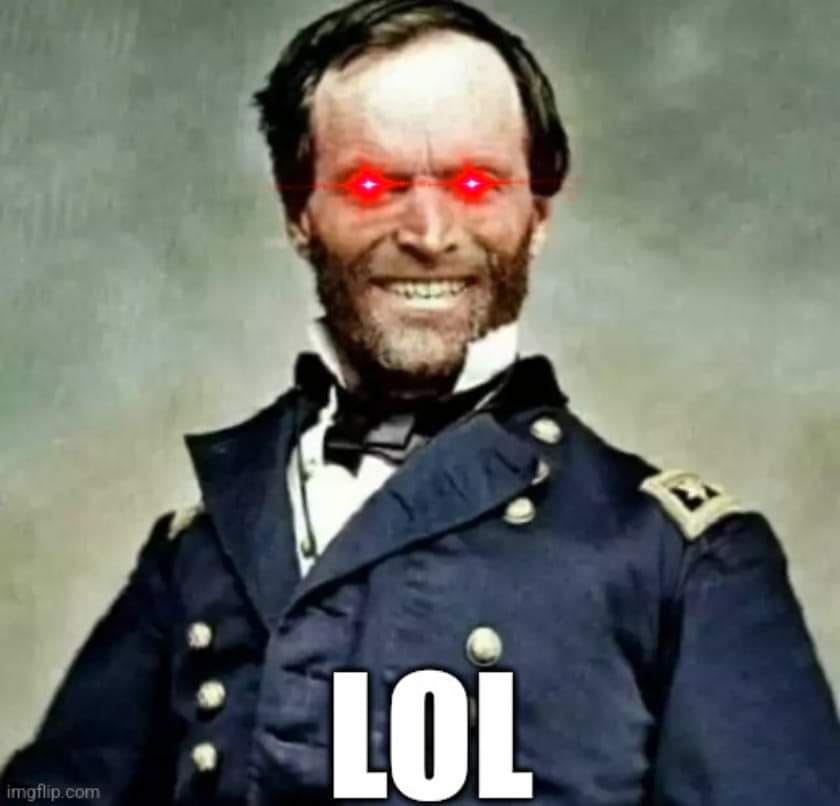
The meme features a photo of General William Tecumseh Sherman, a Union general during the American Civil War, with a stern expression and a red glow in his eyes. The image is captioned "LOL" in a playful, ironic tone, implying that Sherman's serious and intimidating appearance is being mocked or exaggerated for comedic effect.
detailed-analysis (gemma3-27b-vision)
Okay, let's break down this image with the requested analytical lenses. It's a memetic image, so the analysis will lean into that aspect as well.
Visual Description
The image depicts a 19th-century portrait of a man, likely a military officer (based on his uniform), digitally altered. The uniform is a dark blue, typical of Union Army officers during the American Civil War. The man has a full beard and appears to be in his middle age. The most striking alteration is the addition of glowing, intensely red eyes. Below the portrait, in bold, white capital letters, is the internet slang term "LOL" (laugh out loud). The image has the watermark of the image editing platform “imgflip.com.” It is visually jarring, deliberately combining a historical image with a modern internet meme. The combination plays on expectation and subverts the seriousness inherent in the original portrait.
Foucauldian Genealogical Discourse Analysis
This image can be analyzed through a Foucauldian lens by examining how power structures and discourses have historically shaped perceptions of authority, humor, and even the Civil War itself.
- Discourse & Authority: The original portrait represents a discourse of authority—military leadership, patriotic duty, and social order. The addition of "LOL" ruptures this discourse. It deliberately injects a contemporary, informal, and dismissive tone into a historically solemn image. This "rupture" isn't an overthrow of power, but a rearrangement of it. It suggests a shift in how we perceive authority - or at least the possibility of mocking it.
- Genealogy of Humor: We can trace a genealogy of humor: from the court jesters of old to modern internet memes. The “LOL” meme has a history of its own, originating in early internet chat rooms and evolving into a ubiquitous form of digital communication. This image appropriates that history and applies it to a figure imbued with historical gravity.
- Power/Knowledge: The image implies a playful subversion of knowledge about the Civil War and its figures. By associating a serious historical figure with a fleeting internet joke, it questions the inherent reverence associated with historical narratives. The power dynamics are shifted – we, the meme consumers, are empowered by our ability to reinterpret the past through a contemporary lens.
Critical Theory
From a Critical Theory perspective, this image demonstrates the ongoing deconstruction of grand narratives and the questioning of established power structures.
- Deconstruction of the Heroic Narrative: The original portrait likely intended to portray a heroic figure, embodying values like courage, discipline, and leadership. The "LOL" meme undercuts this heroic framing. It introduces a level of irony and absurdity, suggesting that such figures are not necessarily beyond ridicule or questioning.
- Commodification of History: The image exists within the culture of internet memes, which are inherently commodified and consumed rapidly. It represents the way historical events and figures are often reduced to digestible, shareable content, stripped of their complexity and nuance.
- Cultural Critique: The meme could be read as a critique of the romanticization of historical conflict. The "LOL" may suggest a dismissive attitude towards the suffering and loss associated with the Civil War, or conversely, a cynical acknowledgement of the absurdity of such conflicts.
Marxist Conflict Theory
From a Marxist perspective, this image could be seen as a subtle manifestation of class conflict and the questioning of established authority.
- Subversion of Elite Authority: The Civil War was, in many ways, a conflict rooted in economic and class divisions. By mocking a figure of authority from that era, the meme can be interpreted as a symbolic rejection of established power structures and the historical elites who benefited from them.
- Popular Culture as Resistance: Internet memes, as a form of popular culture, can be seen as a means of expressing dissent and challenging dominant ideologies. The "LOL" meme, in this context, represents a form of bottom-up resistance, allowing individuals to participate in a collective act of subversion.
- Commodification of History & Control of Narrative: The meme's existence on a platform like imgflip.com speaks to the broader issue of control over historical narratives. Who gets to tell the story, and how? This image represents a challenge to that control, but also a participation in a capitalist system that commodifies and distributes that narrative.
Postmodernism
This image is deeply embedded in postmodern aesthetics.
- Pastiche & Intertextuality: It combines elements from different eras and contexts—a 19th-century portrait with 21st-century internet slang. This mixing of styles and references is a hallmark of postmodern pastiche.
- Irony & Parody: The meme relies heavily on irony and parody. It subverts the seriousness of the original portrait by juxtaposing it with a casual, dismissive expression.
- Fragmentation of Meaning: The image deliberately disrupts any singular, coherent meaning. It invites multiple interpretations and resists any attempt to fix its meaning definitively.
- Simulation & Hyperreality: It can be seen as a simulation of a reaction—an expression of laughter overlaid onto a historical figure. The "LOL" isn't an authentic emotion, but a digitally constructed representation of one.
Queer Feminist Intersectional Analysis
While this image doesn't explicitly address queer or feminist themes, an intersectional analysis can still reveal underlying power dynamics and potential critiques.
- Challenging Traditional Masculinity: The original portrait likely embodies ideals of Victorian masculinity—strength, stoicism, and authority. The "LOL" meme disrupts these ideals, presenting a figure of authority in a decidedly un-masculine light (a flippant expression of amusement). This can be read as a challenge to traditional gender roles.
- Subversion of the “Great Man” Narrative: Historical narratives often center around “great men” and their achievements, often marginalizing the contributions of women and other marginalized groups. The meme can be seen as a deconstruction of this narrative, questioning the inherent value of such figures and their place in history.
- Intersectional Power Dynamics: The image can be viewed in relation to broader patterns of social power. The Civil War was a conflict with significant racial and class dimensions. The meme, while not directly addressing these issues, participates in a culture that continues to grapple with their legacies. The image might ironically comment on the power structures that uphold those legacies.
I hope this detailed analysis is helpful. It’s important to remember that interpretations can vary, and the meaning of the image is ultimately open to debate.
simple-description (llama3.2-vision)
The meme features a photo of General William Tecumseh Sherman, a Civil War general, with a humorous and exaggerated expression. The text "LOL" is written at the bottom of the image, implying that the general's face is so comically distorted that it's laughable. The image is likely intended to be humorous and ironic, poking fun at the idea of a serious historical figure being portrayed in a ridiculous way.
tesseract-ocr
ay —— 4 in i. ~ er a e e P . e ~EH