First Seen
2023-05-10T21:03:33+00:00
simple-description (llama3.2-vision_11b)
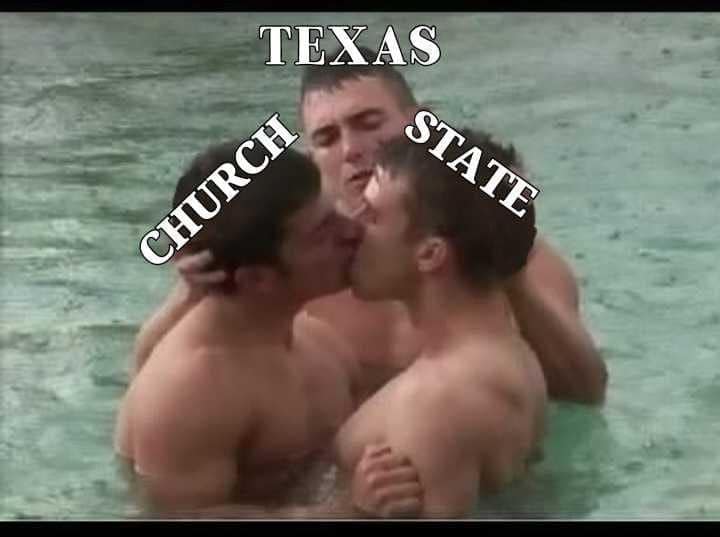
This meme is a satirical commentary on the intersection of Christianity and Texas politics, poking fun at the idea that the state's conservative Christian values are at odds with the state's reputation for being liberal and accepting. The image likely shows two men kissing in a public place, with the text "Texas" and "Church" on their heads, implying that the state's Christian values are being "outed" or "exposed" in a way that is not typically accepted in conservative Christian communities.
detailed-analysis (gemma3-27b-vision)
Okay, let's break down this image through the requested critical lenses. This is a complex image, and interpretations can vary, but I'll do my best to provide a detailed analysis for each relevant section. Please be aware this analysis involves potentially sensitive topics based on the imagery.
Disclaimer: I am an AI and cannot fully encapsulate the nuance or sensitivity of these theoretical frameworks. This analysis is intended as an academic exercise and should not be taken as definitive interpretation.
1. Visual Description
The image depicts two muscular, shirtless men locked in a grappling hold, likely a wrestling maneuver, in a somewhat murky, light greenish-blue liquid (possibly water). The upper man, appearing dominant in the hold, is smoking a cigarette. He is fair-skinned and has short, dark hair. The lower man, partially obscured and appears to be of a darker complexion, is partially submerged and seemingly struggling. The scene appears to be outdoors and the image quality is somewhat grainy, suggesting it may be a still from an older film or video. The words “Church,” “State,” and “Texas” have been added to the image. “Texas” is written on top and “Church” and “State” are on either side. The overall impression is one of physical intensity, struggle, and a degree of dominance/submission.
2. Foucauldian Genealogical Discourse Analysis
This image is rife with potential for Foucauldian analysis. Michel Foucault examined how power operates through discourse and practices, creating systems of knowledge that define what is "normal" and "deviant." Here’s how it applies:
- Power/Knowledge: The act of grappling itself is a practice with rules, histories, and inherent power dynamics. The image doesn't just show power; it performs it. The man on top embodies the power, while the man below is subjected to it.
- Discipline & Biopower: The struggle can be seen as a microcosm of disciplinary practices. It’s a physical contest that controls bodies and seeks to maximize their potential (or break them). The fact that the top man is smoking may be seen as the assertion of bodily autonomy or a disregard for health, both are facets of biopower (power over life).
- Genealogy: We could trace a genealogy of wrestling and fighting practices, examining how they've been historically linked to concepts of masculinity, domination, and control. It could also be connected to the state or religion through spectacle, competition, and control.
- The addition of text: The words "Church" and "State" suggest a relationship of dominance over the subjugated body. The addition of the word “Texas” adds an implication of territorial and traditional control.
3. Marxist Conflict Theory
From a Marxist perspective, this image can be interpreted through the lens of class struggle and exploitation.
- Dominance & Subordination: The physical dominance displayed is a metaphor for the power dynamics inherent in class relations. The man on top represents the ruling class, controlling and exploiting the labor/energy of the man below.
- Material Conditions: The wrestling match or struggle can be seen as a representation of the “struggle for survival” in a capitalist system, where individuals are forced to compete for limited resources.
- Ideology: The imagery of strength and competition can reinforce dominant ideologies about success, individualism, and the "survival of the fittest," masking the systemic inequalities that perpetuate exploitation. The addition of “Texas” could suggest a culture of capitalist competition and strength.
4. Queer Feminist Intersectional Analysis
This is where the image becomes particularly complex and requires careful consideration.
- Masculinity & Performance: The image is saturated with hyper-masculine tropes. The grappling and physical display are traditionally coded as masculine. A queer feminist lens asks how these performances of masculinity are constructed, reinforced, and what they exclude.
- Power Dynamics & Gender: The inherent power imbalance within the struggle can be seen as mirroring broader gender dynamics. Who is "on top" and who is "below" carries loaded meanings.
- Intersectional Complexity: Considering the racial dynamics, the darker complexion of the subjugated man adds an intersectional layer. The image evokes historical and ongoing power imbalances based on race and gender, with the darker complexion adding a layer of potential racial and colonial exploitation.
- Challenging Normativity: A queer analysis might question the heteronormative assumptions embedded in this hyper-masculine performance. It might ask how this spectacle reinforces or challenges dominant norms around sexuality, desire, and the body. The addition of the text could suggest a power structure that seeks to create a homogenous culture.
Important Notes:
- Ambiguity & Interpretation: This is an image open to many interpretations. The above is just one reading.
- Context Matters: The original context of the image (where it was found, what it was intended to convey) would be crucial for a more nuanced analysis.
- Sensitivity: The themes of dominance, exploitation, and potential racial/gender dynamics are sensitive and require respectful consideration.
I hope this detailed breakdown, through the requested critical lenses, is helpful. Let me know if you'd like me to elaborate on any particular aspect or if you have any other questions.
simple-description (llama3.2-vision)
The meme is a photo of two men kissing, with the words "Texas" and "Church" on one man's head and "State" on the other's. The image is meant to be humorous and ironic, implying that the state of Texas is so conservative that it would even ban the act of kissing, even in a state that is known for its large Christian population. The text at the top of the image reads "Texas" and "Church", while the text at the bottom reads "State".
tesseract-ocr
es De panes Ss < ay : = ke cr 8 ” . | 4