First Seen
2023-06-15T22:29:33+00:00
simple-description (qwen3.5_2b-q8_0)
This is a quintessential example of a Reactionary argument. It attempts to justify harm and cruelty against vulnerable groups (like minorities, store clerks, or animals) by claiming that society must be "honest" with those who are perceived as weak or different. It argues that you should be treated like these specific groups because you belong to them, or conversely, that the victim is the one who has been "wronged" by the society. Essentially, it relies on the false premise that violence or mistreatment is the natural result of "honest" interactions with people.
Text in image:
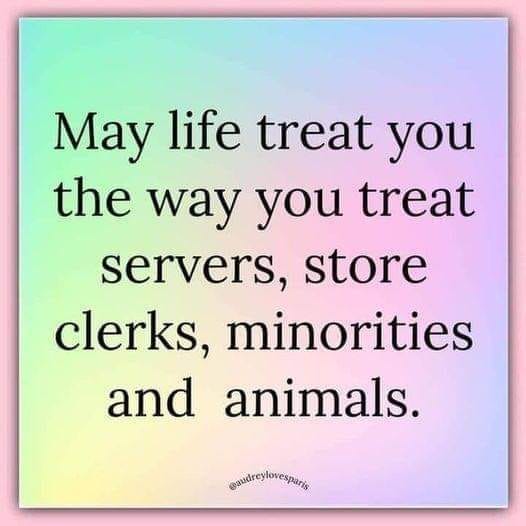
"May life treat you the way you treat servers, store clerks, minorities and animals."
simple-description (llama3.2-vision_11b)
The meme is a humorous take on the concept of "anti-reactionary" ideology, which emphasizes the importance of preserving and respecting the social and cultural norms of the past. The image depicts a character from the show "Rick and Morty" giving a sarcastic speech about how society has changed for the worse, with the text "I'm not saying you have to like it, but you have to get used to it". The meme is poking fun at the idea that people are often resistant to change and prefer to stick with the status quo.
detailed-analysis (gemma3-27b-vision)
Here's an analysis of the image, broken down into the requested sections. Note that some sections won’t apply in detail, and I’ll indicate where that is.
Visual Description
The image is a digitally created square graphic with a blurred gradient background shifting from a turquoise/teal on the top left to a pale yellow/green on the bottom right. The text is centered and bolded in black. It reads: "May life treat you the way you treat servers, store clerks, minorities and animals." At the bottom, in a smaller font, is a watermark or signature "@audreylovesparis". The overall aesthetic feels slightly digitally ‘filtered’, a common style for inspirational/motivational social media posts. It is simple and direct in its presentation, aiming for immediate impact through its message.
Foucauldian Genealogical Discourse Analysis
This statement functions as a miniature “discourse” – a system of thought, ideas, and practices that constructs meaning around how we relate to others. From a Foucauldian perspective, we could explore the power dynamics embedded within the listed categories: servers, store clerks, minorities, and animals.
- Discipline and Normalization: These groups have historically been subject to forms of power that normalize certain behaviors and subjugate others. Servers and store clerks are placed within a service industry structure that often allows for (and sometimes expects) them to endure various forms of mistreatment from customers. Minorities have faced systemic marginalization based on socially constructed categories of difference. Animals are often subjected to exploitation and control. The statement implicitly challenges these established power relations by suggesting reciprocity—that one’s behavior towards these groups will be “returned” by life itself.
- Genealogy of Morality: We could trace a genealogy of how our expectations of service workers, or our assumptions about "minorities" or animals, have been historically constructed through discourse and practice. What expectations of submission or deference are coded into our interactions with these groups?
- Subjectification: The statement positions the reader as a subject whose actions are being watched and measured—subject to a form of "karmic" accounting. It aims to shape the reader’s self-perception and behavior by linking it to an external force ("life").
Critical Theory
The statement aligns with core tenets of Critical Theory by challenging societal norms and power imbalances.
- Emancipation: The statement implicitly calls for a more just and equitable society where all beings are treated with respect. It's a subtle plea for challenging oppressive structures.
- Critique of Domination: It targets areas where domination exists—the power imbalance between customers and service workers, the historical oppression of minorities, and the exploitation of animals. It rejects the idea that some beings are inherently more deserving of respect than others.
- Reflexivity: The statement encourages the reader to reflect on their own actions and their impact on others. This is a core principle of Critical Theory – understanding how our own perspectives and behaviors contribute to social issues.
Marxist Conflict Theory
From a Marxist perspective, this statement can be interpreted as a subtle call for class consciousness and the dismantling of exploitative relationships.
- Power Dynamics: Servers and store clerks represent the working class, often subject to the whims of customers (who potentially represent the owning class or those with more economic power). The statement points to the potential for exploitation within service-based economies.
- Alienation: Service work can be alienating, reducing individuals to their function as providers of a service and potentially dehumanizing both the worker and the customer. The statement challenges this dehumanization.
- Critique of Capitalism: Although subtle, the statement can be seen as a critique of the capitalist system that often prioritizes profit over the well-being of workers and other beings.
Postmodernism
While not explicitly postmodern, the statement can be read through a postmodern lens.
- Deconstruction of Hierarchy: The statement collapses traditional hierarchies by placing seemingly disparate groups—servers, minorities, animals—on the same level of moral consideration. This challenges the idea that some beings are inherently more "important" or deserving of respect than others.
- Emphasis on Subjectivity: The statement implies that “treatment” is subjective – based on the perspective of the treated. The statement isn’t about an objective standard of morality but about reciprocity and the experience of being treated.
- Rejection of Grand Narratives: While not overtly anti-narrative, it implicitly rejects the idea of a universal moral code and suggests that morality is embodied in everyday interactions.
Queer Feminist Intersectional Analysis
This statement is particularly resonant with Queer Feminist Intersectional thought.
- Intersectionality: The statement explicitly brings together marginalized groups - minorities and potentially queer folks amongst those, service workers and animals. The intersectional aspect lies in recognizing how these groups experience overlapping forms of oppression. A person who is a minority service worker will face unique challenges that differ from a white service worker, or a non-marginalized individual.
- Challenging Hierarchies of Care: Feminist ethics emphasizes the importance of care and compassion. This statement challenges the ways in which certain beings (particularly those who are marginalized or vulnerable) are often denied adequate care.
- Animal Liberation: The inclusion of animals directly aligns with animal liberation movements that challenge speciesism and advocate for the rights of non-human animals.
- Care Ethics: The statement resonates with care ethics by emphasizing empathy, reciprocity, and the importance of treating others with respect. It is a call to extend care beyond human beings and to acknowledge the intrinsic value of all living creatures.
Important Note: These analyses are interpretations. The statement is relatively simple, but its meaning can be enriched and complexified through the lens of these different theoretical frameworks.
simple-description (llama3.2-vision)
This meme is a humorous commentary on the way people treat others in their daily lives. The text on the image reads, "May life treat you the way you treat servers, store clerks, minorities, and animals." The meme is suggesting that people should be treated with kindness and respect, just as they would treat others in similar situations.
tesseract-ocr
May life treat you the way you treat servers, store clerks, minorities and animals.