First Seen
2024-04-06T19:04:52.683442+00:00
simple-description (qwen3.5_2b-q8_0)
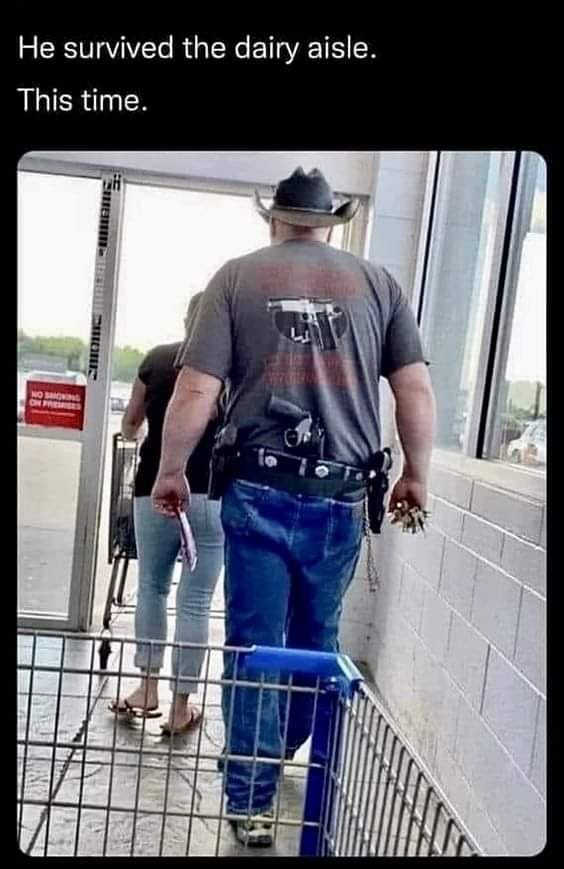
This meme satirizes the middle-class anxiety and the pressure to appear "tough" or "defensive" in everyday settings. The image depicts a man decked out in a "cowboy" hat and a t-shirt featuring a handgun, effectively armoring himself for the grocery store. The caption reads, "He survived the dairy aisle. This time," implying that he has overcome the usual struggles of middle-class survival with a mix of defensive tactics and consumer confidence. It is a "reactionary" joke because it mocks the pushback against the mundane reality of shopping, celebrating the absurdity of taking a supermarket aisle to the extreme like a martial arts practice.
simple-description (llama3.2-vision_11b)
This meme is a humorous take on a "crazy" or "irresponsible" individual who managed to survive in a potentially hazardous situation, in this case, a grocery store's dairy section. The image is likely a photo of a person, possibly with a wild or unkempt appearance, holding a shopping cart or other grocery items, with the text "He survived the dairy aisle. This time." implying that the person has previously struggled to navigate this section of the store.
detailed-analysis (gemma3-27b-vision)
Here's an analysis of the image, broken down into the requested theoretical sections. It's worth noting that this image is highly charged and requires careful consideration. I'll aim for a nuanced, analytical approach, acknowledging the potential for triggering content.
Please be aware: This image evokes strong reactions related to gun culture, perceived threats, and political statements. The analysis below is purely academic and doesn’t endorse any particular viewpoint.
Visual Description
The image shows a man in a grocery store checkout line. He is facing away from the camera, wearing a cowboy hat, a t-shirt, jeans, and multiple visible firearms. The firearms include a handgun on his hip, another in a holster on his side, and what appear to be additional firearms or accessories strapped to his back and waist. The man is pushing a shopping cart. Beside him, a person in jeans and a tank top is standing in line. The setting appears to be a typical American grocery store, with metal checkout dividers and other shoppers visible. The caption reads, "He survived the dairy aisle." The image is brightly lit and appears to be a photograph taken with a mobile device. The focus is squarely on the man and his array of firearms, creating a visually arresting and potentially unsettling composition.
Foucauldian Genealogical Discourse Analysis
Foucault’s work centers around the idea of discourse – systems of thought, language, and practice that shape our understanding of the world. A genealogical analysis focuses on the historical origins of these discourses and how they create power relations.
In this image, we can see a discourse of self-defense actively performed through the man’s visible armament. The “dairy aisle” caption ironically frames the mundane act of grocery shopping as a potentially dangerous situation requiring extensive protection. This performance isn't just about individual safety; it’s about constructing a narrative of vulnerability and the need for armed preparedness.
The image discursive effects include the normalization of overt firearm display, the framing of everyday spaces as zones of potential conflict, and the reinforcing of particular notions of masculinity and control. The man is essentially enacting a counter-discourse against the idea of a safe, communal space, signaling potential threat and demanding a specific kind of respect (or fear). His body performs a discourse of power and vigilantism, historically linked to frontier justice and modern American gun culture.
Critical Theory
From a critical theory perspective (drawing from the Frankfurt School), the image can be seen as symptomatic of broader societal anxieties and the commodification of fear. The man's display of weapons isn't simply about personal safety; it's a representation of a system that profits from insecurity.
The "dairy aisle" caption is ironic and suggests that even the most innocuous activities are perceived as potentially dangerous. This is a reflection of a culture saturated with media depictions of violence, fueled by political rhetoric and the arms industry. The image can be seen as a form of spectacle, drawing attention to the pervasive presence of violence in American society and potentially normalizing it.
Critical theorists would point to how the image reinforces dominant ideologies – individualism, a culture of fear, and the belief that violence is an acceptable solution to problems. It also obscures the underlying social and economic conditions that contribute to violence in the first place.
Marxist Conflict Theory
From a Marxist perspective, this image embodies a visible expression of class and power relations. The man's armament and assertive posture can be interpreted as a demonstration of control and an attempt to exert dominance.
The image hints at an underlying class conflict. The man's display of firepower could be seen as a way of signaling his self-sufficiency and independence, implicitly challenging the authority of the state or other institutions. It could also be a symbolic assertion of his right to protect his property and possessions.
Marxist analysis would emphasize the economic interests that benefit from the proliferation of firearms and the culture of violence. The arms industry, with its vast profits, is a prime example of how capitalism can thrive on conflict and insecurity.
Postmodernism
From a postmodern perspective, the image challenges traditional notions of reality and representation. The ironic caption ("He survived the dairy aisle.") undermines the seriousness of the situation, suggesting that the line between reality and parody has become blurred.
The image deconstructs the idea of a “safe space” and challenges the conventional narrative of grocery shopping. It highlights the fragmentation of meaning and the instability of identity in contemporary society.
Postmodern analysis would emphasize the constructed nature of reality and the role of media and culture in shaping our perceptions. The image is a simulacrum – a copy without an original, a representation that has become detached from reality.
Queer Feminist Intersectional Analysis
This section is complex, given the image’s primary association with masculine displays of power and weaponry. However, an intersectional approach compels us to consider how these dynamics intersect with gender, sexuality, and other axes of identity.
The image is overwhelmingly masculine in its performance. The man's body is presented as strong, assertive, and armed, embodying traditional notions of masculinity linked to protection and control. This performance reinforces patriarchal power structures and potentially marginalizes other ways of being and knowing.
The visible display of weapons can be interpreted as a threat to those who are already vulnerable to violence, particularly women, transgender individuals, and people of color. The image may evoke a sense of fear and intimidation, reinforcing existing power imbalances. The lack of diversity in the representation of bodies in the image further highlights these dynamics.
An intersectional analysis would also consider the ways in which gun culture intersects with other forms of oppression, such as racism and homophobia. The image can be seen as a manifestation of systemic inequalities and a reminder of the ongoing struggle for social justice.
Disclaimer: This is a complex and nuanced analysis based on theoretical frameworks. Interpretations may vary depending on individual perspectives and cultural contexts. The intention is to provide a thorough and critical examination of the image, not to endorse any particular viewpoint.
simple-description (llama3.2-vision)
This meme is an image of a man wearing a cowboy hat and a holster with a gun, walking through a grocery store. The text above the image reads "He survived the dairy aisle" and below it says "This time". The meme is making a humorous connection between the idea of a person surviving a challenging situation (in this case, navigating a busy grocery store) and the idea of a "dairy aisle" being a challenging or intimidating place to navigate.
tesseract-ocr
He survived the dairy aisle. salmaaa rT a : 3 d y i \ : ee es = Le a mh PP. ene aN ; al ie Tae | ee rh Lh , tt eee ith