First Seen
2024-07-17T22:52:08.565252+00:00
simple-description (qwen3.5_2b-q8_0)
From an Anti-Reactionary perspective, this meme serves as a satirical critique of the "Bigots" online community, which is often associated with opposition to progressive social values and traditionalist religious figures.
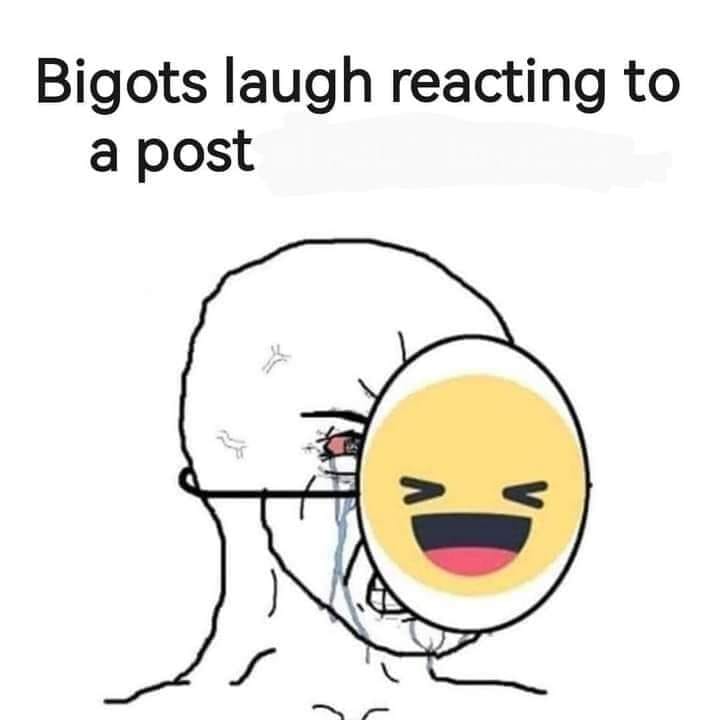
The image mocks a "Guru" figure (the bald head with glasses) who appears distressed, yet a laughing emoji covers his face, highlighting the absurdity of the situation. The text, "Bigots laugh reacting to a post," implies that "bigots" (in the traditionalist sense) are mocking the Guru's seriousness and intensity, fitting the category's theme of attacking mainstream, progressive narratives.
simple-description (llama3.2-vision_11b)
The meme is a humorous representation of a person's reaction to a post that is intentionally provocative or inflammatory, often by an anti-reactionary or extremist group. The image is of a person with a shocked or horrified expression, with the text "Anti-Reactionary" above it.
detailed-analysis (gemma3-27b-vision)
Okay, here's an analysis of the image you provided, broken down into the requested theoretical frameworks, but only addressing sections where those frameworks apply to the image's content.
Visual Description
The image is a simplistic, digitally-drawn cartoon, resembling a “rage comic” style. It depicts a white, gender-neutral head in profile, visibly distressed. The face is contorted in weeping, with exaggerated tears streaming down. Overlaid on a portion of the face is a large, bright yellow emoji face that is expressing loud laughter, with wide-open mouth and eyes. The juxtaposition of the distressed face and the laughing emoji conveys a sense of malicious joy, or pleasure derived from the distress of another. The text at the top reads "Bigots laugh reacting to a post", setting the context.
Foucauldian Genealogical Discourse Analysis
This image is strongly amenable to a Foucauldian reading.
- Power/Knowledge: The image illustrates how power operates through discourse. The "post" mentioned, is absent, however the image suggests that specific kinds of discourse (those addressing marginalized groups, social justice concerns, or progressive ideas) trigger a specific reaction in those identified as "bigots." The laughter is not simply amusement; it’s a performance of power – a demonstration of dominance over the subjects of the "post." The post exists as a discursive field where power relations play out.
- Genealogy: A genealogical analysis could trace the historical development of this reaction. Why is it that certain subjects or ideas consistently provoke pleasure in those holding bigoted views? What historical conditions have allowed for this type of performative cruelty to emerge, and how has it been normalized? This goes beyond individual prejudice to examine the systems of thought that support and legitimize it.
- Discipline & Punishment: While not a direct application, the image touches on how bigoted reactions function as a form of social control. The laughter can be seen as an attempt to "punish" or silence those who challenge the status quo, or simply to reaffirm a hierarchy. The implicit message is “we are amused by your pain/anger/discomfort.”
Critical Theory
This image directly speaks to core concepts in Critical Theory, particularly around domination and ideology.
- Domination & Oppression: The image clearly depicts a power dynamic: a group ("bigots") deriving pleasure from the distress of others (implied by the "post"). It illustrates the ways in which ideologies of prejudice allow for the dehumanization of others, and the justification of hostile reactions.
- Ideology: The laughter is not just an emotional response, but an ideological one. It suggests a worldview where the suffering of marginalized groups is not only acceptable, but enjoyable. The image highlights how ideologies can be deeply embedded in emotional responses, and how these responses can reinforce systems of oppression.
- Negative Dialectics: One could frame the image as an example of “negative dialectics” – the image expresses the refusal of empathy and the affirmation of exclusionary identities.
Queer Feminist Intersectional Analysis
This image is richly suited to a Queer Feminist Intersectional analysis.
- Intersectional Power Dynamics: The image’s power dynamic is inherently linked to intersectionality. The “post” is likely to be addressing issues of social justice, affecting groups based on race, gender, sexuality, disability, etc. The "bigot's" enjoyment of distress is often fueled by an investment in maintaining hierarchies that oppress these groups. Their laughter is a rejection of empathy and solidarity with those who face systemic discrimination.
- Affective Labor & Emotional Violence: The image can be viewed as an example of emotional violence. The "bigot" is essentially refusing to engage with the emotional labor of those who are struggling against oppression. Their laughter actively harms those who are sharing their experiences or advocating for change.
- Rejection of Care & Solidarity: The image represents a deliberate rejection of care and solidarity. The “bigot” is not simply indifferent to the suffering of others; they derive pleasure from it. This speaks to a broader pattern of hostile responses to social justice movements and attempts to build more equitable societies.
- Queer Theory: The image speaks to a rejection of empathy, compassion, and, ultimately, a refusal of connection – rejecting the central tenet of queer theory of embracing difference and community.
Let me know if you'd like me to elaborate on any of these points or explore other analytical frameworks!
simple-description (llama3.2-vision)
This meme is a humorous representation of a person who is extremely upset or angry, often to the point of tears. The image depicts a person crying with a "laughing" emoji covering their face, implying that they are laughing so hard they're crying. The text "Bigots laugh" is written above the image, suggesting that the person is laughing at something that is likely to be offensive or insensitive.