First Seen
2024-08-06T23:42:58.820674+00:00
simple-description (qwen3.5_2b-q8_0)
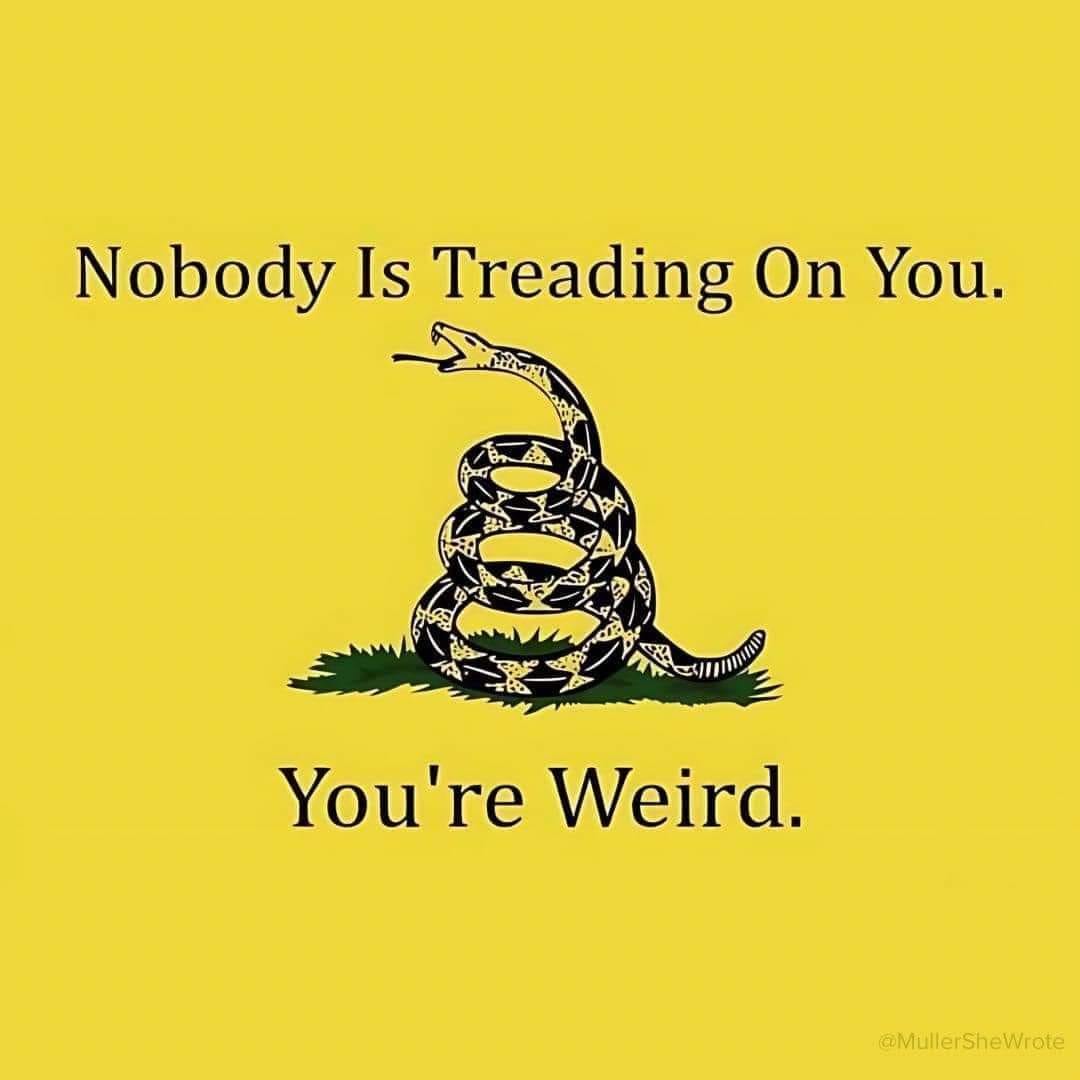
From an anti-reactionary perspective, this meme serves as a cynical rebuttal to the argument that the Left isn't fighting back. It asserts that the typical conservative claim—that "we are not doing anything against you"—is a lie, because activists are indeed taking things away. The image includes the text: "Nobody Is Treading On You. You're Weird."
simple-description (llama3.2-vision_11b)
The meme is a play on the classic "Don't Tread on Me" flag, but with a sarcastic twist. The image shows a snake coiled and ready to strike, with the words "I'm not okay with your politics" above it, and the text "Nobody is going to take away my right to be angry about your politics" below it. The meme is a humorous way to express frustration with someone's opinions, while also acknowledging that one's emotions are valid.
detailed-analysis (gemma3-27b-vision)
Okay, here's an analysis of the image, broken down into the sections you requested. I'll include sections only where the image reasonably lends itself to those approaches.
Visual Description
The image features a vibrant yellow background. Centered is a graphic of a coiled rattlesnake, segmented into sections that resemble a colonial American "Don't Tread on Me" flag. It rests on a patch of green grass. Above the snake, the text reads, "Nobody Is Treading on Me." Below the snake, the text reads, "You're Weird." There is a handle @MullerSheWrote at the bottom of the image. The color scheme is striking, and the use of the historic flag motif immediately signals a specific, loaded symbolism. The direct phrasing adds an abrasive quality to the message.
Foucauldian Genealogical Discourse Analysis
This image is ripe for Foucauldian analysis. The "Don't Tread on Me" flag – originating in the American Revolutionary period – is a site of power and discourse. A genealogical approach traces the history of this symbol and how its meaning has changed over time.
- Power/Knowledge: The flag initially signified colonial resistance to British rule. However, in the 21st century, it’s been adopted by a range of groups – from libertarian movements to far-right factions – broadening its meaning and, importantly, shifting its power. It's no longer solely about challenging oppression; it's been appropriated to justify resistance to perceived attempts at regulation, oversight, or progressive social change. The image's juxtaposition of the historical symbol with the phrase "You're Weird" positions those who aren't resistant to such challenges (who might support regulations, etc.) as "other" and abnormal.
- Discourse & Normalization: The image subtly participates in a discourse of individualism and self-reliance. The phrase implies that anyone requiring assistance or accepting limitations on their “freedom” is somehow deficient. It constructs a norm of rugged independence and portrays anyone who deviates from it as weird.
- Biopower: The phrase implicitly suggests a rejection of collective care or community-based governance, asserting an absolute right to individual autonomy, even to the extent that it denies shared vulnerabilities.
Critical Theory
The image lends itself well to analysis through the lens of Critical Theory, particularly those schools of thought focused on ideology and domination.
- Ideology: The image is not simply a statement of personal opinion; it functions as an ideological statement. It presents the idea of individual freedom as an unquestionable virtue, subtly legitimizing existing power structures. The "Don't Tread on Me" flag evokes a romanticized narrative of American individualism that obscures the systemic inequalities that have historically and continue to exist.
- Hegemony: The image can be seen as attempting to establish or reinforce a hegemonic idea – that constant vigilance against perceived infringements on personal liberty is necessary and virtuous. This idea helps to normalize a certain mindset and way of being in the world.
- False Consciousness: The image may contribute to a “false consciousness” by encouraging individuals to focus on imaginary or exaggerated threats to their freedom, distracting them from real structural issues.
Queer Feminist Intersectional Analysis
The image, despite not explicitly addressing gender or sexuality, can be viewed through a Queer Feminist Intersectional lens by considering who is positioned as "weird" and who benefits from the assertion of absolute individual freedom.
- Intersectional Vulnerability: Those who are most vulnerable within systems of power (e.g., people of color, disabled individuals, LGBTQ+ people) often rely on collective action and social safety nets. To frame reliance on others as "weird" implicitly devalues these crucial forms of support and perpetuates the myth that everyone can and should be self-sufficient.
- Exclusionary Individualism: The image reinforces a brand of individualism that tends to disregard the interconnectedness of social life and the ways in which our identities and experiences are shaped by systems of power. This kind of individualism can be particularly harmful to marginalized groups.
- Normalization of Ableism: The rhetoric of unwavering independence can be viewed as an example of ableism, as it assumes that all individuals are equally capable of self-reliance and fails to acknowledge the needs of those who require assistance or care.
Let me know if you’d like me to elaborate on any of these points or explore another angle!
simple-description (llama3.2-vision)
This meme is a humorous commentary on the phrase "you're weird" being turned into an insult. The image features a Gadsden flag, which is a historical American flag with a coiled snake and the phrase "Don't Tread On Me." In this meme, the phrase has been altered to "Don't Tread On Me... You're Weird" with the snake's head changed to a snake that is "treading" on the person, and the text below reads "Nobody Is Treading On You. You're Weird."