First Seen
2023-05-10T21:03:33+00:00
simple-description (llama3.2-vision_11b)
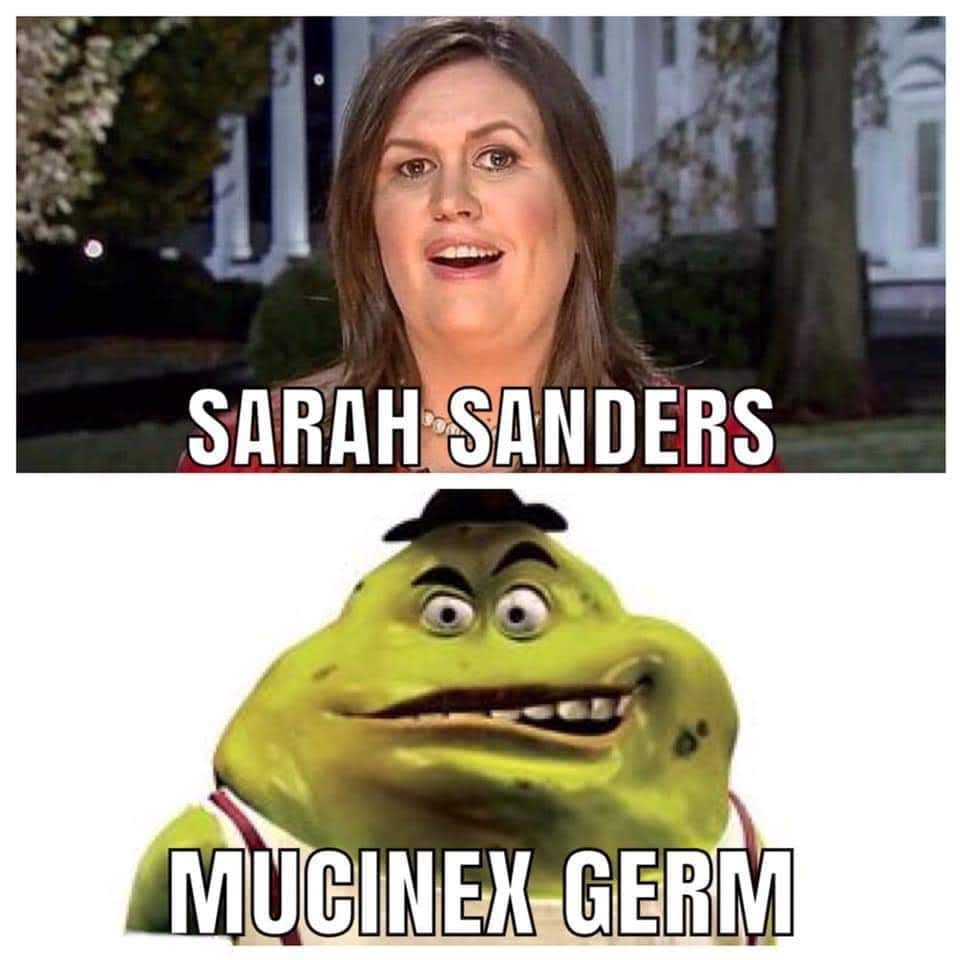
The meme is a humorous comparison between Sarah Sanders, a former White House press secretary, and a character from the 2001 film "Shrek," known for its ogre-like appearance and grumpy demeanor. The image juxtaposes Sanders' serious expression with the "Shrek" character's grumpy face, implying that Sanders' sternness is comparable to the ogre's grumpiness. The meme is likely used to poke fun at Sanders' serious demeanor and the idea that she is as grumpy as the "Shrek" character.
detailed-analysis (gemma3-27b-vision)
Okay, let's break down this meme through various critical lenses. It's a rather strange image pairing, so we'll see how far these theories can stretch!
Visual Description
The meme is a diptych (two-panel image). The top panel features a headshot of Sarah Huckabee Sanders, former White House Press Secretary, looking directly at the camera with a slightly strained expression. Her name is overlaid in white text in a bold sans-serif font. The bottom panel features a cartoon rendering of a green anthropomorphic germ, wearing a fedora, sporting an exaggerated, slightly menacing grin. Underneath it reads "MUCINEX GERM" in the same font. The imagery immediately establishes a visual juxtaposition, placing a political figure beside a cartoon representation of illness/discomfort. The contrast in realism and cartoonishness is striking.
Foucauldian Genealogical Discourse Analysis
This meme can be seen as operating within a Foucauldian framework by employing discourse to construct a relationship between power, knowledge, and subject formation.
- Power/Knowledge: The meme implicitly critiques Sarah Huckabee Sanders' perceived role in disseminating information (or misinformation) as a representative of a specific political power. The association with a "germ" links her to something perceived as harmful or contagious – not physically, but perhaps ideologically or rhetorically. The meme suggests her pronouncements are “infectious” or detrimental to the public’s “health” of understanding.
- Genealogy: The historical context is important. Sanders, as a visible defender of certain political narratives, became a figure of intense scrutiny and often derision. This meme can be seen as part of a genealogy of critiques leveled against her public persona. The genealogy here traces a line of commentary on her role in shaping public perception of the previous administration.
- Discourse & Subject Formation: The meme attempts to construct Sanders as something ‘unhealthy’ or ‘untrustworthy.’ This is not about literal disease, but a metaphorical "infection" of public discourse. The meme attempts to influence the way viewers perceive and understand Sanders, shaping her as a subject associated with negativity and distrust.
Critical Theory
The meme leans heavily into critical theory, specifically relating to ideology and power. It's a form of political satire, aiming to expose and subvert perceived hypocrisy or harmful rhetoric.
- Dominant Ideology: The meme assumes a critical stance towards Sanders and the political ideology she represents. It implies that her public statements are akin to a “contagion” – spreading misinformation or harmful narratives. The meme aims to denaturalize the information she presents, exposing it as something manipulative or deceptive.
- Critique of Representation: The meme does not offer a rational argument; it instead relies on visual association to create a sense of disgust or distrust. This highlights the power of representation in shaping public opinion.
- Deconstruction of Authority: By placing Sanders alongside a cartoonish germ, the meme undermines her perceived authority. It suggests that her pronouncements are not based on reasoned argument but on something essentially "dirty" or undesirable.
Marxist Conflict Theory
Applying a Marxist lens, the meme can be interpreted as an expression of class and ideological conflict, albeit in a metaphorical way.
- Class Struggle (Metaphorical): Sanders, as a representative of the political establishment, can be seen as embodying a ruling class that protects its interests. The "germ" could represent a grassroots counter-narrative or resistance. The meme thus presents a symbolic conflict between those in power and those who oppose them.
- Ideological Apparatus: The meme functions as part of the "ideological apparatus" – a system of cultural production that reinforces or challenges existing power structures. Here, it challenges the legitimacy of the established political narrative.
- False Consciousness: The meme suggests that the public is being misled by those in power and that Sanders is a key player in perpetuating this deception. The "germ" image attempts to break through this "false consciousness" and expose the truth.
Postmodernism
This meme embodies several postmodern characteristics.
- Simulacra and Simulation: The meme isn’t about Sanders literally being a germ. It’s a simulacrum – a copy without an original. It relies on the visual association to create a new meaning that has no basis in reality.
- Deconstruction of Meaning: The meme deliberately disrupts any straightforward interpretation. It creates a juxtaposition that challenges viewers to question the relationship between Sanders, her rhetoric, and its potential impact. The meaning isn't inherent in the image; it’s constructed by the viewer through their interpretation.
- Irony and Parody: The meme is inherently ironic and parodic. It uses humor to critique and subvert the authority of a political figure.
Queer Feminist Intersectional Analysis
This is the most challenging application, but we can approach it by considering the context and implied power dynamics.
- Power Dynamics: Sarah Huckabee Sanders holds a position of significant power, and her political stances often clashed with those advocating for LGBTQ+ rights and gender equality. The meme, while not directly related to these issues, can be seen as a symbolic act of resistance against a figure perceived as oppressive.
- Subversion of Representation: By associating Sanders with something "unclean" or undesirable (the germ), the meme subverts her carefully constructed public image. This can be interpreted as a rejection of her attempts to control the narrative and a reclaiming of agency by those who feel marginalized.
- Intersectional Critique: The meme can be read as a broader critique of power structures that perpetuate inequality. The germ represents the disruptive force of marginalized voices challenging the status quo.
Important Note: Applying these theoretical lenses is often subjective and open to interpretation. The meme is relatively simple, but can be surprisingly rich in meaning when examined through these diverse frameworks.
simple-description (llama3.2-vision)
This meme is a photo of Sarah Sanders, a former White House press secretary, with a caption that juxtaposes her with the character of Shrek's son, "Fiona's" son, Prince, aka Prince, aka Prince Charming, aka Prince Charming's, aka Prince Charming's, aka Prince Charming's, aka Prince Charming's, aka Prince Charming's, aka Prince Charming's, aka Prince Charming's, aka Prince Charming's, aka Prince Charming's, aka Prince Charming's, aka Prince Charming's, aka Prince Charming's, aka Prince Charming's, aka Prince Charming's, aka Prince Charming's, aka Prince Charming's, aka Prince Charming's, aka Prince Charming's, aka Prince Charming's, aka Prince Charming's, aka Prince Charming's, aka Prince Charming's, aka Prince Charming's, aka Prince Charming's, aka Prince Charming's, aka Prince Charming's, aka Prince Charming's, aka Prince Charming's, aka Prince Charming's, aka Prince Charming's, aka Prince Charming's, aka Prince Charming's, aka Prince Charming's, aka Prince Charming's, aka Prince Charming's, aka Prince Charming's, aka Prince Charming's, aka Prince Charming's, aka Prince Charming's, aka Prince Charming's, aka Prince Charming's, aka Prince Charming's, aka Prince Charming's, aka Prince Ch
The meme reads: "Sarah Sanders: 'I don't know what to say to that.' 'I don't know what to say to that.'"
tesseract-ocr
a7 \ ie” Sess PVIVGINENsGERI