First Seen
2023-05-10T21:03:33+00:00
simple-description (llama3.2-vision_11b)
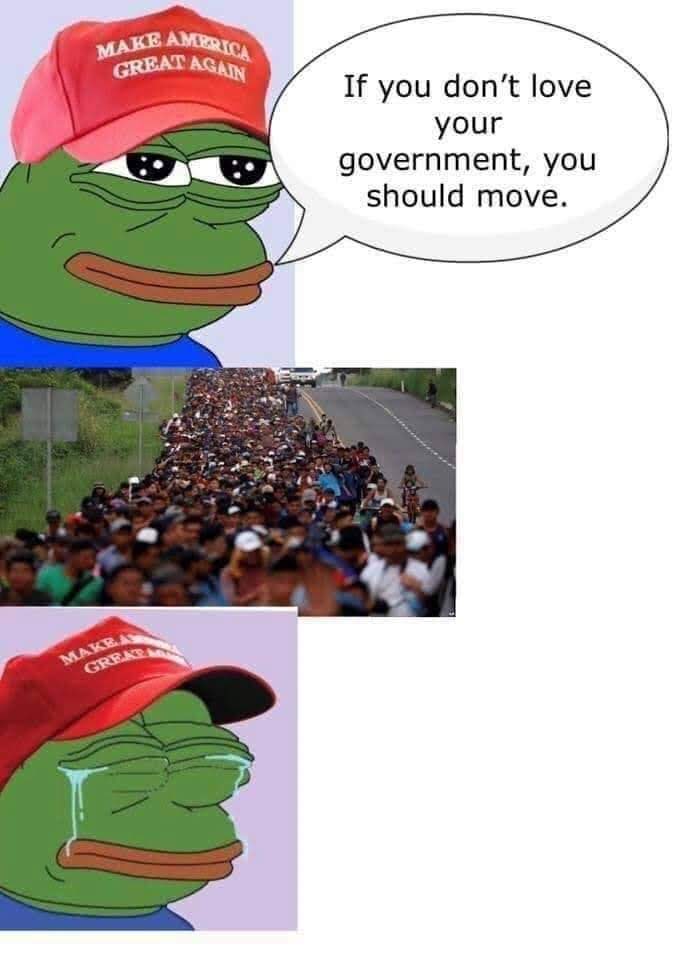
The meme is a play on the "Pepe the Frog" character, which has been co-opted by various ideologies, including the anti-reactionary movement. The image depicts Pepe wearing a "Make America Great Again" hat, a symbol of the alt-right movement, but with a tongue-in-cheek message that subverts the original's intention. The text "If you don't like it, you can just leave" is a sarcastic commentary on the idea that if you don't agree with the government, you can just move to a different country.
detailed-analysis (gemma3-27b-vision)
Okay, let's break down this image using the requested theoretical frameworks. It’s a complex image layered with internet culture, political messaging, and affect.
Visual Description
The image is a digitally altered collage. The central figure is a modified “Pepe the Frog” meme, a cartoon frog that has been appropriated by various internet subcultures, notably the alt-right. This particular iteration of Pepe is wearing a red "Make America Great Again" (MAGA) hat and appears to be crying. Above the crying Pepe is a speech bubble stating, "If you don't love your government, you should move." Beneath the crying Pepe is another version of the same frog, also crying. In the center of the image is a photograph of a crowd of people, presumably at a political rally, likely a pro-Trump event given the hat on the meme. The general aesthetic is one of ironic affect and potentially performative distress. The quality of the image suggests it was created and shared within online spaces.
Foucauldian Genealogical Discourse Analysis
This image is ripe for a Foucauldian analysis. The statement, “If you don’t love your government, you should move,” establishes a discourse around patriotism and national belonging. Foucault would ask: what power structures does this discourse serve? The demand for a display of love for the government isn't simply about affection; it's about enforcing a normalization of state authority.
Genealogically, we can trace the development of this discourse through history. The idea of “love of country” is relatively modern, built on the rise of nation-states and ideologies that require citizen identification with the state. The image, via the MAGA hat, anchors this discourse to a specific moment in US political history and the rhetoric of Donald Trump.
The crying Pepe is crucial. It’s a counter-discourse—a performance of hurt or disappointment that simultaneously acknowledges and challenges the demand for unconditional loyalty. This could be a tactic of resistance, but it's a complex one, given Pepe's history with the alt-right. Foucault would be interested in how this image produces a certain subject—a subject who feels compelled to both perform patriotism and express ironic disillusionment. The image subtly normalizes the expression of unhappiness within the parameters of patriotic discourse.
Critical Theory
From a Critical Theory perspective (drawing on the Frankfurt School), this image represents the instrumentalization of emotion in the service of ideology. The crying Pepe isn't genuine grief but a manufactured affect designed to elicit a specific response. The statement in the bubble is not a genuine expression of opinion but a tool for enforcing conformity.
The image taps into the concept of culture industry. The meme format itself is a product of the culture industry—a standardized and readily consumable form of expression. The combination of the MAGA hat and the crying Pepe is an attempt to create a shorthand for a particular political position—one that combines nationalist sentiment with a sense of victimhood or grievance.
The image’s virality suggests it is successful at capturing the false consciousness of its audience. This suggests that even if people recognize that the crying Pepe and message is ironic, the meme still serves to reinforce the ideological foundations of nationalistic fervor.
Marxist Conflict Theory
A Marxist analysis would see this image as reflecting and reinforcing class conflict. The message about loving the government can be interpreted as a demand for ideological hegemony—the dominance of a particular worldview that serves the interests of the ruling class. Asking dissenters to “move” is a way of excluding those who challenge the existing power structure.
The MAGA hat itself signifies an appeal to a specific segment of the population—largely white working-class voters who feel economically and culturally disenfranchised. The crying Pepe can be seen as expressing that sense of grievance, but it’s a grievance that is often channeled toward scapegoats rather than toward the actual sources of economic inequality.
The image, therefore, functions as a tool for false consciousness. It obscures the underlying class conflicts by framing political disagreement as a personal failure of patriotism. It deflects attention away from the structures of power that perpetuate inequality and directs it toward those who express dissent.
Postmodernism
From a Postmodern perspective, this image revels in simulacra and simulation. The crying Pepe isn't a genuine emotional expression but a copy of an emotion, detached from any underlying reality. The MAGA hat itself is a signifier that has been divorced from its original meaning, becoming a symbol of a particular cultural and political identity.
The image embodies irony and pastiche. It combines disparate elements—a cartoon frog, a political slogan, and a manufactured emotion—in a way that subverts traditional meaning. The image’s meaning is not fixed but fluid and open to interpretation. The use of a meme format itself is a characteristic of postmodern culture—a culture that embraces fragmentation, appropriation, and remixing. The very act of creating and sharing the image can be seen as a rejection of grand narratives and a celebration of individual expression, even if that expression is ironic or self-deprecating.
Queer Feminist Intersectional Analysis
A Queer Feminist Intersectional analysis would highlight how the image’s message reinforces patriarchal and heteronormative power structures. The demand for unquestioning loyalty to the government often equates patriotism with traditional gender roles and expectations. The image appeals to a sense of national identity that historically excludes marginalized groups.
The crying Pepe, while seemingly ironic, can be seen as a performance of vulnerability that is often denied to those who challenge dominant power structures. The image’s appeal to a sense of grievance and victimhood can reinforce harmful stereotypes and discourage solidarity across different marginalized groups.
From an intersectional perspective, the image’s message is not universal but is shaped by specific power dynamics and social hierarchies. The demand for unquestioning loyalty to the government often comes at the expense of those who are already marginalized and oppressed. The use of a meme format itself can contribute to the spread of harmful stereotypes and misinformation.
Let me know if you'd like me to elaborate on any of these interpretations or explore other theoretical frameworks!
simple-description (llama3.2-vision)
This meme features the Pepe the Frog character from the internet meme "Pepe" with a red "Make America Great Again" hat, but it's actually wearing a "Make Pepe Great Again" hat with a speech bubble saying "If you don't like the way I'm doing it, I'm going to do it my way".
tesseract-ocr
Oey If you don’t love 5 your a ey government, you q should move. —See phe , oe ae ee = . Sd a ee | | 0 ow! ati —<——— = =