First Seen
2023-05-10T21:03:33+00:00
simple-description (llama3.2-vision_11b)
The meme is a satirical response to the 2018 Santa Fe High School shooting, where a gunman killed 10 people and injured 23 others. The meme uses a fictional quote from a "tired" student, saying "I don't like it when you do that" in response to the shooter's actions, implying that the student is frustrated with the shooter's actions. The meme is a commentary on the societal issues that lead to such events, using irony and satire to highlight the need for change.
detailed-analysis (gemma3-27b-vision)
Okay, here's an analysis of the provided social media post, broken down into relevant theoretical frameworks. I'll include sections only where those frameworks meaningfully apply. I'll provide a robust interpretation, but remember this is based on a single, short text.
Visual Description
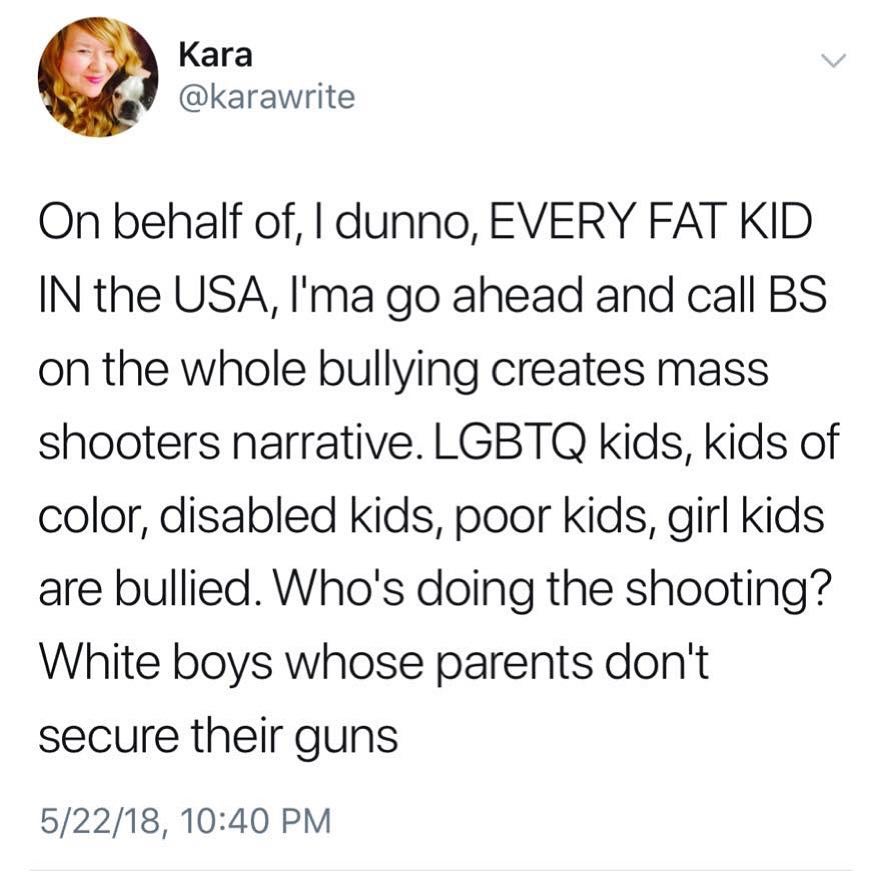
The image is a screenshot of a Twitter post from the account "@karawrite," with a profile picture of a person with curly hair. The post consists of text written in all capital letters, expressing a direct and assertive opinion. The date and time of the post (May 22, 2018, 10:40 PM) are visible at the bottom. The visual is simple, conveying immediacy and directness due to the screen-capture format and emphatic capitalization.
Critical Theory
This post directly engages with a pervasive social narrative—the one linking bullying to mass shootings. The author challenges this narrative and presents a counter-argument rooted in a critical examination of power dynamics and systemic factors. This is core to Critical Theory's concern with exposing hidden structures of domination and challenging dominant ideologies.
The author isn't simply saying bullying isn't related, but is questioning the framing of the issue. The post implies that focusing solely on bullying obscures the actual roots of mass shootings – specifically, the access to guns by a particular demographic (white boys whose parents don't secure them) and the societal conditions that lead to that access.
This challenges the idea that mass shootings are caused by individual psychological issues (like being a bully or being bullied) and shifts the focus toward broader social and political factors. This is a hallmark of Critical Theory – tracing problems back to systemic issues rather than individual failings.
Queer Feminist Intersectional Analysis
The post employs a strong intersectional lens. The author explicitly lists marginalized groups who are frequently bullied: LGBTQ+ kids, kids of color, disabled kids, poor kids, and girls. This demonstrates an understanding that bullying doesn't affect everyone equally; it intersects with multiple forms of oppression. The author's point isn't to diminish the pain of bullying, but to emphasize that these groups are disproportionately targeted, while those actually perpetrating mass shootings belong to a different demographic.
A queer feminist analysis also allows us to see how the narrative of "bullying creates shooters" implicitly normalizes white, male violence. By focusing on bullying as the primary cause, the narrative sidesteps the fact that the vast majority of mass shooters are white males. The post calls attention to this pattern and implicitly asks: why is the narrative so often framed around “anyone could become a shooter” instead of recognizing the patterns of those who do become shooters?
Marxist Conflict Theory
While not as explicit, elements of Marxist conflict theory can be found in the post. The focus on a specific demographic (white boys with access to guns) implies a power structure at play. Access to guns, and the freedom to exercise violence, can be viewed as a form of capital (symbolic or literal) controlled by a specific group, contributing to and reinforcing social inequalities. The post suggests that the narrative of “bullying causes shooters” serves to obscure the ways in which power and resources are concentrated in the hands of this group.
The focus on economic disparity ("poor kids" are bullied) also hints at the role of class struggle. While the connection isn’t fully developed, it suggests that economic inequality contributes to the vulnerability of certain groups to violence and marginalization.
Foucauldian Genealogical Discourse Analysis
A Foucauldian approach would examine the discourse surrounding mass shootings—how the narrative of “bullying creates shooters” has been constructed and how it functions as a form of power. The post directly challenges this established discourse, questioning its origins and its effects.
Tracing the genealogy of this narrative would involve exploring how it emerged, who promoted it, and what interests it serves. It’s likely that this narrative emerged from a desire to find a simple explanation for a complex problem, and perhaps also to shift the blame away from systemic issues like gun control and social inequality.
The post can be interpreted as an attempt to disrupt this discourse by offering a counter-narrative that focuses on the role of privilege, access to guns, and the specific demographics of mass shooters. This disruption is a form of resistance against the dominant power structures that shape our understanding of violence.
Postmodernism
While the post doesn't overtly engage with postmodern concepts, the act of deconstructing the dominant narrative of "bullying creates shooters" aligns with postmodern principles. It challenges the notion of a single, objective truth and asserts that narratives are constructed and subjective. The post doesn't offer a new, grand narrative to replace the old one; rather, it exposes the limitations and biases of the existing narrative and calls for a more nuanced understanding of violence.
Let me know if you would like me to elaborate on any of these sections or provide further analysis.
simple-description (llama3.2-vision)
The meme is a humorous and satirical take on the recent mass shootings in the US. The image features a text that reads: "On behalf of, I dunno, EVERY FAT KID IN THE USA, I'ma go ahead and call BS on the whole bullying creates mass shooters narrative." The text then lists various groups of people who are often blamed for being responsible for mass shootings, including LGBTQ kids, kids of color, disabled kids, poor kids, and kids who are bullied. The text ends with "White boys whose parents don't secure their guns."
tesseract-ocr
Q Kara @karawrite On behalf of, | dunno, EVERY FAT KID IN the USA, I'ma go ahead and call BS on the whole bullying creates mass shooters narrative. LGBTQ kids, kids of color, disabled kids, poor kids, girl kids are bullied. Who's doing the shooting? White boys whose parents don't secure their guns 5/22/18, 10:40 PM