First Seen
2023-05-10T21:03:33+00:00
simple-description (llama3.2-vision_11b)
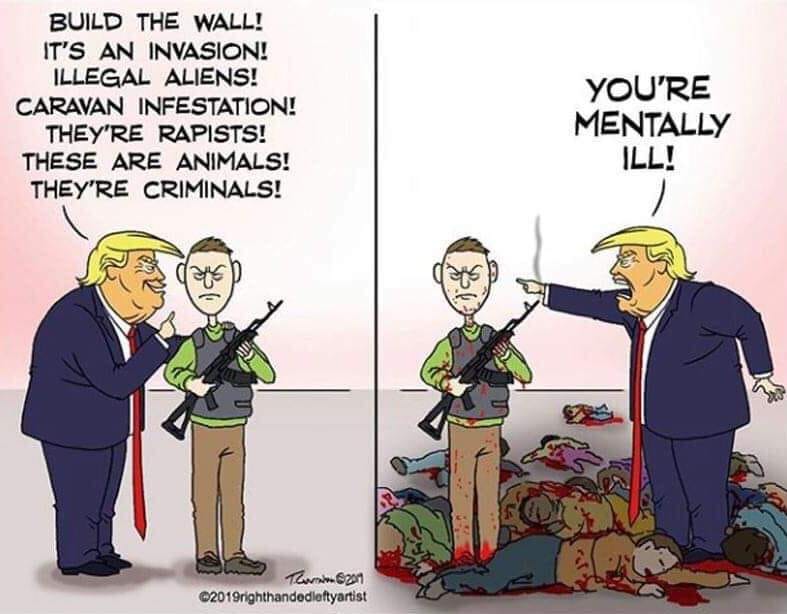
This meme is a satirical commentary on the current state of politics, specifically targeting reactionary ideologies. The image depicts a split-screen comparison between a politician's (Trump) public statement and a more accurate, disturbing reality. The text reads: "Build the wall! It's an invasion! Illegal aliens! Caravan infestation! They're rapists! They're murderers! They're criminals! They're animals!" juxtaposed with a gruesome scene of a politician standing amidst a pile of dead bodies, with a caption "You're mentally ill!"
detailed-analysis (gemma3-27b-vision)
Okay, here's an analysis of the political cartoon, broken down into sections based on the theoretical frameworks you requested. I'll only include sections relevant to the cartoon’s content. (Note: It's important to acknowledge that these theories often overlap and can be used in combination. The separation here is for clarity in addressing each request.)
Please be warned: this image deals with sensitive and potentially disturbing themes of violence, xenophobia, and mental health stigma. The analysis will reflect those themes.
1. Visual Description
The cartoon is a two-panel depiction of Donald Trump addressing two men wielding assault rifles. The scene is stark and deliberately dramatic.
- Panel 1: Trump, in a dark suit and red tie, stands to the left, shouting slogans: "BUILD THE WALL! IT’S AN INVASION! ILLEGAL ALIENS! CARAVAN INFESTATION! THEY'RE RAPISTS! THESE ARE ANIMALS! THEY'RE CRIMINALS!" Before the two men, there are lifeless bodies (of what appear to be migrants) strewn on the ground, covered in blood.
- Panel 2: The two men, still armed with guns, are now facing Trump. Trump is pointing at them and shouting, "YOU'RE MENTALLY ILL!"
- Style: The cartoon is drawn in a somewhat crude, exaggerated style. The colors are limited, and the composition emphasizes the stark contrast between Trump’s rhetoric and the violence it seems to incite. The dead bodies are graphically depicted, though in a simplified manner. The artist’s signature and date are visible at the bottom right.
2. Foucauldian Genealogical Discourse Analysis
This cartoon is ripe for a Foucauldian analysis because it demonstrates how power operates through discourse, creating definitions of "normal" and "deviant."
- Discursive Formation: Trump's language ("invasion," "infestation," "animals," "criminals") isn’t simply descriptive; it constructs a category of "other" – the migrant – as dangerous, subhuman, and a threat to the "normal" (the white, native-born population). This creates a discourse of fear and exclusion.
- Power/Knowledge: The cartoon critiques how power and knowledge are intertwined. Trump’s pronouncements aren't based on objective truth; they produce a reality in which migrants are perceived as inherently violent. This perception then justifies violence against them (as implied by the bodies on the ground).
- Genealogy of "Mental Illness": The ironic shift in Panel 2, where Trump labels the armed men as “mentally ill,” is crucial. It reveals how the category of "mental illness" can be strategically deployed to discredit or dismiss individuals who act on dangerous ideologies. By framing them as mentally ill, Trump attempts to deflect responsibility from his own rhetoric and to neutralize the threat posed by those who embrace it. The cartoon suggests that the real “illness” is the dehumanizing rhetoric that Trump propagates.
- Discipline and Biopolitics: The implied violence and the call for a wall demonstrate forms of discipline and biopolitics – the control of populations through mechanisms of power and the management of life itself. The wall represents a physical boundary that seeks to control movement and define who belongs and who doesn't.
3. Critical Theory
The cartoon strongly aligns with core tenets of Critical Theory, particularly regarding the critique of ideology and the manipulation of language.
- Ideology Critique: The cartoon exposes how Trump’s rhetoric functions as an ideology – a system of beliefs that legitimizes power structures and obscures underlying contradictions. The language of “invasion” and “infestation” is not literal; it’s a metaphorical framing that serves to demonize migrants and justify exclusionary policies.
- Dominant Narratives: The cartoon challenges dominant narratives about immigration, which often portray migrants as a drain on resources or a threat to national security. It suggests that these narratives are not based on evidence but on fear-mongering and prejudice.
- Commodification of Fear: The cartoon implies that fear is being commodified—exploited for political gain. Trump’s rhetoric fuels fear, which then reinforces his power and legitimacy.
- Hegemony: Trump’s ability to shape the public discourse and normalize exclusionary language demonstrates the concept of hegemony – the dominance of one group's worldview over others. The cartoon suggests that this hegemony is not absolute and can be challenged.
4. Marxist Conflict Theory
While not the most dominant lens, Marxist analysis can still illuminate aspects of the cartoon.
- Class Conflict (Indirectly): While not explicitly about class, the cartoon touches on the idea that migrants are often scapegoated for economic anxieties. Trump’s rhetoric might appeal to a working class that feels threatened by economic insecurity.
- Power and Exploitation: The dehumanization of migrants can be seen as a form of symbolic violence that justifies their exploitation. Dehumanizing language makes it easier to justify policies that deny them rights and opportunities.
- False Consciousness: The armed men, perhaps fueled by nationalist or xenophobic ideologies, can be seen as acting on a "false consciousness" – a worldview that obscures their true interests and serves the interests of those in power.
5. Queer Feminist Intersectional Analysis
This is a slightly less direct application, but it can still be insightful.
- Dehumanization & Bodily Vulnerability: The cartoon powerfully depicts the extreme vulnerability of marginalized bodies. The dead bodies on the ground represent the real-world consequences of dehumanizing rhetoric and violence.
- Intersection of Identities: While the cartoon focuses on migration, it's important to note that migrants often have multiple intersecting identities (e.g., race, gender, sexual orientation). The cartoon implicitly suggests that these identities can make them even more vulnerable to violence and discrimination.
- Patriarchy and Violence: The armed men, as upholders of a violent ideology, can be seen as embodying patriarchal power structures. The cartoon implicitly critiques the ways in which patriarchal norms can contribute to xenophobia and violence.
- Reclaiming Agency (Implied): While the cartoon primarily depicts violence, it's important to acknowledge that migrants are not simply passive victims. They have agency and resist oppression in various ways.
Important Note: This analysis is subjective and open to interpretation. Different theoretical perspectives could yield additional insights. The cartoon is a complex and emotionally charged image, and it’s important to engage with it critically and thoughtfully.
simple-description (llama3.2-vision)
This meme is a cartoon image of Donald Trump standing in front of a wall, with a man behind him holding a gun. The text "Build the wall" is written above Trump, and the man behind him says "In 2-3 sentences, describe this meme for someone who cannot see it." The image is a play on the phrase "build the wall" and the Trump administration's policy on immigration.
tesseract-ocr
BUILD THE WALL! IT’S AN cue ILLEGAL ALIENS! YOU’RE CARAVAN INFESTATION! THEY'RE RAPISTS! MENTALLy THESE ARE ANIMALS! ILL! “os CRIMINALS! ) (GR ee} ee) Lome :\ VE, jaa) b Buy ge Cad Se eS oa ~ ff me | — oj Be 4 S = ©2019righthandedieftyartist CS %