First Seen
2023-05-10T21:03:33+00:00
simple-description (llama3.2-vision_11b)
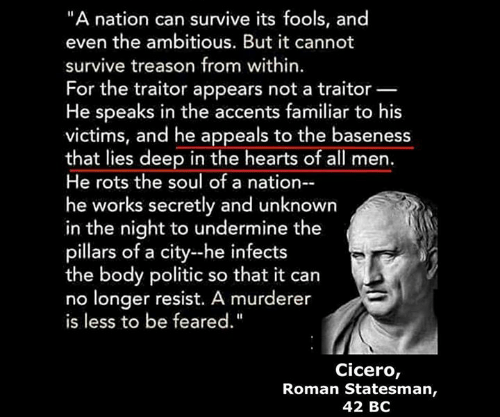
This meme uses a quote from Cicero's "On the State of the Times" to satirize the idea that the "state of the times" is still the same as it was 2,000 years ago. The quote is presented in a modern, informal font, implying that the state of the times has not changed despite the passage of centuries.
detailed-analysis (gemma3-27b-vision)
Okay, here's an analysis of the image and the quote, broken down into sections as requested, only including sections where applicable.
Visual Description
The image is a digitally rendered portrait of Cicero, identified as a Roman Statesman from 42 BC. He is depicted in a classical, bust-style portrait, with a focus on his face. He has a stoic expression. The background is solid black, creating a high-contrast image. Text containing a direct quote by Cicero is overlaid on the image. The overall aesthetic is simple, with the goal of highlighting the text and the historical figure.
Foucauldian Genealogical Discourse Analysis
Cicero's quote lends itself to a Foucauldian analysis, particularly regarding the construction of "the traitor." Foucault emphasized how discourses create categories and norms. This quote defines a specific type of threat, not through outward actions, but through internal corruption.
- Power/Knowledge: The quote illustrates a power/knowledge dynamic. Those in authority (like Cicero, who was concerned with the decline of the Roman Republic) are positing a definition of danger, thereby exercising power over what is considered acceptable behavior and belief. The definition of "treason" is not objective but is constructed within a specific historical and political context.
- Discourse of the Body Politic: The use of terms like "rots the soul of a nation," "infects the body politic" indicates that the nation is seen as an organic entity. This "body" is susceptible to corruption from within, emphasizing a discourse of control over individuals and their thoughts.
- Genealogy: Tracing the historical development of the concept of "treason" would reveal how it has been used to control dissent and maintain power. The quote isn't a timeless truth, but a specific articulation within a specific historical struggle. The definition of "the traitor" is not fixed but has evolved alongside changing political and social structures.
Critical Theory
The quote can be viewed through a Critical Theory lens, specifically concerning ideology and the maintenance of power structures.
- Ideology: Cicero's statement isn't simply a warning about individuals with malicious intent; it reinforces a specific ideology that emphasizes internal threats as more dangerous than external ones. This can be a way to justify internal repression and control by demonizing internal dissent.
- Dominant Discourse: The quote constructs a narrative that emphasizes the vulnerability of the nation to internal corruption, which serves the interests of those in power. By framing the threat as insidious and coming from within, it can justify heightened surveillance, censorship, and suppression of opposition.
- False Consciousness: The quote suggests that "the traitor" appeals to the "baseness" that lies deep in all men. This could be interpreted as a claim that individuals are easily manipulated and that dissent is simply a result of inherent flaws in human nature, thereby masking the political and economic factors that drive opposition.
Marxist Conflict Theory
While the quote doesn’t explicitly discuss economic factors, it can be interpreted within a Marxist framework by considering the underlying class dynamics.
- Internal vs. External Enemies: The emphasis on internal threats can be a tactic used by the ruling class to divert attention from class conflict and maintain their dominance. By focusing on “traitors” within the nation, the ruling class can suppress challenges to their authority and prevent the formation of a unified opposition.
- Ideological Control: The quote suggests that the ruling class needs to control not only the material conditions of society but also the ideas and beliefs of the population. The idea that "baseness" lies deep within all men can be used to justify the suppression of dissent and maintain the existing power structures.
- Class Struggle: While not directly stated, the concept of “traitors” who undermine the “pillars of a city” could be seen as a metaphor for those who challenge the existing economic and political order.
Note: The other sections (Postmodernism, Queer Feminist Intersectional Analysis) don't seem particularly relevant to the core themes of the quote or the visual elements, so they have been omitted. The focus is on the most fitting lenses for analysis.
Let me know if you'd like me to elaborate on any of these points or explore a different analytical framework!
simple-description (llama3.2-vision)
This meme features a quote from Cicero's "The Roman Inaugural Address of the Distant and the Diverse" (which is actually from "The Roman Inaugural Address of the Distant and the Diverse") in a modern, playful way. The text reads: "A nation can survive its own...". The image is a meme that uses this quote to make a humorous point about the state of the US.
tesseract-ocr
Re UU ah Roo UL) even the ambitious. But it cannot amor oR For the traitor appears not a traitor — feel Ue RCL Lm OMI) victims, and he appeals to the baseness Sarco MA) on eee areas aac Ural Role M aCe he works secretly and unknown ” in the night to undermine the \\\ Roa Relea PT the body politic so that it can VA no longer resist. A murderer aR oo RCL To A Cicero, Pose POE tel