First Seen
2023-07-01T13:06:34+00:00
simple-description (qwen3.5_2b-q8_0)
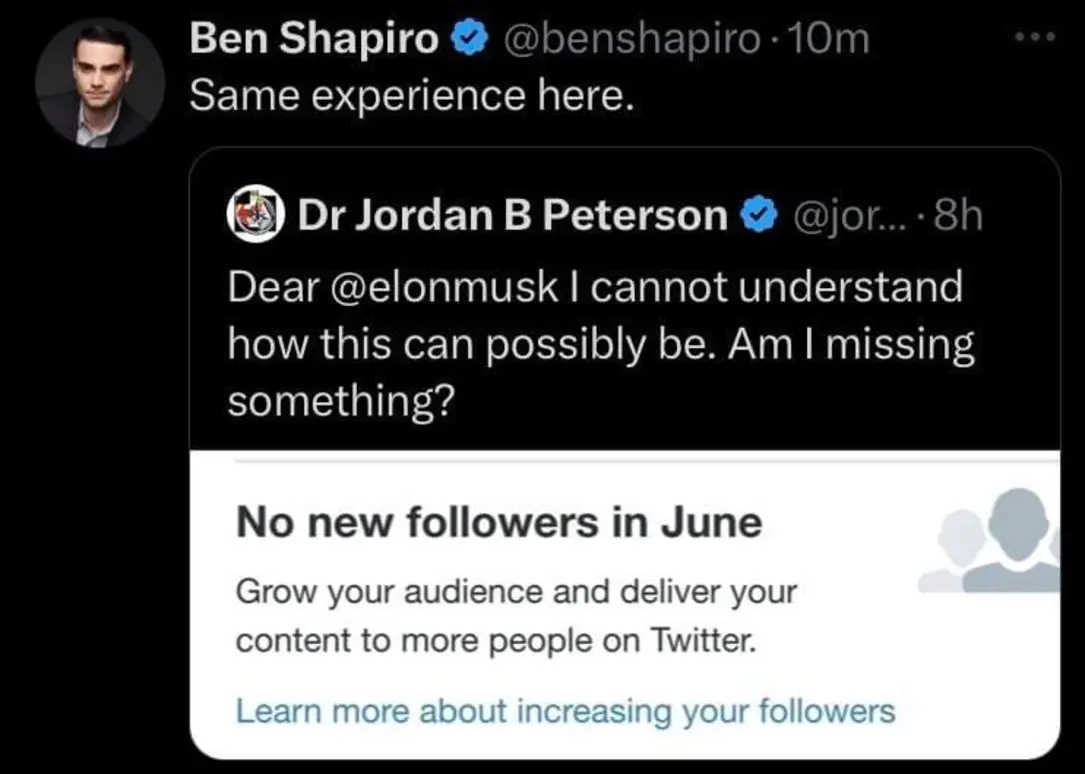
Ben Shapiro is mocking Dr. Peterson for being "stupid" about a "No new followers in June" message. He claims he has the "Same experience here," implying that Peterson is confused or missing out. This reactionary style of blaming the "victim" for failing to see their own status highlights the absurdity of the internet culture.
simple-description (llama3.2-vision_11b)
The meme is a screenshot of a Twitter conversation between Elon Musk and Jordan Peterson, a philosopher and psychologist. Elon Musk is responding to a question from Jordan Peterson about his views on free speech, and Musk's response is "same" which is a common internet slang for "same to you". The meme is a humorous take on the idea that both Elon Musk and Jordan Peterson are known for their strong opinions and are often at odds with each other.
detailed-analysis (gemma3-27b-vision)
Okay, let's break down this Twitter exchange using the requested theoretical lenses. It's a complex setup, and some lenses will be more applicable than others.
Visual Description
The image depicts a screenshot of a Twitter exchange. At the top, we see Ben Shapiro’s profile and a short statement: "Same experience here." Below that is a quote tweet from Jordan Peterson, directed at Elon Musk, stating, "Dear @elonmusk I cannot understand how this can possibly be. Am I missing something?". Below that is a notification from Twitter saying "No new followers in June," followed by prompts to "Grow your audience" and "Learn more about increasing your followers". Both Shapiro and Peterson’s accounts are verified. The overall visual reinforces the feeling of a confused, possibly aggrieved, response to a perceived decline in Twitter engagement, presented in the format of public social media dialogue.
Foucauldian Genealogical Discourse Analysis
This exchange is prime material for a Foucauldian analysis, particularly regarding power/knowledge and discourse.
- Power/Knowledge: The screen-shot illustrates how platforms like Twitter constitute knowledge and, therefore, influence the distribution of power. The notification about a lack of new followers is a form of data that dictates the "truth" about the reach of these personalities. The implication is that a lack of followers is a lack of influence, a reduction in "power."
- Discourse of Influence: The entire exchange relies on a particular discourse of “influence” and "reach" on social media. This isn't a neutral metric. It's a constructed system of valuing individuals based on quantifiable metrics (follower count). Shapiro and Peterson’s distress speaks to the internalization of this discourse; their value feels diminished by the numbers.
- Genealogy: One could trace the "genealogy" of this preoccupation with followers. How did social media platforms create a system where quantification equals legitimacy? What historical shifts enabled this paradigm? The exchange becomes a symptom of this genealogy.
- Panopticism: Twitter itself, and the constant monitoring of follower counts, can be seen as a digital panopticon, where these users are constantly aware of being observed and evaluated, leading to self-regulation.
Critical Theory
This interaction is deeply relevant to Critical Theory, especially regarding the culture industry and the commodification of the self.
- Culture Industry: Shapiro and Peterson, as public intellectuals, are part of the “culture industry.” They create content, and their "value" is determined, at least partially, by engagement metrics. The Twitter notification reveals how they’re subject to the economic logic of the platform. They aren't simply thinkers; they are products that need to "perform" to maintain their perceived value.
- Commodification of the Self: Their concerns aren’t just about ideas or intellectual impact. It’s about the loss of visibility and thus, a loss of perceived value in the marketplace of ideas (and potential economic benefit). They are commodifying themselves through their online presence and are concerned with the fluctuations of their "market price."
- Ideology: The assumption that follower count equates to merit is itself ideological. It masks the complex factors that influence online visibility (algorithms, paid promotion, etc.) and presents a simplified, quantifiable measure of intellectual authority.
Marxist Conflict Theory
This situation has clear implications from a Marxist perspective, focusing on the dynamics of capital and the attention economy.
- Attention as Capital: In the context of social media, attention is a form of capital. Followers represent a base of potential influence, monetization, and political power. A decline in followers is, therefore, a loss of capital.
- Class Struggle (of Attention): There is a struggle for attention within the platform. Algorithms, bots, and paid promotion can skew the distribution of visibility, creating inequalities in the "attention economy." Shapiro and Peterson can be seen as representatives of a "intellectual elite" who feel their access to this capital is being threatened.
- Alienation: The fact that their value is determined by an algorithm they don't control (and likely don't fully understand) is a form of alienation. They are separated from the means of production (visibility) and are subject to the whims of the platform's owners.
Postmodernism
Postmodern analysis can explore the instability of meaning and the fragmentation of authority.
- Simulation and Hyperreality: The obsession with follower counts creates a simulation of influence. The number itself becomes more important than the actual content or impact of their ideas. This aligns with Baudrillard’s concepts of simulation and hyperreality.
- Deconstruction of Authority: Postmodernism challenges traditional notions of authority. The fact that two prominent intellectuals are visibly concerned about follower counts undercuts their claims to intellectual authority, framing them as beings who are also subject to algorithmic valuation.
- Subjectivity of Truth: Postmodernism argues that "truth" is constructed rather than objective. In this case, the "truth" about their influence is being dictated by an algorithm—a constructed system of measurement.
Queer Feminist Intersectional Analysis
While less directly applicable, this perspective can still offer insights.
- Algorithmic Bias: Algorithms are created by people and are susceptible to bias, and can amplify existing power structures. A decline in followers could be disproportionately affecting marginalized voices, if the algorithm favors certain types of content or profiles. This dynamic intersects with issues of representation and visibility.
- Platform Politics: Twitter as a platform is inherently political. The algorithms, moderation policies, and overall architecture of the platform can reinforce existing inequalities, and silence certain voices.
- Commodification of Identity: Even intellectuals are constructing and performing identity online, and are subject to the pressures of the attention economy. This performance can be particularly fraught for marginalized individuals, who may face greater scrutiny and judgment.
In conclusion, this seemingly simple Twitter exchange is a rich text for a variety of theoretical analyses. It speaks to the power dynamics, ideological forces, and cultural shifts shaping our digital world.
simple-description (llama3.2-vision)
This meme is a screenshot of a Twitter conversation between Ben Shapiro and Jordan Peterson. Ben Shapiro responds to Jordan Peterson's question about how to understand Elon Musk's tweets, saying "Same experience here." The image shows a tweet from Jordan Peterson asking for an explanation of Elon Musk's tweets, and Ben Shapiro's response saying they have the same experience.
tesseract-ocr
= Ben Shapiro Ta 0-10 rf ° ye Tanlom => Olcl aoa leoM acl ice wy ey) Dr Jordan B Peterson lamers) Dear @elonmusk | cannot understand how this can possibly be. Am | missing something? No new followers in June Grow your audience and deliver your content to more people on Twitter. Learn more about increasing your followers