First Seen
2023-05-10T21:03:33+00:00
simple-description (llama3.2-vision_11b)
The meme is a screenshot of a quote from the 1990 book "The Mysterious and the Mystical: An Exploration of the Mysterious and the Mystical in the 21st Century" by David C. Boelina. The quote is written in a font that resembles a handwritten, cursive script, and it reads: "The Mysterious and the Mystical in the 21st Century: An Exploration of the Mysterious and the Mystical in the 21st Century." The quote is attributed to a book that was written by a person named "David C. Boelina" in 1990.
detailed-analysis (gemma3-27b-vision)
Okay, let's break down the image and quote with the requested theoretical lenses.
Image Description
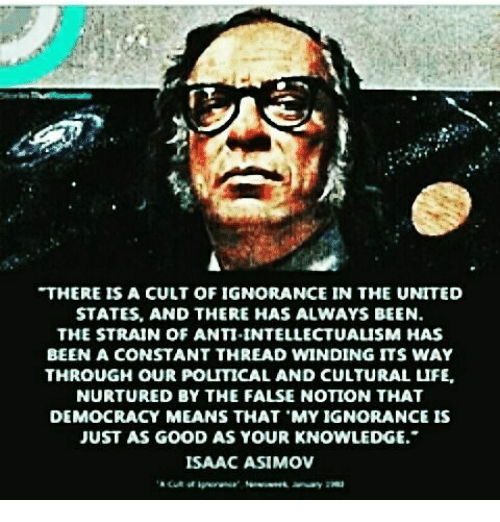
The image features a black and white portrait of Isaac Asimov, a renowned science fiction author. He is looking forward with a stern expression and wearing glasses. The image has a slightly distressed, grainy texture, resembling a vintage or aged photograph. In the upper left corner, there is a splash of red and blue paint. Below the portrait is a white rectangular box with black text featuring a quote attributed to Asimov. The quote decries a “cult of ignorance” in the United States, arguing that it's rooted in the false belief that ignorance is equivalent to knowledge. Beneath the quote, there's a citation identifying the source as "A Cult of Ignorance" from Newsweek in January 1980.
Foucauldian Genealogical Discourse Analysis
A Foucauldian approach emphasizes how knowledge and power are interconnected. This image and quote provide fertile ground for such an analysis.
- Discourse of Anti-Intellectualism: The quote points to a specific discourse – a system of thought, language, and practice – of anti-intellectualism within the United States. Foucault would argue that this discourse isn't simply about the rejection of ideas, but a productive force in shaping social relations. It's not that people passively reject knowledge; the discourse actively constructs ignorance as a virtue.
- Power/Knowledge: The quote reveals the interplay of power and knowledge. Those who promote the idea that "my ignorance is just as good as your knowledge" are wielding power by devaluing expertise and critical thinking. This effectively flattens hierarchies of knowledge and justifies the dismissal of evidence-based reasoning.
- Genealogy: A genealogical analysis would trace the historical origins of this “cult of ignorance.” We could examine how it developed through the history of American populism, the distrust of elites, and the rise of certain forms of media (especially those valuing “common sense” over nuanced understanding). It wouldn’t look for a single “cause” but for the shifting historical conditions and power dynamics that made this discourse possible.
- Subjectification: This discourse constructs subjects who identify with ignorance, finding a sense of agency and belonging through rejecting what is perceived as "establishment" or "expert" knowledge.
Critical Theory
Critical Theory, originating from the Frankfurt School, focuses on uncovering power structures and the ideology that sustains them.
- Ideology: The quote points to a key ideological function: the justification of inequality and social control. If knowledge and expertise are devalued, it becomes easier to rationalize policy decisions based on emotion, prejudice, or vested interests rather than reason and evidence.
- Instrumental Reason: Asimov's quote can be viewed as a critique of the dominance of “instrumental reason” – a focus on efficiency and pragmatism at the expense of critical reflection and ethical considerations. The devaluation of knowledge could be a symptom of a society prioritizing immediate results over the pursuit of understanding.
- Culture Industry: We could connect this to the concept of the "culture industry," which mass produces standardized forms of entertainment and information. This can lead to a decline in critical thinking as people are bombarded with superficial content that doesn't challenge their assumptions.
- False Consciousness: The idea that ignorance is "just as good as knowledge" creates a false consciousness, where people are unable to recognize their own subjugation and the forces that shape their lives.
Marxist Conflict Theory
From a Marxist perspective, society is characterized by class struggle, and ideology serves to maintain the existing power structures.
- Hegemony: The “cult of ignorance” could be seen as a form of cultural hegemony – a dominant ideology that is accepted as common sense by the masses. By promoting the idea that knowledge is suspect, the ruling class can undermine challenges to its authority.
- Class Consciousness: The devaluation of knowledge hinders the development of class consciousness among the working class. If people don't have access to information or the ability to critically analyze their social conditions, they are less likely to organize and fight for their interests.
- Material Conditions: We can connect this to material conditions. Perhaps the promotion of ignorance serves to distract from economic inequality or other forms of social injustice.
Postmodernism
Postmodernism challenges grand narratives and universal truths, emphasizing the subjectivity of knowledge and the constructed nature of reality.
- Deconstruction: A postmodern approach might deconstruct the idea of “knowledge” itself, questioning what it means to know something and how knowledge is socially constructed. Is “knowledge” simply a form of power, or is there a realm of objective truth?
- Relativism: While not necessarily endorsing outright relativism, postmodernism would emphasize the limitations of any claim to absolute truth. It would argue that all knowledge is situated and shaped by the perspective of the knower.
- Meta-Narratives: Asimov's quote can be seen as a critique of the grand narrative of progress through reason and science. By pointing to the dangers of anti-intellectualism, he suggests that reason is not always a force for good.
Queer Feminist Intersectional Analysis
This lens would focus on how power operates through intersecting systems of oppression, including those based on gender, sexuality, race, class, and ability.
- Epistemic Violence: The devaluation of knowledge and expertise can be a form of epistemic violence – the silencing and erasure of marginalized voices and perspectives. Those who are already marginalized (women, people of color, LGBTQ+ individuals) are often denied access to education or their knowledge is dismissed as unreliable.
- Intersectionality: The "cult of ignorance" doesn't affect everyone equally. The consequences of anti-intellectualism are more severe for those who are already vulnerable due to intersecting forms of oppression.
- Standpoint Epistemology: This perspective suggests that marginalized groups have unique insights and perspectives that are often overlooked by dominant groups. By silencing these voices, society loses valuable knowledge and understanding.
Let me know if you would like me to elaborate on any of these theoretical applications!
simple-description (llama3.2-vision)
This meme is an image of a man with a serious expression, likely a historical figure or a famous person. The text overlay on the image is a quote from the comedian and writer Isaac Asimov, which reads: "There is a cult of ignorance in the United States and there always has been. The strain of anti-intellectualism has been a constant thread winding its way through our political and cultural life, as we have seen in the years of our life and the years of our life. The strain of anti-intellectualism has been a constant thread winding its way through our political and cultural life, as we have seen in the years of our life and the years of our life. The strain of anti-intellectualism has been a constant thread winding its way through our political and cultural life, as we have seen in the years of our life and the years of our life. The strain of anti-intellectualism has been a constant thread winding its way through our political and cultural life, as we have seen in the years of our life and the years of our life. The strain of anti-intellectualism has been a constant thread winding its way through our political and "
However, it appears that the quote has been truncated and is actually a quote from an article in the New York Times from 1963. The actual quote is "There is a str of anti-intellectualism has been a constant thread winding its way through our political and " and the actual quote is "There is a str of anti-intellectualism has been a constant thread winding its way through our political and "
tesseract-ocr
7s ir? - i ae _ Be pe) NS ae SE i 7 ae ek = le © a ms = Beta eee al eae Bie STATES, AND THERE HAS ALWAYS BEEN. Bie ee eta far eS ee eel eee THROUGH OUR POLITICAL AND CULTURAL LIFE, NURTURED BY THE FALSE NOTION THAT De eee le ay JUST AS GOOD AS YOUR KNOWLEDGE.” pes Ute SL fold Fee