First Seen
2023-05-10T21:03:34+00:00
simple-description (llama3.2-vision_11b)
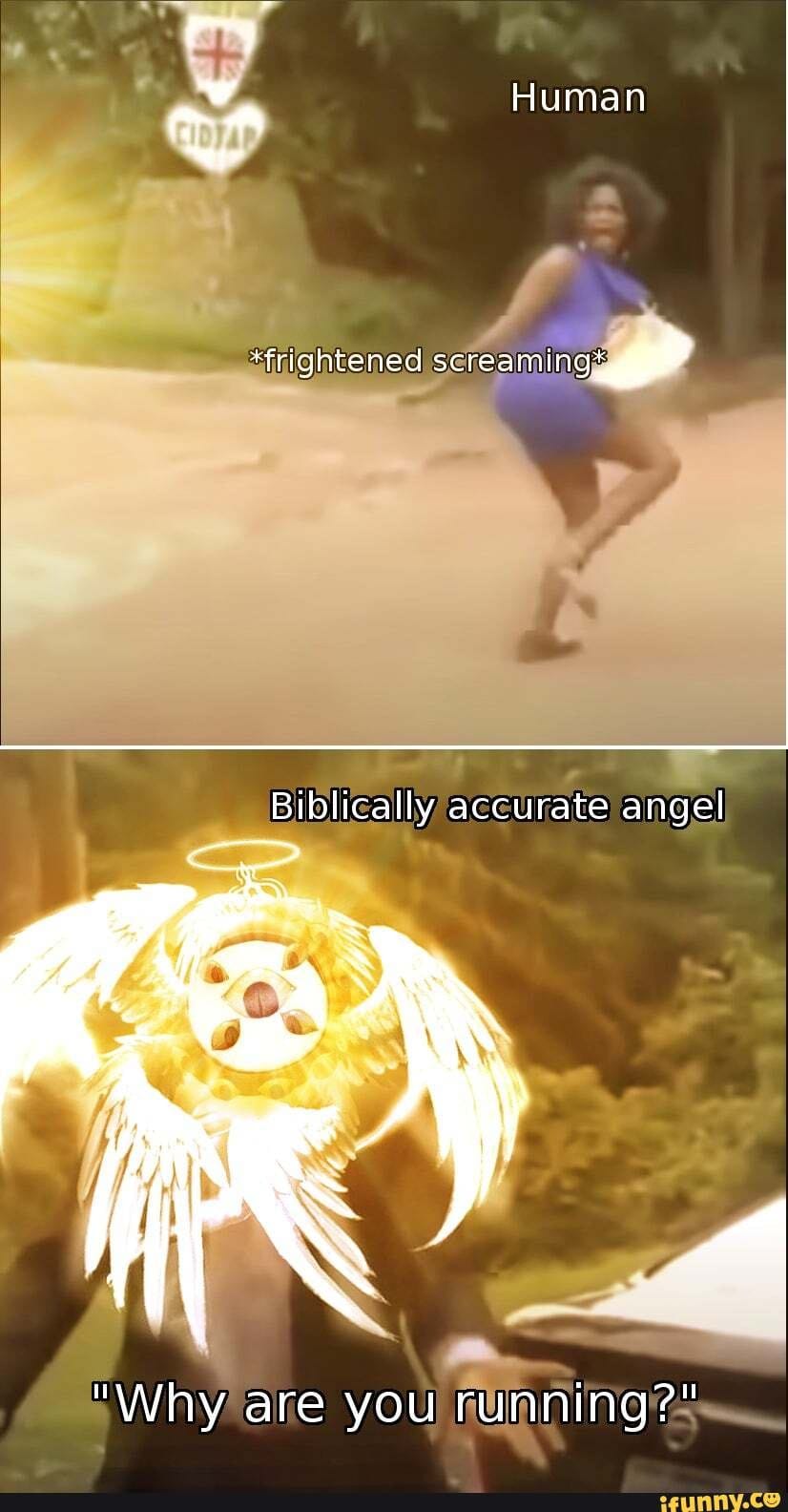
The meme is a humorous take on the concept of a "biblically accurate angel" being a ridiculous and humorous concept. The image shows a person running away from an angel, with the angel asking "Why are you running?" and the person responding with a sarcastic "I'm running from God's wrath, duh!" The meme is a lighthearted poke at the idea of a "biblically accurate angel" being a ridiculous and humorous concept, implying that the idea of an angel being a literal, physical being is absurd.
detailed-analysis (gemma3-27b-vision)
Okay, let's break down this image and apply some theoretical lenses. It's a meme, which already lends itself to deconstruction and multiple interpretations.
Visual Description
The image is composed of two panels, utilizing the common "drake meme" format.
- Top Panel: Depicts a blurry, low-resolution image of a human figure running in a forest, apparently distressed and emitting a "frightened scream" according to the text. The figure is angled dynamically, suggesting motion and panic.
- Bottom Panel: Features a close-up, heavily stylized image of an angel – a "biblically accurate angel" as the text claims. This angel deviates from typical Western depictions, exhibiting multiple eyes and a somewhat unsettling appearance.
- Text: The bottom panel features the question "Why are you running?" attributed to the angel. The meme implies a contrast: the human's fear versus the angel's incomprehension of that fear.
Foucauldian Genealogical Discourse Analysis
This meme can be analyzed through a Foucauldian lens by examining the discourses surrounding fear, angels, and biblical accuracy.
- Discourse of Fear: The meme relies on a pre-existing discourse surrounding fear and its association with the natural world (forest, unknown) and potentially the supernatural. The “scream” is an articulation within this discourse. Foucault would suggest this discourse isn’t natural; it’s historically constructed through narratives, power relations, and societal anxieties.
- The Angel Discourse: The "biblically accurate angel" subverts the dominant, romanticized discourse of angels in Western culture. By presenting an angel based on scripture (as claimed), it challenges the constructed nature of angelic imagery and how that imagery has been deployed to exert power. Traditionally, angelic imagery has often been used to reinforce hierarchies and authority.
- Genealogy: The genealogy of fear and angel imagery is quite complex. Examining the historical development of both reveals how power dynamics and cultural beliefs shaped our understanding of both concepts. This meme participates in that discourse by poking fun at conventional depictions.
Critical Theory
Critical Theory, particularly regarding ideology, is a relevant approach here.
- Deconstructing Ideology: The meme can be seen as a deconstruction of the conventional association between angels and safety/divine benevolence. The “biblically accurate” angel, if taken literally, doesn’t embody the reassuring qualities of traditional Western angel imagery. This challenges the ideological work that conventional angelic images perform – reinforcing religious beliefs and hierarchies.
- Power Dynamics: The angel’s question, “Why are you running?” highlights a power imbalance. The angel doesn't understand the human's fear, suggesting a disconnect between divine/higher power and human vulnerability. This reflects a critique of how religious authority has historically positioned itself above the concerns of ordinary people.
- Alienation: The human's isolated fear and the angel's incomprehension could be interpreted as a microcosm of human alienation – a key concept in Critical Theory. The human is isolated in their fear, and there's no empathetic connection with the higher power.
Marxist Conflict Theory
While perhaps less directly applicable, Marxist ideas can be present.
- Class Struggle (Metaphorical): The angel, as a representation of divine or otherworldly authority, could be seen as representing a ruling class. The human, running in fear, embodies the oppressed class. The angel's question, "Why are you running?" subtly reinforces this power dynamic – the authority doesn't understand or acknowledge the reasons for the oppressed's fear. This is a metaphorical application, as the image isn't explicitly about economic class.
- False Consciousness: The traditional, romanticized view of angels could be seen as contributing to a "false consciousness," obscuring the real power relations between humans and higher powers. The "biblically accurate" angel disrupts this false consciousness by presenting a less comforting, more potentially intimidating figure.
Postmodernism
Postmodernism is very central to this meme.
- Irony & Parody: The meme is fundamentally ironic and parodic. It subverts expectations about both angels and fear. The "biblically accurate" angel is a play on the way we traditionally represent religious figures.
- Deconstruction of Meaning: Postmodernism emphasizes the instability of meaning. The meme does not offer a single meaning. It's open to interpretation, relying on the viewer's existing knowledge and biases.
- Simulacra & Hyperreality: The meme is a simulacrum - a copy of a copy. It's a representation of a representation (an angel, fear). The meme itself becomes more real than the original concept it's referencing.
- Meta-Narratives: The meme challenges the dominant meta-narratives around religion and the supernatural by offering a counter-image.
Queer Feminist Intersectional Analysis
This requires a bit more imaginative application, but is possible.
- Challenging Normative Representations: The traditional depiction of angels (and the fear of the “other” the human is running from) often reinforces binary oppositions (good/evil, sacred/profane). The “biblically accurate” angel, with its multiple eyes and alien appearance, disrupts those binaries. This aligns with queer and feminist aims to destabilize rigid categories and challenge normative representations.
- Power Dynamics & Vulnerability: The human’s fear could be read as reflecting the vulnerability of marginalized groups in the face of dominant power structures. The angel’s lack of understanding highlights the disconnect between those in power and the experiences of those who are marginalized.
- Reclaiming the Sacred: The meme could be interpreted as a reclaiming of the sacred, disrupting traditional, often patriarchal, religious imagery and replacing it with something more unsettling and complex. This could resonate with feminist critiques of patriarchal religion.
Important Note: As with any theoretical analysis of a meme, these interpretations are subjective and open to debate. The strength of the meme lies in its ambiguity and ability to provoke multiple readings.
simple-description (llama3.2-vision)
The meme features two images. The top image shows a woman running in fear, with the caption "Human: frightened screaming". The bottom image shows a cartoon angel with a shocked expression, captioned "Angel: why are you running?". The meme is humorous because it exaggerates the human's fear and the angel's confusion, implying that the human's fear is irrational and the angel's question is a silly response to the situation.
tesseract-ocr
~~ 4 Human tae ae + « oe. |e = “frightened screaming £ i Si Biblically accurate angel a oo GD 45 = 4 \\y fi ~~ << f' dy’ _ | ih b \ — »Why are YOU GUNNING? Pat Aad