First Seen
2023-05-10T21:03:34+00:00
simple-description (llama3.2-vision_11b)
This meme is a humorous commentary on the idea that spiritual or mystical experiences can be just as absurd and ridiculous as literal interpretations of religious texts. The image depicts a person digging a hole and then, instead of finding a spiritual or mystical experience, they simply find a shovel and a bucket, implying that the "spiritual" experience is just a mundane and ordinary one. The text "Spiritual Path" is ironic, suggesting that the person's spiritual journey is actually just a mundane one.
detailed-analysis (gemma3-27b-vision)
Okay, let's break down this image ("Spiritual Path") using the requested theoretical lenses.
Visual Description
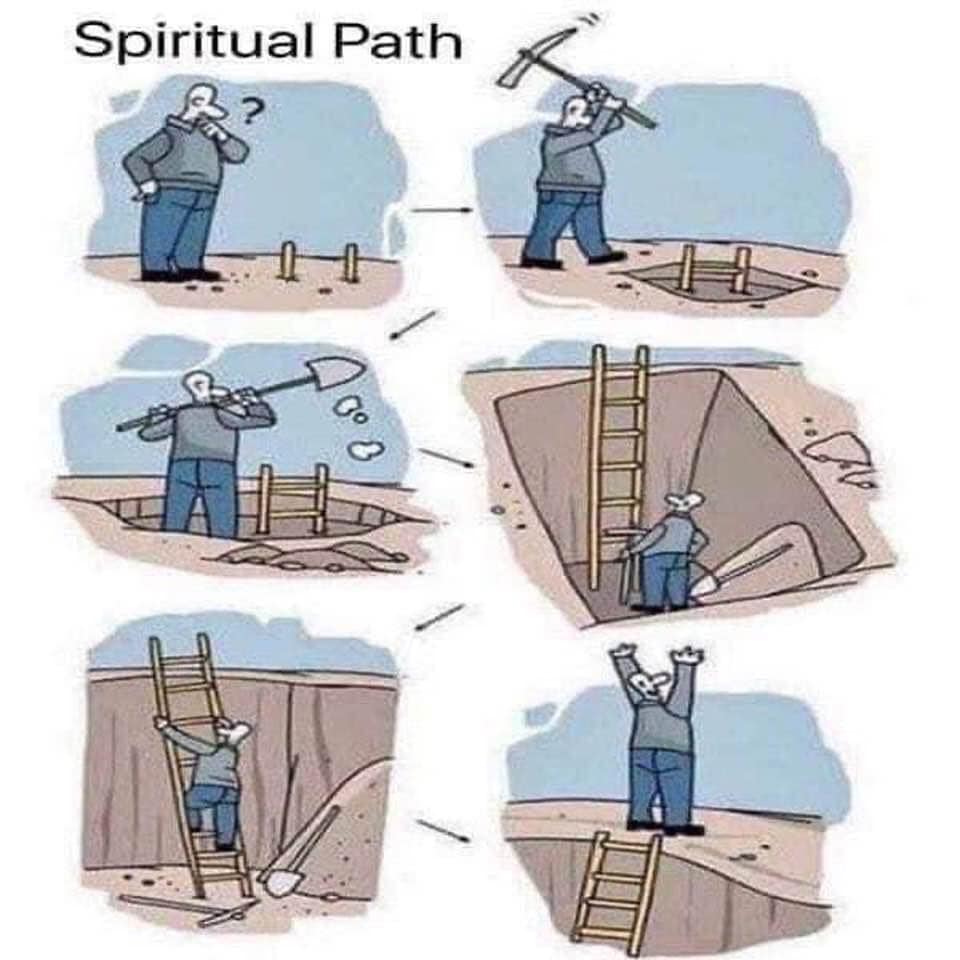
The image is a six-panel cartoon depicting a man engaging in a seemingly endless task of digging and re-digging.
- Panel 1: A man stands in a field, looking puzzled/confused, surrounded by small posts.
- Panel 2: The man begins digging with a pickaxe, around the posts, creating the initial outline of a hole.
- Panel 3: He switches to a shovel, deepening the hole and building up the dirt sides.
- Panel 4: He erects a ladder, going down into the hole.
- Panel 5: The man climbs up the ladder, arms raised in triumph.
- Panel 6: The ladder is now gone, and he stands next to a very deep hole, having achieved nothing.
The cartoon's style is simple, utilizing line work and flat colors, creating a feeling of monotony and futility. The background is a pale, muted color. The visual rhythm implies relentless effort followed by a cyclical return to the beginning.
Foucauldian Genealogical Discourse Analysis
This cartoon is ripe for a Foucauldian reading. The "spiritual path" isn’t a natural progression, but a discourse constructed through practices and power dynamics.
- Power/Knowledge: The man's digging isn't about finding something, but about performing spirituality. The act of digging becomes the demonstration of devotion or commitment. The ladder isn't a tool for ascension, but part of the ritualistic performance. The "spiritual path" is defined by the act of digging—it doesn't lead to something beyond.
- Genealogy: We can trace the history of this “spiritual path” as a set of practices that have been established and normalized over time. Where did this idea of needing to "work" at spirituality come from? What authorities or institutions benefit from this cycle of labor?
- Disciplinary Power: The digging itself is a form of self-discipline. The man internalizes the requirement to labor. He punishes himself with the effort, reinforcing the norms of the spiritual "path." The final panel demonstrates the futility of this self-inflicted discipline. The man achieved nothing, and the ladder (tool of discipline) is gone.
This reading rejects the idea of an inherent "meaning" to spirituality. The "path" is created and maintained through the power-knowledge relationship—the normalization of self-labor as a spiritual practice.
Critical Theory
From a critical theory perspective (influenced by the Frankfurt School, like Adorno or Horkheimer), this cartoon highlights the potential for instrumental rationality to pervade even seemingly non-rational domains like spirituality.
- Reason as Domination: The man's relentless digging can be seen as a manifestation of reason divorced from purpose. He's applying rational, goal-oriented effort (digging) to a goal that is ultimately meaningless. He is caught in a cycle of effort simply for the sake of effort.
- The Culture Industry: This “spiritual path” can be interpreted as a form of commodification. The man is performing labor (digging) not to achieve enlightenment, but to feel like he’s doing something “spiritual.” This keeps him engaged in a cycle of consumerism (of spiritual practices), preventing critical thought or true liberation.
- False Consciousness: The man's "triumph" in panel five is an illusion. He believes he has achieved something, but the final panel reveals he has merely perpetuated a futile cycle. This represents a state of false consciousness, where the individual is unaware of the true nature of their condition.
The cartoon suggests that even spirituality, when subjected to the logic of instrumental reason, can become a form of alienation and self-oppression.
Marxist Conflict Theory
From a Marxist perspective, the image can be viewed as an allegory for alienated labor under capitalism.
- Alienation: The man is alienated from the product of his labor (there is no product, only a hole). He is also alienated from the process of labor (the digging is inherently meaningless). And, crucially, he is alienated from his own species-being – his potential for meaningful activity and self-realization.
- False Needs: The "spiritual path" can be seen as a socially constructed "need" that serves the interests of those who benefit from the cycle of labor. This "path" keeps the man occupied and prevents him from challenging the systems that oppress him.
- Exploitation: The man is essentially exploiting himself, expending energy and effort for no tangible reward. This self-exploitation reinforces the broader logic of capitalist exploitation, where labor is extracted for the benefit of others.
The cartoon suggests that even in the realm of spirituality, the dynamics of class conflict and exploitation can be found.
Postmodernism
A postmodern reading would focus on the instability of meaning and the rejection of grand narratives.
- Deconstruction: The cartoon deconstructs the idea of a linear "spiritual path." There's no inherent destination, no ultimate meaning to the digging. The ladder, a symbol of progression, simply leads back to the beginning.
- Simulacra & Simulation: The “spiritual path” may be a simulacrum – a copy without an original. It’s a performance of spirituality without any underlying authenticity. The act of digging has become detached from any genuine purpose.
- Rejection of Metanarratives: The cartoon challenges the idea of a universal, overarching narrative of spiritual growth. It suggests that such narratives are merely social constructions.
- Fluidity & Fragmentation: The cyclical nature of the cartoon embodies postmodern notions of instability and fragmentation. The man's effort doesn’t accumulate into something meaningful; instead, it endlessly returns to the initial state.
The cartoon supports the postmodern critique of traditional structures of meaning and the emphasis on the arbitrary and contingent nature of reality.
Queer Feminist Intersectional Analysis
While not immediately explicit, this cartoon can be read through a queer feminist intersectional lens.
- Performativity (Judith Butler): The man's digging can be seen as a performance of masculinity and spirituality. He's enacting a culturally prescribed role—the diligent, hardworking seeker. The ladder climb and triumphant pose reinforce patriarchal notions of achievement and mastery.
- Repetitive Labor & Gender: The image can be connected to the historical and ongoing expectation that women (and marginalized genders) perform invisible and often meaningless labor. The endless digging can be seen as a metaphor for this unpaid and unacknowledged work.
- Power & Subjectivity: The cartoon suggests that our identities are not fixed but are constructed through power relations. The man’s identity as a “spiritual seeker” is created through the performance of this repetitive labor.
- Deconstruction of Norms: The image challenges the notion that there is a singular, “correct” way to pursue spirituality. It can be read as a critique of patriarchal norms that define spiritual progress through laborious self-discipline.
While subtle, the intersectional reading highlights the ways in which power dynamics (gender, sexuality, etc.) shape our understanding of spirituality and the performance of identity.
I hope this detailed analysis is helpful! Let me know if you'd like me to elaborate on any of these points or explore other theoretical frameworks.
simple-description (llama3.2-vision)
This meme is a humorous illustration of a person's spiritual journey, represented as a literal journey through a series of underground tunnels. The text "Spiritual Path" appears at the top of the image, and the accompanying text reads: "I'm not lost, I'm just on a spiritual path...". The image shows the person starting with a confident and self-assured attitude, but as they progress through the tunnels, they become increasingly disoriented and lost, finally ending up in a pit with a sign that says "Spiritual Path: End of Line".
tesseract-ocr
Spiritual Path 7 4 os “ “ os 7 _ SEY OEE, — cia as 2 Gea pa. ms += a. =p ae sec 4 - ae = : Wy | WES hf \ Th tif) Fey ~S eae =