First Seen
2023-05-10T21:03:34+00:00
simple-description (llama3.2-vision_11b)
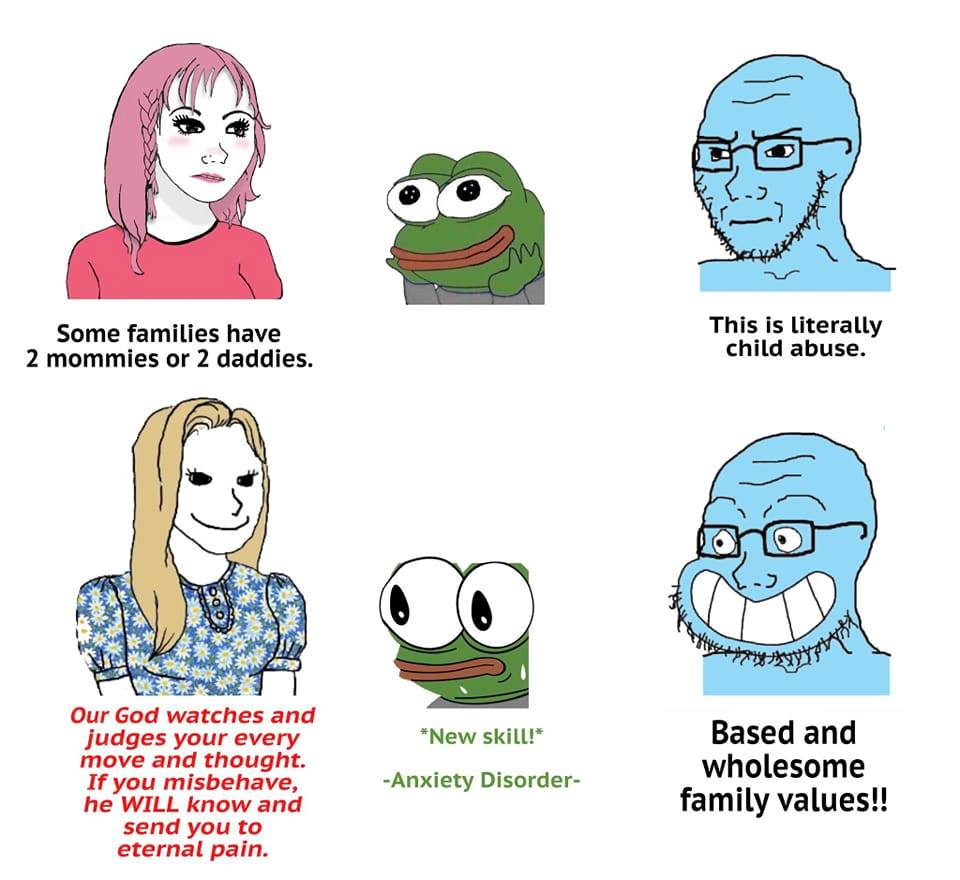
The meme is a satirical commentary on the absurdity of certain religious or spiritual beliefs. It presents a contrast between two extreme and unrealistic scenarios, implying that the person is either a devoutly religious individual or a completely unreligious person. The image juxtaposes the two scenarios with a caption, highlighting the absurdity of certain beliefs.
detailed-analysis (gemma3-27b-vision)
Here's an analysis of the image, broken down into the requested theoretical frameworks where applicable. This is a complex image, rich in internet subculture and loaded with ideological implications.
Visual Description
The image is a grid of six panels, each containing a crudely drawn, stylized cartoon face (memes) and a short text caption. The faces are all variations of online “reaction” images: a smiling woman, a Pepe the Frog variant, and a blue-faced, bespectacled man. The drawing style is intentionally amateurish, resembling quickly-made digital doodles. The captions vary in tone and content, from what appears to be LGBTQ+ family acceptance ("Some families have 2 mommies or 2 daddies") to statements involving religious judgment, and potentially abusive sentiments. The captions seem to be intentionally dissonant, creating a jarring effect. There's an overall sense of chaotic and ironic messaging. The use of deliberately low-quality, meme-style imagery contributes to a subversive and potentially antagonistic tone.
Foucauldian Genealogical Discourse Analysis
This image powerfully exemplifies Foucault's concept of discourse and power/knowledge.
- Discursive Formation: Each caption isn't a standalone statement but contributes to a complex discursive formation around family, religion, mental health, and potentially abuse. It's a fractured and contradictory discourse, revealing power dynamics at play.
- Power/Knowledge: The statements attempt to establish “truth” about these topics (what constitutes a family, the role of religion, the definition of abuse). The image suggests that these “truths” are not neutral but are constructed through discourse, and wield power. For example, the claim about abuse, even if hyperbolic, aims to wield power over how that concept is understood.
- Genealogy: We can trace the genealogy of these statements: LGBTQ+ family acceptance draws on evolving cultural acceptance and legal recognition, while the religious judgment and abuse claims tap into traditional, potentially oppressive, power structures. The meme imagery itself has a genealogy, originating in online subcultures and evolving over time.
- Archaeology: The arrangement of these statements reveals an "archaeological" layer. They aren't simply juxtaposed; they are in relation to each other, creating a specific meaning.
Critical Theory
This image lends itself readily to critical analysis, particularly focusing on the role of ideology and societal norms:
- Ideology: The image can be read as a critique (or reinforcement) of dominant ideologies surrounding family, religion, and mental health. The juxtaposition of acceptance with potentially abusive statements highlights the contradictions and power imbalances within those ideologies.
- Culture Industry: The use of memes is key. Memes are a product of the culture industry – readily disseminated, easily consumed, and often functioning as a form of ideological messaging. This image subverts, remixes, and potentially challenges the norms of typical meme content.
- Hegemony: The image could be interpreted as an attempt to disrupt the hegemonic (dominant) narratives around these themes. It presents alternative (or exaggerated) perspectives, questioning the status quo.
- Commodification of Suffering: The framing of mental health ("Anxiety Disorder") and potential abuse alongside ironic/meme framing could be considered a commodification of suffering, reducing complex issues to easily digestible (and potentially harmful) content.
Marxist Conflict Theory
While not immediately explicit, Marxist analysis can be applied by focusing on underlying power dynamics:
- Class and Ideology: The image's ironic and often antagonistic tone might reflect a disillusionment with mainstream ideologies – a rejection of "false consciousness" perpetuated by dominant class interests.
- Power Struggles: The clashing statements (acceptance vs. judgment, mental health vs. abuse) represent a struggle over meaning and control. These are power struggles played out through discourse.
- Alienation: The disjointedness and chaotic nature of the image could reflect a sense of alienation and fragmentation within contemporary society – a feeling of disconnection from established norms and values.
Postmodernism
This image is fundamentally postmodern:
- Deconstruction: The image deconstructs traditional notions of family, religion, and mental health. It presents these concepts as unstable, contradictory, and open to multiple interpretations.
- Irony and Parody: The ironic tone and use of meme culture are hallmarks of postmodern aesthetics. It’s a self-aware, playful, and often subversive approach to communication.
- Simulacra and Simulation: The image arguably functions as a simulacrum – a copy without an original. It's a representation of representations, detached from any underlying reality.
- Fragmentation and Instability: The disjointedness of the image reflects a postmodern embrace of fragmentation and instability, rejecting the notion of a coherent, unified worldview.
Queer Feminist Intersectional Analysis
This image lends itself to a queer feminist intersectional analysis, particularly due to the presence of the statement about "2 mommies or 2 daddies:"
- Challenging Normative Family Structures: The affirmation of same-sex families directly challenges the heteronormative and patriarchal assumptions that traditionally define family structures.
- Intersectionality: The image can be read as a comment on how different forms of oppression (homophobia, religious judgment, ableism related to mental health) intersect and reinforce each other.
- Disrupting the Binary: The statement about diverse families disrupts the traditional binary of mother/father.
- Power and Vulnerability: The framing of statements related to abuse suggests a power dynamic at play, and potentially vulnerability within marginalized communities.
In Conclusion:
This image is a complex and layered artifact of internet culture. It’s rife with ideological tensions and can be analyzed through a variety of theoretical lenses. Its intentional dissonance and ironic tone make it a compelling example of how meaning is constructed and contested in the digital age. It’s a provocative and potentially disturbing image, precisely because of its ambiguous and fragmented nature.
simple-description (llama3.2-vision)
The meme is a humorous comparison between two contrasting family values. The left side features a stereotypical "good" mother and father, with the text "Some families have 2 mommies or 2 daddies." The right side features Pepe the Frog, a meme character known for his sarcastic and often insensitive comments, with the text "This is literally child abuse."
tesseract-ocr
(SS a es «2 ps{(=y ‘Nee BE? ££ 2 : : ; Some families have This is literally 2 mommies or 2 daddies. child abuse. ( \\ | \\ | & yey? <1 feo . - CRA) Sees (/ A) WO ACP Ye reer ag) Vit a " i las | PS Our God watches and judges your every *New skilL!* Based and move and thought. If you Tiisbohave: -Anxiety Disorder- wholesome he WILL know and family values!! send you to eternal pain.