First Seen
2023-05-10T21:03:34+00:00
simple-description (llama3.2-vision_11b)
The meme is a commentary on the hypocrisy of people who claim to be Christian while also being emotionally abusive and neglecting their children. The image features a split-screen comparison of a Christian woman and a Pepe the Frog character, with the woman saying "I love you, sweetie" while the Pepe character responds with a sarcastic and dismissive comment. The text "I love you, sweetie" is juxtaposed with the Pepe character's response, highlighting the contrast between the woman's words and the Pepe character's sarcastic and dismissive tone.
detailed-analysis (gemma3-27b-vision)
Okay, here's an analysis of the image, broken down into sections as requested, focusing on relevant theoretical frameworks. I'll indicate where a section isn't applicable.
Visual Description
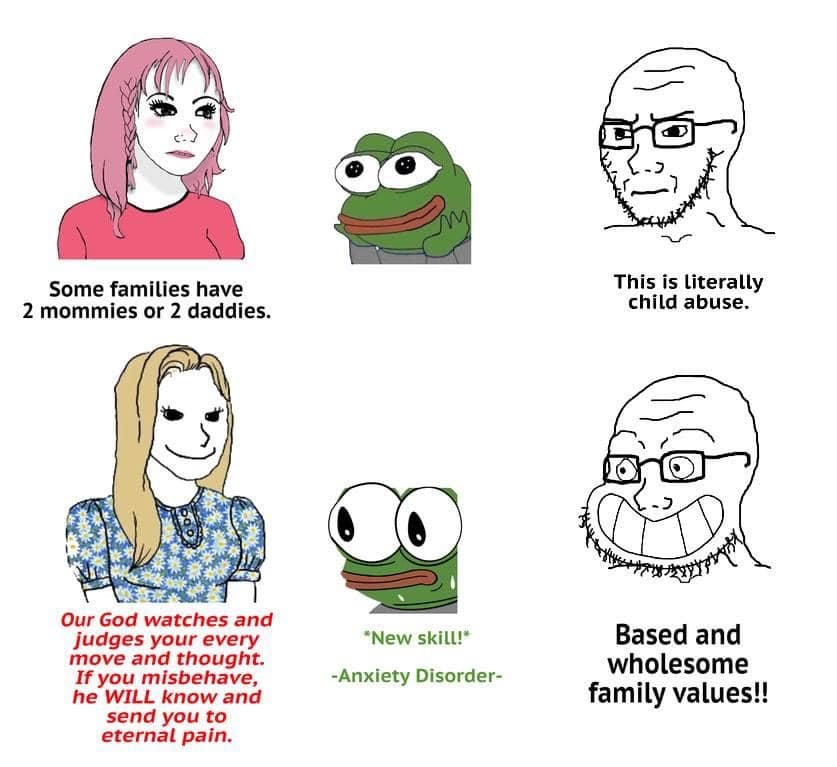
The image is a grid of six panels, each featuring a crudely drawn cartoon figure associated with internet meme culture, particularly "Pepe the Frog" and variations of the Wojak character. Each panel also has text overlaid, presenting short phrases or statements.
- Top Row: Features a woman with red hair, a Pepe the Frog, and a man with a beard and glasses. The text reads "Some families have 2 mommies or 2 daddies," "This is literally child abuse," and "Based and wholesome family values!!"
- Bottom Row: Another woman with blonde hair, another Pepe the Frog, and the bearded man. The text reads "Our God watches and judges your every move and thought. If you misbehave, he WILL send you to eternal pain.," "“New skill!!” -Anxiety Disorder-", and “Based and wholesome family values!!”
The aesthetic is deliberately low-resolution and intentionally "bad," which is common in internet meme culture. The juxtaposition of these images and text creates a jarring and provocative effect.
Foucauldian Genealogical Discourse Analysis
This image lends itself well to a Foucauldian analysis. It demonstrates how concepts like “family” and “abuse” aren’t natural or fixed, but constructed through discourse. The image stages a conflict between competing discourses around what constitutes a “normal” or “acceptable” family.
- Power/Knowledge: The statements on the image function as exercises of power/knowledge. The claims about “child abuse” and “eternal pain” are presented as authoritative truths. The statement asserting “based and wholesome family values!!” attempts to legitimize a specific vision of the family as the normative one.
- Genealogy: One could trace the genealogy of the discourses at play. The idea of "traditional" family values (represented by the image's language) is not timeless; it's a historically constructed set of beliefs shaped by religious, social, and political forces. Similarly, contemporary discourses around same-sex parenting and the definition of abuse have evolved through social movements and shifting cultural norms.
- Disciplinary Power: The threat of “eternal pain” represents a form of disciplinary power – an attempt to control behavior through surveillance and the threat of punishment. The “child abuse” claim also serves as a disciplinary mechanism, aiming to enforce a specific standard of acceptable behavior or family structure.
Critical Theory
This image speaks to central themes in Critical Theory, particularly regarding ideology and hegemony.
- Ideology: The image operates through the presentation of competing ideologies—a traditional/religious ideology emphasizing a heteronormative family structure and a discourse around abuse that seeks to control behavior, versus what could be interpreted as a contemporary acceptance of diverse family structures.
- Hegemony: The insistence on "wholesome family values!!" attempts to establish a hegemonic understanding of the family—one that is presented as natural and universally desirable, while suppressing alternative visions.
- Domination/Resistance: The image can be seen as a site of struggle between dominant and resisting forces. The juxtaposition of statements suggests a conflict between those who seek to uphold traditional norms and those who challenge them.
Marxist Conflict Theory
While not as directly applicable as other frameworks, a Marxist lens can be used to interpret the image.
- Power Relations: The image highlights power relations embedded in family structures. The discourse of “abuse” can be seen as a tool used by dominant groups to maintain control and suppress dissent.
- Ideology and False Consciousness: The insistence on “wholesome family values!!” might be interpreted as an ideology that obscures the material conditions of families and reinforces existing power structures.
Postmodernism
The image is profoundly postmodern in its aesthetic and its disregard for stable meaning.
- Fragmentation and Juxtaposition: The image is fragmented, presenting disparate elements (cartoons, slogans, contradictory statements) without a coherent narrative.
- Irony and Parody: The use of internet memes and the jarring juxtaposition of statements suggest a playful, ironic, and potentially parodic approach. The use of language like "based" is an example of an internet irony.
- Deconstruction of Meaning: The image resists a single, authoritative interpretation. The meaning of "family," "abuse," and "wholesomeness" is destabilized through the clash of competing discourses.
- Simulacra and Simulation: The image can be seen as a simulation of ideas around family, filtered through the lens of internet culture and divorced from any "real" referent.
Queer Feminist Intersectional Analysis
This image strongly invites a Queer Feminist Intersectional analysis.
- Heteronormativity and Homophobia: The statement "Some families have 2 mommies or 2 daddies" is directly confronted with accusations of “child abuse.” This represents a classic instance of heteronormative backlash against LGBTQ+ families.
- Intersection of Oppressions: The image can be interpreted as representing the intersection of multiple oppressions. The threat of “eternal pain” tied to religious beliefs can be seen as a form of patriarchal control.
- Deconstruction of the "Family": The image challenges the traditional, patriarchal understanding of the family as a fixed and natural institution. It opens up space for alternative family structures and challenges the notion of a "normal" family.
- Power dynamics: This image shows how religious ideals, traditionally dominant discourses, and the potential for online harassment (through accusations of abuse) can be wielded to marginalize and control queer and diverse families.
In conclusion: The image is a complex and provocative example of how seemingly simple ideas can be laden with ideological, political, and cultural significance. It's a fertile ground for theoretical analysis, revealing the ways in which power, knowledge, and discourse shape our understanding of the world.
simple-description (llama3.2-vision)
This meme is a humorous commentary on the differences between online personalities and their real-life counterparts. It juxtaposes the online persona of Pepe the Frog, a popular internet meme, with various stereotypes of online personalities. The text accompanying the meme reads: "Some people are like Pepe on the internet, but in real life they're like..."
tesseract-ocr
aN = | (= 5 (=) \( ft EG d, s : Cd ca f - ‘ ; ie Some families have THe. is literally 2 mommies or 2 daddies. child abuse. \\/> <j = | | eo \ (IO) | N\ ~ AE. Neh = ye Wan FG j KINI ce te ) C9, ‘vee ty eee 2 ;) \ x fat Eg Pel fy tea pes | ES Our God watches and judges your every “New skiLL!* Based and move and thought. Ifyou misbenave, “Anxiety Disorder wholesome he WILL know and family values!! send you to eternal pain.