First Seen
2023-10-22T02:58:51+00:00
simple-description (qwen3.5_2b-q8_0)
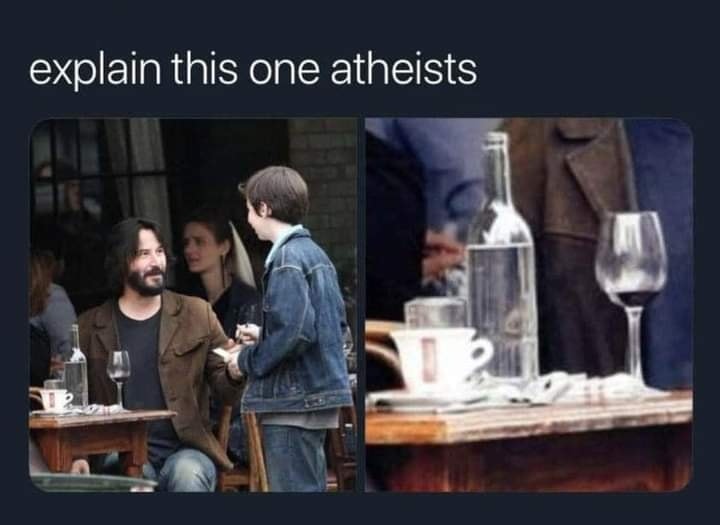
This meme plays on the concept of "spiritual hunger," referencing a scene from the movie The Revenant where a character is physically starving (indicated by the empty table and bottle of water). While religious believers might view a lack of food as a spiritual crisis or a state of being spiritually unsustained, atheists simply don't apply this framework. They often don't "explain" the scene in the same way, viewing the character's lack of food as just a biological necessity or a character trait, rather than a moral or spiritual failing.
simple-description (llama3.2-vision_11b)
This meme is from the category "Anti-Religion" and features a humorous image of a person explaining the concept of God to a child. The image shows a child asking "Is God like a magic rock?" and the adult responding with a confused expression. The text above the image reads "Explain this to an atheist" and the meme is likely poking fun at the idea that atheists are somehow incapable of understanding complex religious concepts.
detailed-analysis (gemma3-27b-vision)
Okay, let's break down this meme, applying the requested theoretical lenses. It’s important to note this is interpretive, and the application of these complex theories to a seemingly simple image will be speculative, but aiming for coherence with the core principles of each.
Visual Description
The meme juxtaposes two images. The first shows two men, seemingly in a casual setting, possibly a cafe or restaurant. One is Keanu Reeves, the other is Andrew Tate. They appear to be in a conversation, though the content isn't visible. The second image is a still life of a glass wine bottle, a glass, and a cup with a red liquid, set on a worn wooden surface. The juxtaposition suggests a comparison between the two men, with the still life acting as a symbolic framing.
Foucauldian Genealogical Discourse Analysis
Michel Foucault's work examines how power operates through discourse – systems of thought, language, and practice that construct reality. A Foucauldian analysis might look at how the meme constructs a particular "truth" about Reeves and Tate through the act of placing their images side-by-side.
- Discursive Formation: The meme's popularity and circulation demonstrate an existing discourse around “masculinity” and “ideal men.” The meme performs this discourse, signaling a specific valuation of Reeves versus Tate. The red liquid in the second image could be read as representing passion, anger, or “toxic masculinity,” hinting at the discourse surrounding Tate’s public persona.
- Genealogy of Power: Tracing the historical development of ideals of "masculinity" reveals how these ideals are not natural but socially constructed and change over time. The meme suggests that Reeves represents a preferable genealogy – a “good” masculinity—while Tate represents an archetype linked to problematic traditions of control, aggression, and patriarchal dominance.
- Surveillance & Normalization: The meme acts as a form of social “surveillance,” defining who fits the “acceptable” model of masculinity. By associating Reeves with the "good", the meme subtly normalizes a contrasting, non-toxic masculinity.
Critical Theory
Building on the Frankfurt School, Critical Theory examines how culture and ideology perpetuate systems of domination.
- Culture Industry: The meme itself is a product of the “culture industry” – the mass production of cultural commodities. It simplifies complex issues (like differing public personas) and feeds into consumer culture’s demand for easily digestible judgements.
- Ideology: The meme operates ideologically by presenting Reeves as the ‘good’ archetype and Tate as the negative one. This reinforces the existing social order’s valuation of certain behaviours and values (humility, kindness) over others (aggressiveness, dominance).
- Hegemony: The meme’s popularity suggests a hegemonic shift in values. A growing rejection of hyper-masculine, aggressive models (represented by Tate) in favour of more empathetic, humble figures (Reeves).
Marxist Conflict Theory
Conflict theory, rooted in Marxist thought, focuses on power struggles and class conflict.
- Symbolic Capital: Reeves and Tate both represent forms of “symbolic capital”—non-monetary forms of prestige and recognition. The meme pits these two forms of symbolic capital against each other. Reeves’ symbolic capital stems from his perceived kindness, humility, and philanthropy, while Tate’s comes from wealth, power, and a self-presented image of success.
- Class & Power: The meme subtly touches on class anxieties. Tate’s image is closely tied to wealth and material success, while Reeves is perceived as more grounded and relatable. This sets up a contrast between a "dominant" form of power (wealth) and a "subordinate" one (kindness and humility) - though this is a simplistic interpretation.
- Ideological Struggle: The meme represents a broader ideological struggle between different values and worldviews. It’s a form of symbolic conflict, where the “good” and “bad” archetypes are used to promote certain ideologies.
Postmodernism
Postmodernism challenges grand narratives and emphasizes subjectivity, fragmentation, and the blurring of boundaries.
- Simulacra and Simulation: The meme operates within a realm of "simulacra" – copies that have no original. The images of Reeves and Tate are mediated representations, constructed through social media and popular culture. The meme doesn’t engage with their ‘true’ selves, but with their images.
- Deconstruction of Meaning: The meme “deconstructs” the traditional notion of "hero" and "villain". It doesn't offer a clear moral judgement, but rather presents two archetypes for comparison. The ambiguity invites the viewer to create their own meaning.
- Fragmented Identity: The meme plays with the idea of fragmented identity. Reeves and Tate are presented as distinct and opposing figures, each embodying a different set of values and beliefs.
Queer Feminist Intersectional Analysis
This lens examines how power structures intersect and operate based on gender, sexuality, race, and other social categories.
- Toxic Masculinity: The meme implicitly critiques “toxic masculinity” – a harmful set of social norms associated with aggression, dominance, and emotional repression—commonly associated with figures like Andrew Tate. By contrasting Tate with Reeves, the meme promotes a different model of masculinity, one that values empathy and kindness.
- Patriarchal Power: Tate represents a particularly extreme version of patriarchal power. His rhetoric and actions reinforce traditional gender roles and power imbalances.
- Intersectionality: It’s important to note that the meme primarily focuses on gender. A more comprehensive analysis would consider the intersection of gender with other social categories, such as race, class, and sexuality.
Important Caveats:
- This is a highly interpretive analysis.
- The meme’s meaning is open to debate.
- These theoretical frameworks are complex and nuanced, and applying them to a simple image inevitably involves simplification.
Let me know if you'd like me to elaborate on any specific aspect of this analysis!
simple-description (llama3.2-vision)
The meme is a humorous comparison between the way a Christian (or "Christian" in this case) and an atheist (or "atheist" in this case) would explain a situation. The meme shows a Christian explaining to an atheist that God is like a wine glass that is empty, and the atheist responding with a photo of an empty wine glass. The text at the top of the meme reads "explain this one atheists".
tesseract-ocr
explain this one atheists in . \ bs t wl . behead