First Seen
2023-07-10T06:03:23+00:00
simple-description (qwen3.5_2b-q8_0)
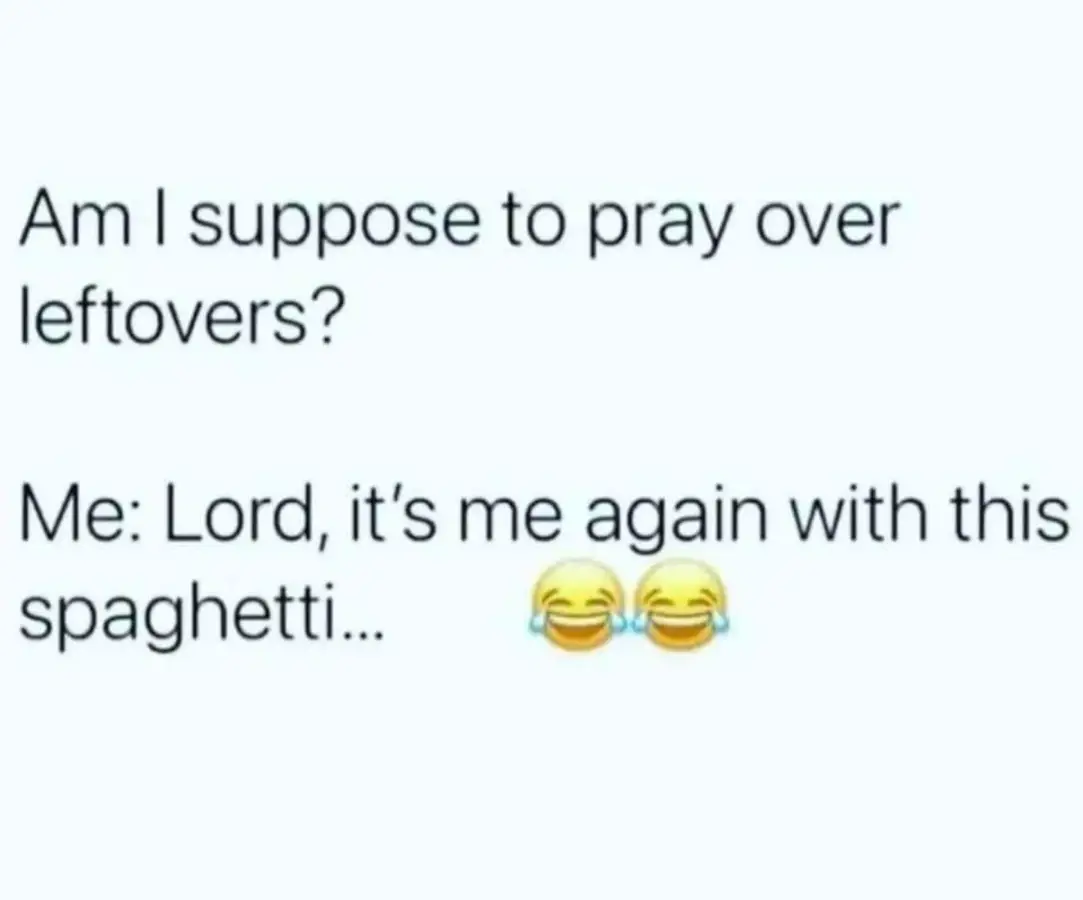
This meme plays on the absurdity of imposing religious rituals on mundane, everyday tasks. The text shows someone asking if they should pray over leftover food, only to be told they are "Me" again with this specific, messy meal. It highlights how religious figures are often rigid about specific details that have nothing to do with spirituality.
simple-description (llama3.2-vision_11b)
This meme is a humorous take on a common phrase, "The Lord is my shepherd," which is a biblical reference. However, in this version, the phrase is modified to "The Lord is my spaghetti" and the response is a playful jab at the idea of praying to a deity for food, implying that one's faith is not as strong as their hunger for pasta. The meme is a lighthearted way to poke fun at the idea of praying for material needs rather than spiritual ones.
detailed-analysis (gemma3-27b-vision)
Here's an analysis of the image, broken down into the requested theoretical sections. Note that some sections are more relevant than others to the content; some will be shorter or absent because the meme doesn't explicitly lend itself to those frameworks.
Visual Description
The image is a simple text-based meme. It presents a question in a casual, conversational format: "Am I suppose to pray over leftovers?" followed by a response, imitating a prayer format: "Lord, it's me again with this spaghetti..." The inclusion of two “crying-laughing” emojis suggests a humorous and relatable experience. The text is white against a light gray background, making it easily readable. The overall aesthetic is clean and minimalist.
Foucauldian Genealogical Discourse Analysis
This meme reveals a discourse around piety and everyday life. Michel Foucault would be interested in how the act of "praying over leftovers" became a recognizable, even humorous, concept. This isn't about whether the act should be done, but how a practice, historically rooted in religious gratitude for sustenance, has become normalized enough to be joked about.
The meme implies a power dynamic. Historically, religious authority prescribed practices like prayer. This meme, however, subtly subverts that authority. The joke relies on the implicit tension between the traditional "sacredness" of prayer and the mundane, almost comical, act of praying over something as ordinary as leftover spaghetti. This disruption of established norms – questioning whether one should pray over leftovers – reveals the constructed nature of these "rules" and their power to shape behavior. The humor stems from the incongruity—highlighting how even everyday actions can be (potentially absurdly) steeped in religious expectation.
Critical Theory
From a Critical Theory perspective (drawing on thinkers like the Frankfurt School), this meme highlights the colonization of everyday life by ideology. Religion, as a social institution, operates as an ideology, shaping our perceptions and values. The joke suggests that even something as personal as preparing a meal and consuming leftovers becomes subject to ideological expectations.
The humor also subtly critiques the normalization of guilt or obligation. The speaker feels a need to justify or address God about something (leftover spaghetti) that is logically trivial. This highlights how ideology can create unnecessary anxieties or impose frameworks onto otherwise neutral experiences. It questions the necessity of seeking divine approval for something entirely mundane, revealing a potentially oppressive aspect of religious conditioning.
Marxist Conflict Theory
The application of Marxist conflict theory is somewhat weaker here, but we can explore it. The meme could be viewed as a subtle commentary on surplus and waste. Leftovers represent surplus – extra food that wasn't immediately consumed. Within a capitalist system, efficiency and consumption are prized. The joke’s humor is related to the almost ‘absurd’ notion of needing to ‘justify’ the existence of leftovers to a divine power. The “Lord, it’s me again” aspect hints at a continual cycle of consumption and (potential) guilt associated with any "waste." However, this interpretation requires significant stretching, and the primary focus remains on the religious aspect.
Postmodernism
This meme strongly embodies postmodern sensibilities. It demonstrates a playful blurring of the sacred and the profane. The traditionally "high culture" act of prayer is juxtaposed with the "low culture" and quotidian act of eating leftovers. This deliberate mixing of levels is a hallmark of postmodernism.
The meme also deconstructs the notion of a grand narrative. It challenges the traditional religious framework by questioning the necessity of applying ritual to the mundane. There is no attempt to reinforce a sacred truth; rather, the humor arises from undermining the seriousness of religious practice. The self-deprecating tone ( "Lord, it's me again") further reinforces this disruption of traditional authority. The emoji use indicates a lighthearted rejection of serious, authoritative discourse.
Queer Feminist Intersectional Analysis
Applying a queer feminist intersectional lens is a weaker fit. However, we could consider how domestic labor (preparing food, dealing with leftovers) historically falls disproportionately on women. The speaker (“me”) is genderless in the meme, but the implicit association of managing leftovers with domestic work could be seen as reinforcing that gendered expectation. The act of seeking divine approval for something so commonplace could be viewed as a subtle way of internalizing societal expectations around a woman’s role within the home. This is a stretch, but it highlights how even seemingly harmless humor can reinforce existing power dynamics.
In conclusion, the meme's strength lies in its postmodern deconstruction of religious practice and its commentary on the intersection of piety and everyday life. It is a subtle, relatable critique of how ideology and expectation can permeate even the most mundane aspects of our existence.
simple-description (llama3.2-vision)
This meme is a humorous exchange between a person and God, where the person asks if they can pray over leftovers, and God responds with a playful jab about eating the leftovers with the person's favorite food, spaghetti. The text "Am I supposed to pray over leftovers?" is followed by God's response "Lord, it's me again with this spaghetti..." The meme uses a playful tone to poke fun at the idea of praying over food, and the use of the phrase "it's me again" is a clever reference to the classic "it's me again" phrase used in phone calls.
tesseract-ocr
Am | suppose to pray over leftovers? Me: Lord, it's me again with this spaghetti... <axee