First Seen
2023-05-10T21:03:34+00:00
simple-description (llama3.2-vision_11b)
The meme is a play on the "Tankies" (a derogatory term for fans of the Soviet Union) and their tendency to defend the Soviet Union's actions during the Soviet Union's invasion of Poland in 1939. The image depicts a person trying to drive a car, but the car's brakes are stuck, and the person is unable to stop the car. The text "When Tankies try to drive" is above the image, and the text "Call the ambulance!" is below the image.
detailed-analysis (gemma3-27b-vision)
Okay, let's break down this meme using the requested theoretical lenses. It's important to note that applying these frameworks to a meme is often a bit of a playful exercise in over-interpretation, but can be illuminating nonetheless.
Visual Description
The meme utilizes a two-panel format derived from a dramatic video scene.
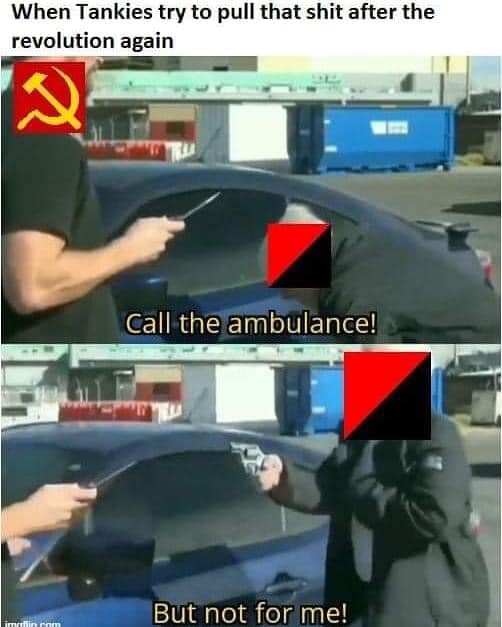
- Panel 1: A person in a black shirt is depicted leaning into a vehicle, seemingly pointing a knife or sharp object towards the driver. Above the vehicle is a red flag displaying the hammer and sickle, a symbol of communism/socialism. Text reads "Call the ambulance!"
- Panel 2: The same scene, but now the person leaning into the car is also brandishing a handgun, in addition to the knife. Above the vehicle now is an Anarchist flag, a black flag with a red 'A'. Text reads "But not for me!"
The implication is that those who attempt further revolutionary action after a failed initial attempt are violent, but the meme’s author exempts themselves from any association with this violence. The meme is likely aimed as a jab at those considered “leftist” or “radical”.
Foucauldian Genealogical Discourse Analysis
This meme constructs a discourse about revolutionary action and its practitioners.
- Power/Knowledge: The meme utilizes a specific “knowledge” about leftist ideologies. It associates both communist/socialist and anarchist ideologies with violence. This association isn't presented as a neutral observation, but as a way to exercise power by framing these ideologies as inherently dangerous. The meme actively constructs a narrative that reinforces the idea that revolutionary action is violent, positioning the author as separate from this perceived violence.
- Genealogy: One could trace the genealogy of this meme to historical anxieties about revolutionary movements. The imagery relies on a long history of portraying revolutionary figures as violent and disruptive. The meme leverages this historical baggage to quickly establish a certain reading of “leftist” action.
- Disciplinary Power: The meme subtly asserts a “normal” or “reasonable” stance by implying that calling the ambulance is a reasonable response to violence, but reserving that reaction for ‘others’. This assertion subtly reinforces a disciplinary regime which frames violence as an ‘other’ to be controlled and policed.
Critical Theory
The meme is a clear example of how ideology functions to maintain power structures.
- Ideology: The meme operates on the assumption that revolutionary action is inherently violent, which serves to discredit and delegitimize those who advocate for systemic change. This is a way of naturalizing the status quo by presenting any challenge to it as dangerous and irrational.
- Hegemony: The meme subtly reinforces dominant societal narratives about the dangers of radicalism and reinforces a hegemonic understanding of acceptable political behavior. The author presents themselves as being above the violence, which reinforces a belief that they are within the acceptable parameters of social and political norms.
- Domination: The meme implicitly positions the author as someone ‘above’ the violence, which subtly reinforces hierarchical social structures where some are seen as rational and responsible, while others are seen as dangerous and chaotic.
Marxist Conflict Theory
From a Marxist perspective, this meme is a manifestation of class conflict and ideological struggle.
- Class Consciousness: The meme can be seen as a way to delegitimize any potential challenge to the existing capitalist order by associating revolutionary action with violence. This aims to stifle class consciousness and prevent the formation of a unified opposition.
- Ideological Apparatus: The meme functions as an ideological apparatus, reinforcing the dominance of bourgeois ideology by presenting revolutionary action as chaotic and dangerous. It's a form of propaganda aimed at discouraging people from questioning the existing power structures.
- False Consciousness: The meme might be interpreted as contributing to false consciousness, leading individuals to accept the status quo and prevent them from recognizing the systemic issues that contribute to inequality and oppression.
Postmodernism
A postmodern reading of the meme focuses on its self-referentiality and the instability of meaning.
- Simulacra & Simulation: The meme is a simulacrum – a copy without an original. It's a representation of a representation, divorced from any ‘real’ revolutionary event. It focuses on the sign of revolution, rather than any underlying political ideology.
- Deconstruction: One could deconstruct the meme to reveal the underlying power dynamics and contradictions within its seemingly simple message. What does it actually mean to be "not for me?" What makes the author believe they are exempt from the violence?
- Meta-Narratives: The meme challenges any overarching "meta-narrative" about revolution by reducing it to a humorous and ironic exchange. It suggests that all attempts at systemic change are ultimately futile or dangerous.
Queer Feminist Intersectional Analysis
This is potentially the most tenuous application, but interesting nonetheless.
- Power Dynamics: Even within "leftist" spaces, power dynamics and hierarchies exist. This meme could be read as a critique of performative radicalism, or the way some individuals within these spaces engage in aggressive posturing.
- Intersectionality: The meme ignores the way different forms of oppression intersect. Violence is often rooted in broader systems of power—race, gender, class, sexuality, etc. The meme fails to acknowledge how these systems of oppression shape revolutionary movements.
- Critique of the "Hero" Narrative: The meme reinforces a "hero" narrative, where the author positions themselves as being outside the cycle of violence, which can be a form of silencing or marginalizing the voices of those who are actually affected by these systems.
Let me know if you'd like me to elaborate on any of these analyses or explore a different theoretical angle!
simple-description (llama3.2-vision)
This meme is a humorous commentary on the struggles of the Soviet Union's military during World War II. The image shows a person trying to escape from a tank, but the tank's commander is shouting "Incom" and the tank is saying "Incom" in response. The text at the top reads "When Tankies try to pull that shit after the revolution again" and the text at the bottom says "Call the ambulance!"
tesseract-ocr
When Tankies try to pull that shit after the revolution again = ! Seas prt i = oad Pence, a _— —__ = x , Ps ~~ = “ ape Tnn Tare! = a | Mm yw “ : “| z. F _— But not for me!