First Seen
2023-07-11T22:43:28+00:00
simple-description (qwen3.5_2b-q8_0)
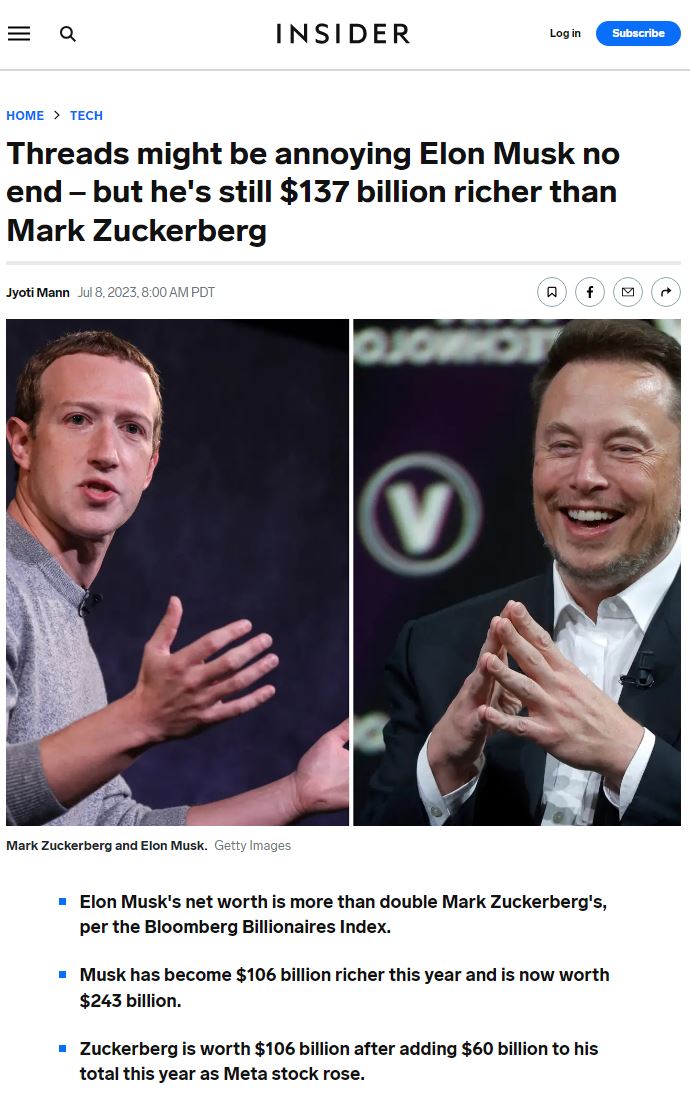
This meme is a cynical Anti-Tech commentary suggesting that the tech industry has descended into a toxic hierarchy where Crypto Kings like Elon Musk overshadow established giants like Mark Zuckerberg. It frames Threads as a tool for control over users, only to immediately undercut it by declaring Musk’s net worth exceeds Zuckerberg's despite Zuckerberg being a "tech magnate" while Musk is a "Crypto King." The caption highlights that Musk has become $106 billion richer this year, cementing the narrative that Crypto is the new gold standard and that Tech giants are essentially selling data to generate a pension.
simple-description (llama3.2-vision_11b)
The meme is an image of a Twitter post from Elon Musk, where he claims that he is now worth more than the combined net worth of the world's richest people. The image shows a tweet from Elon Musk's Twitter account, with the text: "Just a reminder that I'm now worth more than the combined net worth of the world's richest people. #NotImpressed".
detailed-analysis (gemma3-27b-vision)
Okay, let's break down this article snippet through a series of theoretical lenses. Given the specific content, some lenses will be more applicable than others.
1. Visual Description
The image is a diptych (two panels). On the left, we see a close-up portrait of Mark Zuckerberg, appearing in a relatively casual setting. His expression is neutral, but somewhat serious. He is dressed in what appears to be a grey t-shirt. The lighting is soft.
On the right, Elon Musk is shown speaking, seemingly at a conference or event. He's in a more formal suit. There is a bright, circular "V" logo in the background, suggesting the context of the event (potentially a conference related to "V"). He appears animated and is mid-speech. The visual contrast immediately highlights the difference in demeanor and presentation. The diptych reinforces the article's point about the stark disparity in wealth and perceived success. The composition implicitly sets up a comparison between the two figures.
2. Foucauldian Genealogical Discourse Analysis
This article snippet offers an interesting starting point for a Foucauldian analysis.
- Discourse of Wealth & Success: The article participates in a discourse surrounding wealth and success as measured by net worth. It normalizes the practice of quantifying human value in monetary terms. It treats "billionaires" as an identifiable category worthy of reporting.
- Power/Knowledge: The "Bloomberg Billionaires Index" represents a specific form of power/knowledge. It claims objective authority in assigning value, but this is a constructed value based on market metrics. The index doesn’t merely describe wealth; it produces it as a meaningful category. The media's reporting on this index reinforces that constructed authority.
- Genealogy of the "Billionaire": Examining the historical conditions that gave rise to the category of the "billionaire" would reveal shifts in economic systems, global capitalism, and the rise of specific industries (like tech) that concentrate wealth. The idea of a "billionaire" is not natural or inevitable; it's a product of specific historical forces.
- Surveillance & Control: The tracking of net worth can be seen as a form of surveillance, subtly creating a hierarchy and normalizing the idea of constant economic evaluation.
3. Marxist Conflict Theory
The article immediately fits within a Marxist framework.
- Class Conflict: The headline and data highlight the extreme disparity of wealth between two individuals representing the capitalist class. This is a clear manifestation of class inequality. The substantial wealth accumulation of both Musk and Zuckerberg is built upon the exploitation of labor.
- Means of Production: Both Musk and Zuckerberg control significant means of production (tech companies). Their wealth stems from owning and controlling capital.
- Capital Accumulation: The article demonstrates ongoing capital accumulation at the very top, even while many others face economic hardship. The increase in Meta's stock price, benefiting Zuckerberg, can be linked to labor practices, data extraction, and other potentially exploitative business models.
- False Consciousness: Media attention focused on the net worth of these individuals can distract from the systemic issues that create and perpetuate inequality. It might promote the idea that wealth is earned through merit rather than through systemic advantages.
4. Postmodernism
Postmodern analysis could focus on the constructed nature of reality and the instability of meaning within this context.
- Simulation and Hyperreality: The obsession with net worth is itself a simulation, a symbolic representation of wealth that increasingly overshadows the actual value or usefulness of the underlying resources. It's a hyperreal phenomenon, where the representation becomes more important than the real.
- Deconstruction of "Success": Postmodern thought challenges the notion of objective "success." The article implicitly accepts the standard definition of wealth as a measure of success. A postmodern analysis would ask: What are the hidden costs of this kind of wealth? What alternative measures of success exist?
- The Spectacle: The constant media coverage of billionaire wealth can be seen as part of a "spectacle" (drawing from Debord) that distracts from real social issues and reinforces consumerism.
5. Critical Theory
Critical Theory, building on Marxist ideas and adding complexity, would analyze the broader social, political, and cultural implications.
- Ideology: The article subtly reinforces the ideology of meritocracy, suggesting that wealth is earned through talent and hard work. Critical theory would examine how this ideology masks the structural inequalities that enable wealth accumulation.
- Hegemony: The dominance of capitalist ideologies and the normalization of extreme wealth are examples of cultural hegemony.
- Commodification of Everything: The very act of assigning a monetary value to a person's net worth is a form of commodification. This contributes to a broader trend of turning everything into something that can be bought and sold.
6. Queer Feminist Intersectional Analysis
While not immediately present in the article's surface content, this lens can add nuance.
- Intersectional Inequality: The wealth of Musk and Zuckerberg is built on a system that already perpetuates inequalities based on gender, race, and other factors. While the article doesn't explicitly address these intersections, it's important to recognize that the benefits of wealth accumulation are not evenly distributed.
- The Patriarchy of Capital: Capitalist systems have historically been structured in ways that favor men and reinforce patriarchal power structures.
- Disrupting Narratives of Success: A queer feminist analysis might challenge the conventional narratives of success promoted by the media and propose alternative models that prioritize care, community, and social justice.
I hope this multi-faceted analysis is helpful! Let me know if you'd like me to expand on any of these theoretical lenses.
simple-description (llama3.2-vision)
The meme is an image of a tweet from Elon Musk, where he jokingly claims to be richer than Mark Zuckerberg, but actually has a much smaller amount of money. The tweet says "I'm richer than @Zuck" and has a screenshot of Musk's net worth of $200 billion, which is a fraction of the actual number of people who follow him. The tweet is meant to be humorous and ironic, poking fun at Musk's ego and wealth.
tesseract-ocr
= a INSIDER on CED HOME > TECH Threads might be annoying Elon Musk no end - but he's still $137 billion richer than Mark Zuckerberg Jyoti Mann Jui8,2023,8:00 AM PDT a) (4) (&) (+ rae Te SS , A Kone ’ , as ZA; , is { a 1 > P. 7) ie | ay Mark Zuckerberg and Elon Musk. Getty Image: = Elon Musk's net worth is more than double Mark Zuckerberg's, per the Bloomberg Billionaires Index. = Musk has become $106 billion richer this year and is now worth $243 billion. = Zuckerberg is worth $106 billion after adding $60 billion to his total this year as Meta stock rose.