First Seen
2023-05-10T21:03:34+00:00
simple-description (llama3.2-vision_11b)
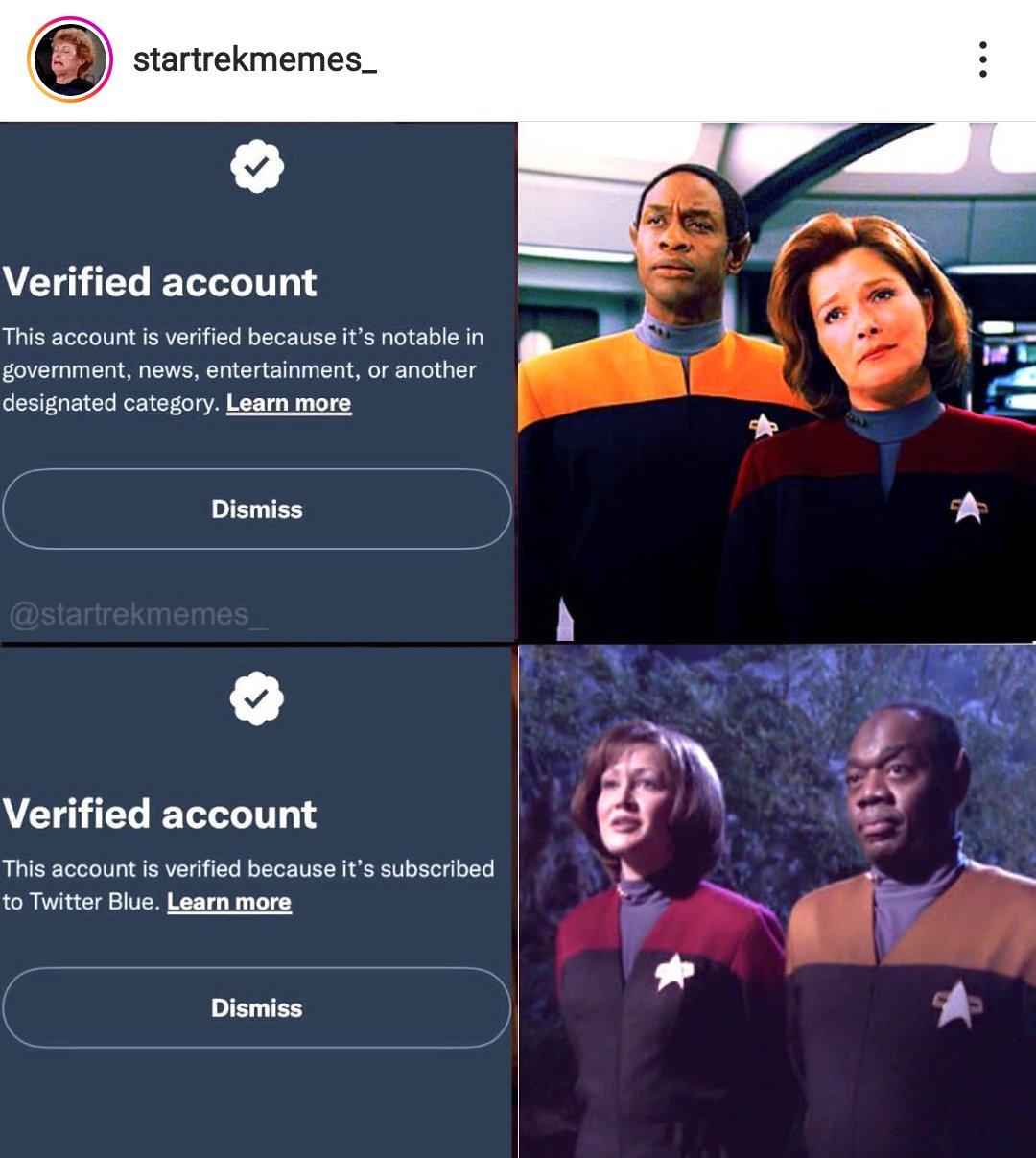
The meme is a screenshot of Twitter's "Verified" account notification, but the text is altered to say "Verified because it's a good boy". This is a humorous take on the idea that some Twitter accounts are verified because of their "good boy" status, implying that they are somehow special or deserving of verification.
detailed-analysis (gemma3-27b-vision)
Okay, let's break down this image, focusing on the requested theoretical lenses. The image consists of two screenshots from the Twitter/X account "@startrekmemes". Both screenshots depict similar content: a photo of Geordi La Forge and Deanna Troi (from Star Trek: The Next Generation) looking intently, with superimposed "Verified" badges and explanatory text about the verification process.
1. Visual Description
The image showcases two screenshots of the Twitter/X account "@startrekmemes". Each screenshot highlights a photo of Geordi La Forge (LeVar Burton) and Deanna Troi (Marina Sirtis) in what appears to be a bridge scene from Star Trek: The Next Generation. Both actors are looking to the side, their expressions serious and focused. Superimposed on the image is a blue “Verified” badge. The screenshots also contain text explaining that the account is verified either because it’s notable in a specific category or because it’s subscribed to Twitter Blue (now X Premium). The screenshots suggest a shift in what constitutes verification, initially based on notability/authority, and now potentially based on economic subscription.
2. Foucauldian Genealogical Discourse Analysis
This image is rife with possibilities for a Foucauldian analysis. The "Verified" badge itself is a key point. Foucault's work emphasizes how knowledge and power are intertwined, and how concepts like “verification” aren’t neutral truths, but constructions produced within a specific historical context.
- Discourse of Authority: The original "Verified" badge was meant to signify authority, trustworthiness, and a certain level of importance within the Twitter/X ecosystem. It was a way to distinguish legitimate sources from potential impersonators or bots. The genealogy of this badge traces back to older forms of credentialing and authentication.
- Shifting Power Dynamics: The transition to verifying based on a subscription service (Twitter/X Blue) represents a significant shift in the discourse. Power is no longer solely based on established notability, but also on economic capital. This raises questions about who gets to be seen as authoritative, and how the platform is re-defining legitimacy.
- Discipline and Control: The verification system functions as a mechanism of discipline and control. Users are encouraged to seek verification, creating a hierarchy of status and influence. This can create a system where those who can afford the subscription have a higher level of perceived credibility, regardless of their actual expertise or contribution to the platform.
- Construction of Truth: The badge claims to signify authenticity, but in the new model, authenticity becomes linked to economic participation. This blurs the line between genuine authority and purchased status. The platform is actively constructing a version of “truth” and “legitimacy” that benefits its financial interests.
3. Marxist Conflict Theory
From a Marxist perspective, this image highlights the commodification of authority and trust.
- Class Divide: The shift to verification via subscription creates a class-based distinction within the platform. Those who can afford the subscription gain a form of "digital status," essentially buying access to a perceived higher level of credibility. This reinforces existing inequalities.
- Commodification of Social Capital: The "Verified" badge traditionally represented social capital—a user's reputation and influence. By tying it to a monetary transaction (Twitter/X Blue), the platform is commodifying social capital. It’s turning a previously earned form of trust into a product that can be bought and sold.
- Exploitation of User Desire: The platform is exploiting the desire for credibility and influence. Users who want to be seen as authoritative are encouraged to purchase the subscription, contributing to the platform's profits.
- Hegemony: The platform is exerting its hegemony—its dominance over the discourse—by defining what constitutes verification and authority. It’s setting the rules of engagement and benefiting from the resulting power imbalance.
4. Postmodernism
Postmodernism, with its questioning of grand narratives and emphasis on subjectivity, can be applied here:
- Deconstruction of Authority: The shift in verification challenges the traditional notion of authority. The badge is no longer a marker of objective truth or expertise, but a symbolic gesture determined by a commercial entity. It's a simulacrum—a copy without an original.
- Blurring of Reality and Representation: The image highlights the increasingly blurred lines between reality and representation in the digital age. The "Verified" badge becomes a performance of authenticity, rather than a genuine reflection of it.
- Rejection of Metanarratives: The image deconstructs the metanarrative of "trustworthiness" on social media. The platform is admitting that verification is no longer based on objective criteria, but on economic participation.
- Fragmentation of Meaning: The changing meaning of the “Verified” badge contributes to a fragmentation of meaning in the digital sphere. What once signified authenticity now carries a complex and potentially cynical connotation.
5. Queer Feminist Intersectional Analysis
While the image doesn't immediately appear to be centered on queer/feminist issues, an intersectional approach can reveal underlying dynamics:
- Access and Exclusion: The requirement for financial resources to achieve verification can create barriers for marginalized communities who may have less disposable income. This can further marginalize their voices and limit their ability to participate in online discourse.
- Commodification of Identity: Verification, as a marker of status, can intersect with existing power dynamics related to race, gender, and sexuality. Individuals from marginalized groups may feel pressured to conform to certain norms or expectations in order to gain credibility.
- Algorithms and Bias: The algorithms that determine who receives verification can perpetuate existing biases and inequalities. If these algorithms are not carefully designed, they may favor certain groups over others.
- Digital Divide: The intersection of economic inequality and digital access further exacerbates the problem. Marginalized communities may have limited access to technology and the internet, making it more difficult for them to participate in online discourse and gain verification.
In conclusion, the image of the @startrekmemes account with the shifting "Verified" badge offers a rich tapestry of theoretical interpretations. It’s a small image that encapsulates larger issues of power, authority, commodification, and social inequality in the digital age.
simple-description (llama3.2-vision)
This meme is a humorous comparison between the characters from the TV show "Star Trek: The Next Generation" and their modern-day Twitter equivalents. The image shows a tweet from Captain Jean-Luc Picard (played by Patrick Stewart) and his crewmates, with a caption saying "When you're trying to get people to follow you on Twitter".
tesseract-ocr
startrekmemes_ : - -_ 4 & 26 Verified account — | 5 This account is verified because it’s notable in 4 we government, news, entertainment, or another ‘ fi designated category. Learn more a - —_ me na ( eye ey } : Ms i Ris %: aI, -, “ft 7 ae 4 ) Sd Verified account ' i . This account is verified because it’s subscribed . . Fi to Twitter Blue. Learn more i Zs ra ( Dismiss ) r —————