First Seen
2023-05-10T21:03:34+00:00
simple-description (llama3.2-vision_11b)
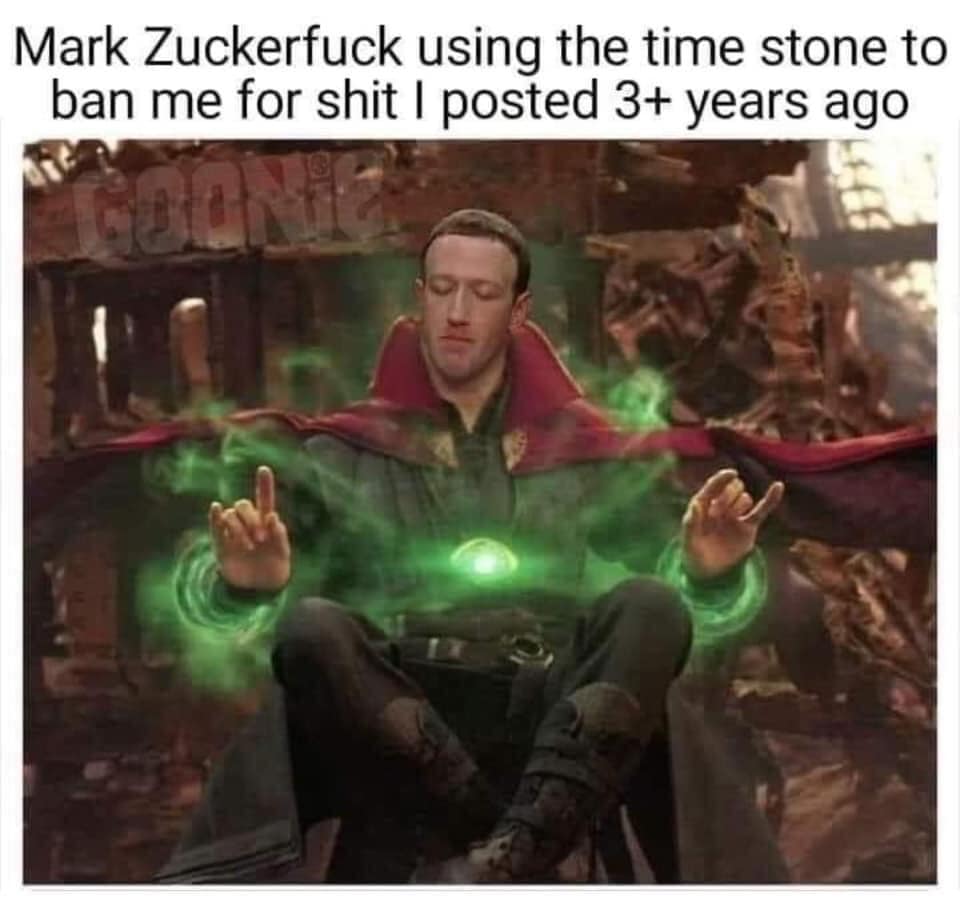
This meme is from the Anti-Tech category, which pokes fun at the negative consequences of technology. The meme features a screenshot of Mark Zuckerberg, the CEO of Facebook, from the 2019 film "Joker" where he is playing a fictionalized version of himself. The meme is captioned "Mark Zuckerberg using the time stone to ban me for saying something I posted 3+ years ago" and is likely referencing the controversy surrounding Facebook's moderation policies and the lack of transparency in its decision-making process.
detailed-analysis (gemma3-27b-vision)
Okay, let's break down this meme using the lenses you’ve requested. It's a richly layered image and caption, lending itself to multiple analytical approaches.
Visual Description
The image depicts Mark Zuckerberg photoshopped into the role of Doctor Strange from the Marvel Cinematic Universe. He is sitting in a meditative pose, with bright green energy swirling around his hands—mimicking the visual effects associated with Doctor Strange's magic. He is wearing Doctor Strange's signature red and black robes. The background is dark and hints at a mystical, otherworldly setting. The caption reads: “Mark Zuckerfuck using the time stone to ban me for shit I posted 3+ years ago.” The capitalization on 'Zuckerfuck' is deliberate.
Foucauldian Genealogical Discourse Analysis
This meme is ripe for a Foucauldian analysis. The central theme is power. Foucault examines how power isn't simply top-down repression, but a diffuse network that operates through discourse—ways of talking and thinking that shape our understanding of the world.
- Power/Knowledge: The meme highlights Facebook’s immense power over users, specifically regarding content moderation. The "time stone" metaphor suggests Facebook wields the ability to retroactively judge and punish behavior, even years after it occurred. This isn’t simply about deleting posts; it's about exercising control over historical narratives within the platform. The power isn't simply in banning someone, but in defining what is considered acceptable or unacceptable after the fact.
- Disciplinary Power: Facebook’s content moderation operates as a form of disciplinary power—it's not about overt punishment, but about shaping behavior through surveillance, normalization, and the threat of sanction. The "3+ years ago" phrasing implies an arbitrary exercise of this power—a haunting of the past. The user doesn't even remember what they posted, or it has lost relevance, yet still incurs the wrath of the platform.
- Genealogy: A genealogical approach would trace how Facebook's content moderation policies evolved. We’d ask how Facebook came to possess this level of control, what historical conditions enabled it, and what "truths" about appropriate online behavior are being constructed through its policies. It would reveal the often-hidden rationales and power dynamics embedded within these policies.
Critical Theory
Applying a critical theory lens, particularly drawing on the Frankfurt School, we can see the meme as critiquing the ways technology—specifically social media—reinforces existing power structures and alienates individuals.
- Commodification of the Self: The platform commodifies users, reducing them to data points and subjecting them to opaque algorithms. The ban becomes a denial of self-expression and participation in the digital public sphere.
- Instrumental Reason: Facebook's algorithms operate based on "instrumental reason"—focusing solely on efficiency and control without considering ethical or humanistic concerns. The ban is not a reasoned judgment but an output of a cold, calculating system.
- Culture Industry: The platform is part of the "culture industry" that manufactures consent and discourages critical thought. The ban, even if seemingly trivial, reinforces the norms of the platform and silences dissenting voices.
- Loss of Autonomy: The meme speaks to the erosion of individual autonomy in the digital age. Users are subjected to the whims of a powerful corporation that controls their online presence.
Marxist Conflict Theory
From a Marxist perspective, the meme reflects the inherent conflict between capital (Facebook) and labor (users).
- Exploitation of Data: Users provide the data that fuels Facebook’s profits, but they receive little in return beyond access to the platform. The ban can be seen as a demonstration of Facebook’s power over the "producers" of this data.
- Control of Means of Communication: Facebook controls the "means of communication"—the platform through which information is disseminated. This control allows it to shape the narrative and suppress dissenting voices.
- Alienation: The ban contributes to the alienation of users, disconnecting them from the digital community and denying them a voice.
- Class Struggle: While not explicitly about economic class, there's a power dynamic at play—the corporation exerts control over individual users, creating a form of digital class struggle.
Postmodernism
A postmodern reading focuses on the deconstruction of meaning and the blurring of boundaries.
- Simulacra and Simulation: The image itself is a simulacrum—a copy without an original. Zuckerberg is playing the role of a magical figure, blurring the lines between reality and representation. This reflects the increasingly mediated nature of our experiences in the digital age.
- Hyperreality: The platform creates a hyperreality—a simulation of reality that is more real than real. The ban, while seemingly arbitrary, has real consequences for the user’s online life.
- Deconstruction of Authority: The meme challenges the authority of Facebook by portraying its CEO as a manipulative, god-like figure. It exposes the power dynamics that underlie the platform's content moderation policies.
- Irony and Parody: The meme uses irony and parody to critique Facebook's power. The absurdity of Zuckerberg wielding a magical stone highlights the absurdity of the platform's control over user content.
Queer Feminist Intersectional Analysis
This is perhaps the most subtle but potentially rich angle.
- Power Dynamics & Silencing: The ban can be seen as an instance of silencing—a common experience for marginalized groups. The arbitrary nature of the ban suggests a disregard for context or nuance, mirroring how systemic power often operates.
- Surveillance & Control: The platform’s surveillance apparatus can be understood as a form of control that disproportionately affects marginalized communities, who are often subject to increased scrutiny and policing online.
- Intersectional Oppression: While not explicitly stated, the ban could be connected to intersectional oppression. A user might be banned for expressing their identity or challenging dominant norms, reflecting the ways power operates at the intersections of race, gender, sexuality, and other social categories.
- Reclaiming Narrative: By using a fantastical image and playful language (“Zuckerfuck”), the meme can be seen as an act of reclaiming narrative and resisting the platform's power. It allows the user to express their frustration and expose the absurdity of the situation.
Let me know if you’d like me to expand on any of these points or explore a different theoretical framework!
simple-description (llama3.2-vision)
This meme is a humorous take on the 2023 Meta (Facebook) outage. The image depicts Mark Zuckerberg, the CEO of Meta, as a powerful wizard, with the caption "Mark Zuckerberg using the time stone to ban me for shit I posted 3+ years ago". The meme is a joke about Zuckerberg's supposed ability to use a powerful magical artifact to ban users from the platform for past transgressions.
tesseract-ocr
Mark Zuckerfuck using the time stone to ban me for shit | posted 3+ years ago a 2 ¥ . { om - ita ‘i ie ‘ : x ee MR. ‘a ie r ; . . Ki Se =“ "