First Seen
2023-09-24T23:13:39+00:00
simple-description (qwen3.5_2b-q8_0)
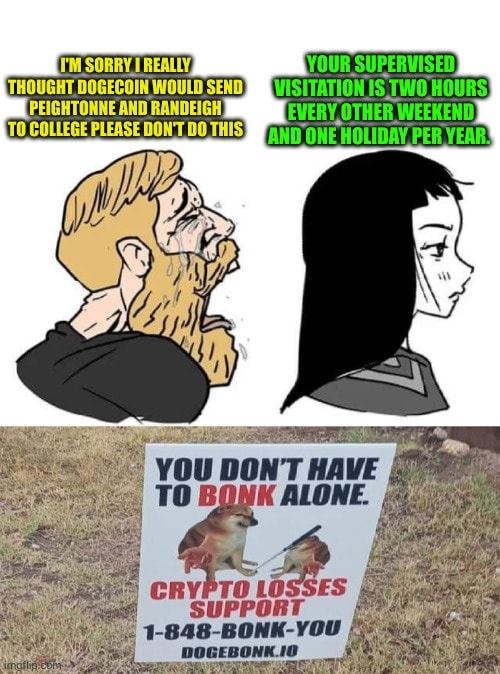
This meme satirizes the "Anti-Tech" perspective by treating cryptocurrency volatility as a natural, inevitable disaster rather than a market failure. The bottom panel humorously explains that "Bonking"—a crash or technical failure of a digital exchange—is a common occurrence, implying that users shouldn't have to pay for it alone. The top panels then reveal the irony: despite the tech failing to send money to college, the families are actually trying to use this digital currency to fund school attendance.
simple-description (llama3.2-vision_11b)
The meme is a play on the stereotype that people in tech are often socially awkward and have difficulty relating to non-technical individuals. The image shows a person who has just been told they need to take a break from their work computer and go for a walk in nature. The caption reads "I'm not saying I'm a bad coder, I'm just saying I'm not saying I'm a bad coder". This is a humorous way of acknowledging that one's skills in a particular field (in this case, coding) are not necessarily relevant to other areas of life.
detailed-analysis (gemma3-27b-vision)
Okay, let's break down this image, applying the requested theoretical frameworks where appropriate. It's a layered, meme-infused image, so the analysis will need to reflect that complexity.
I. Visual Description
The image is a multi-panel meme constructed with cartoon-style imagery.
- Top Panel (Left): A caricature of a man with exaggerated features (large nose, prominent jaw, blond hair) is depicted with his hands clasped in a pleading gesture, looking upwards. Text above him reads: "I'M SORRY I REALLY THOUGHT DOGECOIN WOULD SEND PEIGHTONNE AND RANDEIGH TO COLLEGE PLEASE DON'T DO THIS."
- Top Panel (Right): A woman with long dark hair and a stern expression is presented, standing rigidly. Text above her reads: "YOUR SUPERVISED VISITATION IS TWO HOURS EVERY OTHER WEEKEND AND ONE HOLIDAY PER YEAR."
- Bottom Panel: A digitally manipulated image depicting a dog (looks like a Shiba Inu) seemingly weeping or overwhelmed, overlaid with a text-based ad/poster. The poster reads: "YOU DON'T HAVE TO BONK ALONE." It includes the phrase "CRYPTO LOSSES SUPPORT" and a website URL "DOGEBONK.IO" with a phone number 1-848-BONK-YOU.
The overall aesthetic is intentionally crude and employs typical meme elements: bold text, exaggerated characters, and a somewhat absurd juxtaposition of concepts. The color scheme is fairly limited, primarily relying on black, white, and skin tones.
II. Foucauldian Genealogical Discourse Analysis
This image lends itself well to a Foucauldian interpretation. Foucault focuses on how power operates through discourse (systems of thought, language, and practices) and how these discourses construct subjects and truths.
- Power Dynamics & Control: The image presents a clear power imbalance. The woman dictates terms ("two hours every other weekend"), implying a controlling relationship (potentially involving parental rights, legal guardianship, or a similar controlling situation). The man is in a position of pleading, suggesting his power is limited and he’s subject to this control.
- Discourse of the Family/Relationship: The imagery taps into the discourse surrounding family, parenting, and relationships. The concept of "supervised visitation" explicitly references legal and institutional control over family interactions.
- Discipline and Normalization: Supervised visitation is a disciplinary practice designed to “normalize” interaction within defined parameters. The woman embodies the authority enforcing these norms.
- The Dogecoin/Crypto Discourse: The unexpected insertion of Dogecoin and "crypto losses" introduces a new layer. It suggests a history of bad financial decisions, potentially linking the man’s lack of control in the relationship to his financial failures. Dogecoin is a cultural symbol, and in this context, can be read as a signifier of reckless abandon and poor planning.
- "Bonk" and the Internet Subculture: The "Bonk" references, along with the site “dogebonk.io,” evoke internet subculture and the meme culture surrounding Dogecoin. “Bonk” is associated with a specific meme involving a Shiba Inu being "bonked" with a hammer, signifying a negative outcome. This suggests that the individual might be “bonked” with crypto losses.
III. Critical Theory
From a Critical Theory perspective, we can examine how the image reflects and reinforces societal structures and ideologies.
- Gender Roles: The image subtly reinforces traditional gender roles. The man is presented as emotionally vulnerable and financially irresponsible, while the woman is portrayed as stern, controlling, and rational. This aligns with stereotypical gender expectations that often place responsibility on women and vulnerability on men.
- Capitalism and Financialization: The inclusion of Dogecoin and "crypto losses" highlights the impact of late-stage capitalism on personal relationships. Financial stability (or lack thereof) becomes a factor in controlling access to family and relationships. The failure of a speculative investment (Dogecoin) contributes to the power imbalance.
- Ideology of Control: The “supervised visitation” aspect is emblematic of a broader ideological tendency toward control and surveillance. The image suggests that even personal relationships are subject to external regulation and enforcement.
- Commodification of Relationships: Implicitly, the man’s plea could be read as attempting to "buy" access to his children/partner through a failed financial scheme. This suggests a commodification of emotional connection.
IV. Marxist Conflict Theory
A Marxist reading would focus on the underlying class conflict and economic factors.
- Economic Disparity & Power: The man's reliance on a speculative investment like Dogecoin suggests economic vulnerability. The woman’s control over visitation could be seen as a manifestation of economic power – she likely has greater financial stability and thus, greater leverage in the situation.
- Alienation and Loss of Agency: The man appears alienated from traditional means of financial security. His attempt to invest in a volatile cryptocurrency can be viewed as a desperate attempt to regain control, which ultimately fails.
- The State & Legal System: "Supervised visitation" is enforced by the state (legal system). This demonstrates how the state intervenes in personal relationships to uphold certain social and economic norms, often reinforcing existing power structures.
V. Postmodernism
The image’s fragmented, ironic, and self-referential nature aligns with postmodern aesthetics.
- Pastiche & Irony: The combination of seemingly unrelated elements (relationship drama, cryptocurrency, internet memes) creates a pastiche. The use of Dogecoin in a context that has nothing to do with finance is ironic.
- Deconstruction of Meaning: The image undermines straightforward interpretations. The meaning isn’t clear, and the viewer is forced to question the relationship between the different elements.
- Loss of Grand Narratives: The image rejects any overarching explanation of the situation. There is no clear moral or message; only a fragmented, chaotic representation of reality.
- Simulacra & Hyperreality: The image is a simulation of reality, filtered through internet culture and meme conventions. It's a hyperreal representation that emphasizes the superficiality and artificiality of contemporary life.
VI. Queer Feminist Intersectional Analysis
While the image doesn’t explicitly deal with LGBTQ+ issues, a queer feminist intersectional lens can provide valuable insights:
- Gendered Power Dynamics: The image reinforces a heteronormative power dynamic. The man's pleading posture and association with financial failure align with patriarchal stereotypes. The woman's stern control can be seen as a reflection of societal expectations of female authority, but also as potentially reinforcing a controlling dynamic.
- Intersection of Class and Gender: The man's economic vulnerability intersects with his gender. His reliance on a risky investment could be seen as a consequence of societal pressures on men to be financially successful, leading him to take irrational risks.
- Disrupting Traditional Roles: The fact that the man is in a supplicant position could be read as a subversive disruption of traditional gender roles. However, the image doesn’t fully challenge these roles, and ultimately reinforces them.
In conclusion: This meme is complex and layered. It can be analyzed through multiple theoretical lenses, revealing insights into power dynamics, gender roles, economic inequalities, and the influence of contemporary culture. It reflects the fragmentation and contradictions of modern life, filtered through the lens of internet humor and meme culture.
simple-description (llama3.2-vision)
The meme is a humorous exchange between two characters, with the first saying "I'm sorry I thought Dogecoin would send Peightonne and Randegh to college" and the second responding with "Your supervised visitation is two hours every other weekend and one holiday per year". The image is accompanied by a text that reads "I'm sorry I thought Dogecoin would send Peightonne and Randegh to college".
tesseract-ocr
AAT OTE TT) aH Oa TTT aC) 170 COLLEGE PLEASE DON'T DO THIS) £ pb . d \f tira eae SS ws Sak oer =) YOU DONT HAVE £7 et, VO BORK ALONE aay —— £14 2 Dig cee op yhee, es a ee, A 5 ee) CRYPTO LOSSES (iia Ba seca el SS Ee Pies nr 8% Ay cog 1 848-BONK YOU ee ae eae EBO! ni yeah 8: Cy see mocesonnio fd ci Oe