First Seen
2023-09-24T23:06:08+00:00
simple-description (qwen3.5_2b-q8_0)
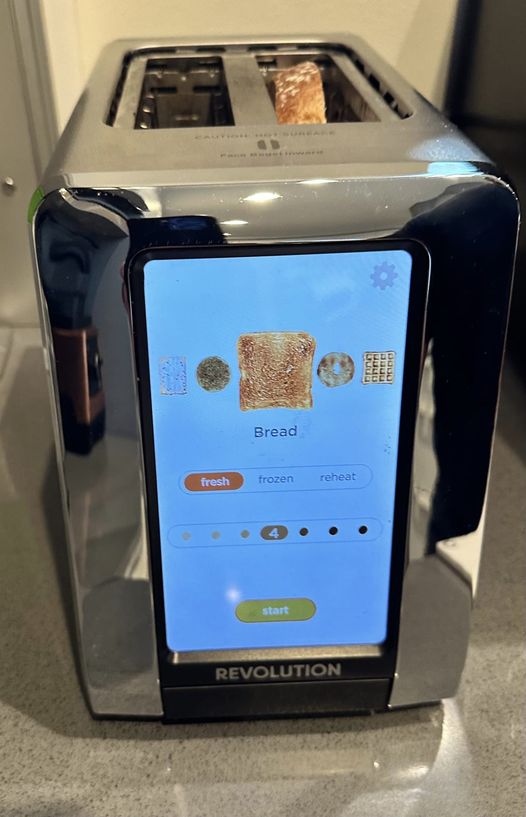
This "Anti-Tech" meme highlights the frustration of modern gadgets that seem to complicate simple tasks rather than make them easier. The image shows a shiny, metallic toaster with a confusing screen that asks the user to select a specific bread type, such as "fresh," "frozen," or "reheat," all while tracking a specific slot number with colored dots. It serves as a joke on how technology often adds unnecessary layers of complexity to basic functions like cooking bread, leaving a user wondering exactly what they are doing when they just want to toast something.
simple-description (llama3.2-vision_11b)
The meme is a screenshot of a toaster with a screen displaying a "Toast Not Found" error message, implying that the toaster is unable to toast bread. The text on the screen reads " Toast Not Found. Please check your bread. " The meme is likely poking fun at the idea that a toaster, a device designed for toasting bread, is unable to perform its primary function.
detailed-analysis (gemma3-27b-vision)
Okay, here's an analysis of the image, broken down into sections based on the requested theoretical frameworks, only including sections where the framework meaningfully applies.
Visual Description
The image depicts a “Revolution” brand toaster oven. It's a sleek, modern appliance with a black exterior and a prominent touchscreen display. The toaster is sitting on a speckled gray countertop. A slice of bread is visible partially inserted into the toasting slot.
The touchscreen display is showing a menu for selecting bread type and toasting settings. Options presented include icons for different types of bread (white, wheat, bagel, waffle etc.) and settings for “fresh,” “frozen,” or “reheat.” A circular indicator shows the selected darkness level (level 4 out of a number of points). A large, green “start” button is visible at the bottom of the screen. The word "REVOLUTION" is branded at the bottom.
Foucauldian Genealogical Discourse Analysis
This seemingly simple appliance provides fertile ground for a Foucauldian analysis. The “Revolution” toaster, rather than being a neutral tool, produces a specific discourse around breakfast, convenience, and control.
- Discipline & Normalization: The menu options ("fresh," "frozen," "reheat") aren't merely providing choices; they establish a regime of truth around how bread should be prepared. The machine categorizes and dictates acceptable forms of bread and its preparation. It creates a “normal” way to eat toast—a perfectly browned, consistently produced slice. Deviations (slightly burnt, unevenly toasted) are implicitly rendered "abnormal" or requiring adjustments to achieve the desired "correct" outcome.
- Power/Knowledge: The touchscreen interface and the algorithms within the appliance embody power/knowledge. The creators of this toaster possess the knowledge to define "optimal" toasting parameters for various bread types. This knowledge is embedded in the device, and the user is subjected to it. They relinquish a degree of control over the toasting process, outsourcing it to the machine’s internal logic.
- Genealogical tracing: This toaster is not an isolated instance. It's part of a historical lineage of increasingly automated kitchen appliances, a trajectory toward making food preparation more efficient and standardized. This lineage reveals a desire for control over basic needs and a growing reliance on technology to regulate even the most mundane aspects of life.
Critical Theory
From a Critical Theory perspective, this toaster is a clear example of how technology can reify existing social structures and contribute to a culture of consumerism and control.
- Instrumental Rationality: The focus on efficiency and perfect toasting exemplifies instrumental rationality – the prioritizing of means over ends. The goal isn't necessarily to enjoy a good slice of toast; it’s to achieve the "optimal" result through technological means. The machine becomes an end in itself.
- Commodity Fetishism: The sleek design and touchscreen display contribute to a sense of fetishization of the object. The use value (toasting bread) is obscured by the emphasis on the exchange value (the appliance’s price, status as a desirable kitchen gadget). The toaster is not merely a tool; it's a symbol of a particular lifestyle.
- Domination: The automation inherent in the toaster can be viewed as a form of subtle domination. The user relinquishes agency over the toasting process, submitting to the machine’s logic. This seemingly benign act reflects a broader trend of technological control in modern life.
Postmodernism
The "Revolution" toaster, with its digital interface and customizable options, is indicative of several postmodern themes:
- Hyperreality: The meticulously curated images of perfectly toasted bread on the touchscreen create a hyperreal image of breakfast. It’s a simulation of the “ideal” breakfast experience, blurring the lines between reality and representation. The user isn’t interacting with actual bread; they’re interacting with a digital representation of bread, and making choices based on a constructed image.
- Fragmentation & Simulacra: The array of bread type options, each represented by an icon, suggests a fragmentation of culinary experience. The toaster presents multiple "authentic" options, but these are ultimately simulations – representations that have lost their connection to any original "real" experience.
- Loss of Grand Narratives: The very fact that we need a sophisticated appliance to perform the simple task of toasting bread challenges traditional narratives about home cooking and domesticity. It reflects a breakdown of established ways of life and a shift toward a more fragmented and individualized experience.
Let me know if you'd like me to expand on any of these analyses or explore another theoretical framework!
simple-description (llama3.2-vision)
This meme is a humorous image of a toaster with a screen displaying a "Toast Settings" menu. The menu lists various options, including "Toast Level", "Toast Color", and "Toast Sound", but the most interesting option is "Toast Personality" with a dropdown list of "Sarcastic", "Bitter", and "Angry".
tesseract-ocr
Bu oy } _ 3 ee