First Seen
2024-01-04T02:48:44+00:00
simple-description (qwen3.5_2b-q8_0)
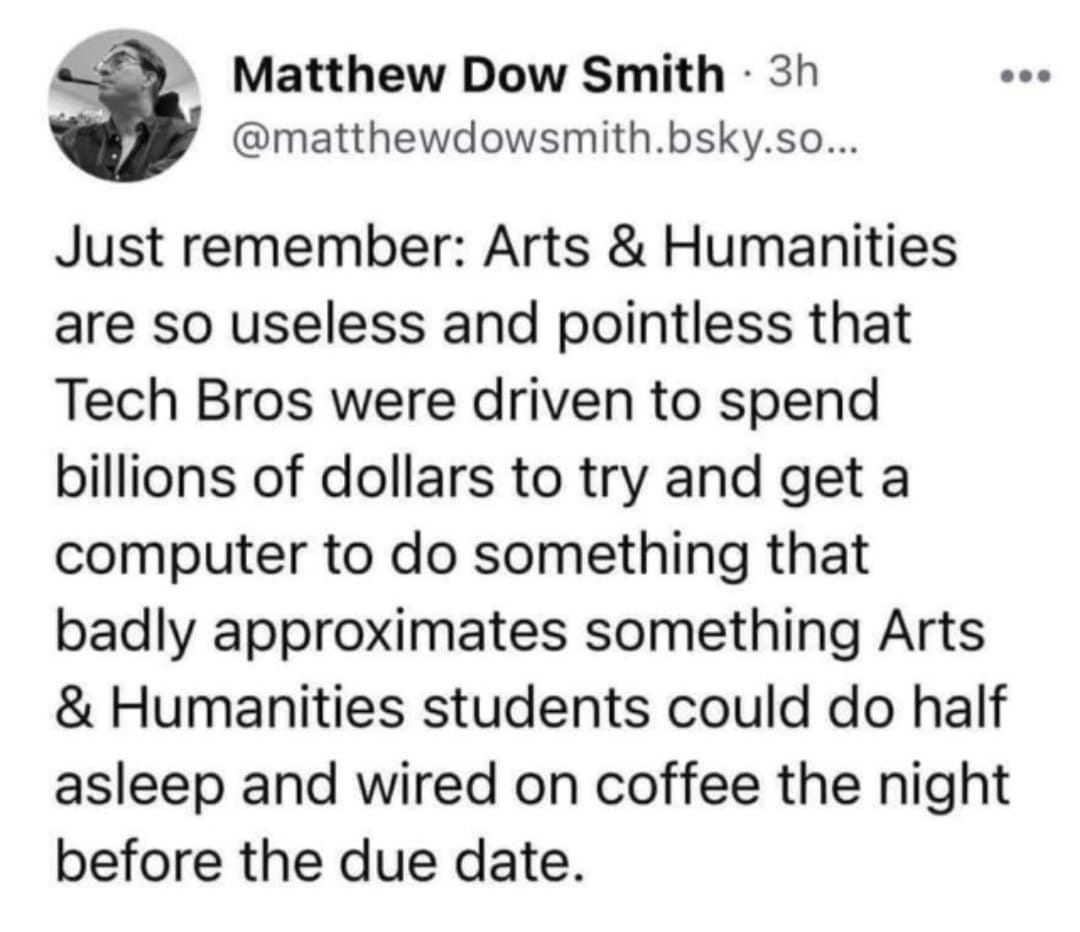
This Anti-Tech joke mocks the futility of complex technological solutions for non-technical tasks. It argues that "Tech Bros" waste money building sophisticated systems to handle problems a human could simply do half-asleep before a deadline. The punchline asserts that a computer cannot truly approximate the artistic value and speed of a human mind just before a due date.
simple-description (llama3.2-vision_11b)
The meme is a humorous critique of the tech industry's obsession with innovation and progress, suggesting that even the most seemingly advanced technologies can have absurdly mundane applications. The text in the image reads: "Just remember: Tech Bros were like 'We can put a man on the moon!' and we're like 'You can put a coffee machine on the moon!'"
detailed-analysis (gemma3-27b-vision)
Okay, let's break down this social media post through various theoretical lenses, as requested.
Visual Description
The image is a screenshot of a social media post (likely from a platform like Bluesky, given the URL ending). At the top is a circular profile picture showing a person with dark hair and a beard. Below this is the username "Matthew Dow Smith". The main body of the post is a text-based comment making a pointed critique of the arts and humanities. It's a minimalist visual – focusing solely on text and a basic profile. This lack of visual elaboration enhances the impact of the text, as it demands immediate attention without distraction.
Critical Theory
This post is ripe for analysis through the lens of Critical Theory, specifically relating to the Frankfurt School and the critique of instrumental reason. The comment posits a direct opposition between "Arts & Humanities" and "Tech Bros" (representing technological and capitalist rationalism).
- Critique of Instrumental Reason: The post implicitly criticizes the dominant logic of techno-capitalism—the emphasis on efficiency, calculation, and profit-driven outcomes. The 'Tech Bros' investing billions to approximate what students do on little sleep highlights the absurdity of trying to technologically solve something that fundamentally relies on human interpretive skills, creativity, and contextual understanding. Instrumental reason aims to quantify and control, but the Humanities, in this view, deal with things that resist quantification.
- Culture Industry: We can also see a hint of the "Culture Industry" critique. The 'Tech Bros' attempt can be seen as a crude attempt to manufacture or reproduce the intellectual output of the Humanities, driven by a desire for control and commodification.
- Emancipatory Knowledge: Implicitly, the post argues that the value of the Humanities lies not in its 'usefulness' (in the capitalist sense) but in its ability to foster critical thinking, complex understanding, and a more nuanced perspective on the world. This aligns with the Critical Theory aim of promoting emancipatory knowledge—knowledge that challenges dominant power structures.
Marxist Conflict Theory
This post immediately sets up a class-based/ideological conflict: "Tech Bros" (representing a new capitalist elite) versus "Arts & Humanities students."
- Economic Basis of Ideology: The post can be interpreted as a challenge to the dominant ideology of capitalism—the idea that ‘value’ is determined by market forces and technological innovation. The 'Tech Bros' investing billions implies they're attempting to buy what the Humanities already offer, exposing the limitations of purely economic valuation.
- Class Struggle: The post subtly portrays the arts and humanities as a realm of intellectual labor outside the direct control of capital. The fact that students can achieve similar results "half asleep and wired on coffee" suggests a form of resistance to the demands of efficiency and optimization that characterize capitalist production.
- Commodification of Knowledge: The attempt to replicate humanities output with a computer exemplifies the commodification of knowledge—reducing complex intellectual work to a set of algorithms and data points.
Postmodernism
The post touches on several key postmodern themes:
- Deconstruction of Grand Narratives: The comment implicitly challenges the narrative of technological progress as the sole driver of value. It suggests that there are forms of knowledge and skill that cannot be easily reduced to technological solutions.
- Irony & Playfulness: The exaggerated claim that ‘Tech Bros’ spent billions to create something a student can do on coffee is clearly ironic and playful. This self-aware tone is typical of postmodern discourse.
- Simulation & Hyperreality: The 'computer approximating' humanities work can be seen as a form of simulation—a copy without an original. This alludes to the postmodern concept of hyperreality—where simulations become more real than the real itself. The post suggests that this attempt creates a pale imitation of actual human thought.
Foucauldian Genealogical Discourse Analysis
Applying a Foucauldian lens, we can analyze how the post participates in a discourse around the value of knowledge and labor.
- Power/Knowledge: The post reveals a power dynamic between the 'Tech Bros' and the Humanities. The investment of billions demonstrates the power of capital to attempt to define and control knowledge production. The post implicitly challenges this control.
- Genealogy: We could trace the historical development of the idea that knowledge must be “useful” or “practical.” A genealogical analysis would show how this notion emerged from specific historical and social contexts (e.g., the rise of industrial capitalism and the emphasis on quantifiable results).
- Discursive Formation: The post contributes to a discursive formation that positions the Humanities as either irrelevant or valuable in ways that challenge conventional economic logic. It creates a space for questioning the dominant metrics of value.
Queer Feminist Intersectional Analysis (Less Directly Applicable but Present)
While not the primary focus, an intersectional analysis could be layered on by acknowledging:
- Marginalization of Humanities: The Humanities have historically been undervalued and underfunded, often associated with feminized or marginalized forms of labor. This contributes to a broader pattern of devaluing work traditionally done by women and people of color.
- Disrupting Normative Value Systems: The post subtly challenges normative value systems that prioritize economic utility and technological progress. This aligns with queer and feminist critiques of patriarchal and capitalist structures.
- The 'Hacker Ethic': The description of students functioning on minimal resources (coffee, lack of sleep) subtly references the 'hacker ethic' – finding creative solutions with limited resources, and subverting established norms. This resonates with feminist and queer approaches that celebrate resourcefulness and resistance.
Let me know if you'd like me to elaborate on any of these points, or explore other theoretical perspectives!
tesseract-ocr
wa Matthew Dow Smith - 3h eee @matthewdowsmith.bsky.so... Just remember: Arts & Humanities are so useless and pointless that Tech Bros were driven to spend billions of dollars to try and get a computer to do something that badly approximates something Arts & Humanities students could do half asleep and wired on coffee the night before the due date.
simple-description (llama3.2-vision)
The meme is a humorous commentary on the perceived lack of relevance of Arts and Humanities in modern times. The text reads: "Just remember: Arts & Humanities are so useless and pointless that Tech Bros were able to build a billion-dollar company with a 100% non-arts-and-humanities-educated workforce. They did it by using the 100% non-arts-and-humanities-educated workforce because they are cheap and they work for free."