First Seen
2024-02-02T22:02:43.885580+00:00
simple-description (qwen3.5_2b-q8_0)
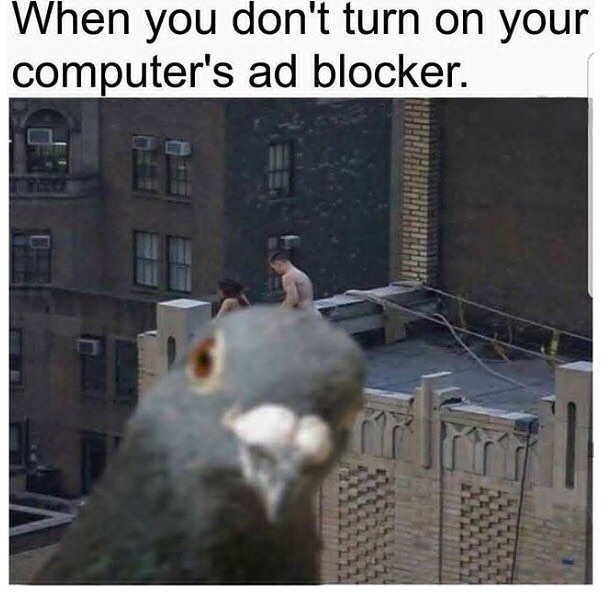
This meme plays on the frustration of dealing with annoying advertisements, as the text asks, "When you don't turn on your computer's ad blocker." The "anti-tech" humor is delivered by placing a pigeon directly in the foreground, a common internet trope, which creates a surreal contrast suggesting the bird is the main distraction from ignoring the tech annoyance.
simple-description (llama3.2-vision_11b)
The meme is a humorous take on the frustration of dealing with online ads and trackers. The image shows a person (likely a man) on a rooftop, with a giant bird of prey (likely a hawk or eagle) swooping down towards him. The text overlay reads "When you don't turn on your ad blocker". The implication is that the person is being targeted by online advertisers and is now being attacked by a bird, symbolizing the frustration and annoyance of being bombarded with ads.
detailed-analysis (gemma3-27b-vision)
Okay, let's break down this meme through several theoretical lenses. It’s a surprisingly rich image for analysis.
Visual Description
The image is a close-up, slightly blurry shot of a pigeon. The pigeon is looking directly at the viewer with a somewhat judgmental or distressed expression. The background shows a miniature cityscape, constructed as a diorama or model. A tiny figure of a person is visible in the background, seemingly about to jump or fall from one of the buildings. The text overlay reads, "When you don’t turn on your computer’s ad blocker." The quality of the image (slightly grainy, odd framing) adds to a sense of absurdity and discomfort.
Foucauldian Genealogical Discourse Analysis
This meme utilizes a discourse around surveillance and control, mirroring Foucault's concepts. The “ad blocker” functions as a site of power negotiation.
- Discourse of Advertisement & Data Collection: The meme implies the pervasive and often invisible process of data collection that happens during internet browsing. The lack of an ad blocker allows for the accumulation of "data points" on the user – tracking browsing habits, preferences, and creating a "digital profile." This data is then used for targeted advertising, extending its influence into our consumption patterns.
- Panoptic Effect: While not direct, the meme subtly evokes the panoptic principle. The user feels potentially watched (by advertisers tracking browsing data), even if it's not a physical surveillance. The pigeon’s judgmental gaze acts as a metaphorical stand-in for the ever-present gaze of those tracking our online activities.
- Genealogy of the Ad Blocker: Tracing the historical development of ad blockers reveals a growing awareness of these power dynamics. Early forms were technical solutions to speed up browsing. Over time, they have become tools of resistance against the increasing intrusiveness of online advertising and data collection. The meme acknowledges this historical development, portraying the ad blocker as a necessary tool for self-preservation.
Marxist Conflict Theory
This meme can be read as a small-scale representation of class struggle and exploitation.
- Exploitation of Attention: Advertisements are a core component of the capitalist system, driving consumption. The meme frames the lack of an ad blocker as an acceptance of being subjected to constant bombardment of marketing messages, thus having your attention, time, and mental energy exploited for profit.
- Digital Proletariat: The internet user without an ad blocker becomes a form of "digital proletariat," willingly exposing themselves to these exploitative practices. The ad blocker represents a means of reclaiming agency and resisting the capitalist forces that seek to profit from our online activity.
- Means of Protection: The ad blocker can be seen as a “tool” (like the means of production in Marxist theory) used to protect the user from being exploited.
Postmodernism
The meme embodies several elements of postmodern thought.
- Simulation & Hyperreality: The miniature cityscape is a clear example of simulation. It’s not a real city but a representation, a model, a copy. Similarly, the online world itself can be seen as a hyperreality, a simulation of reality that often feels more intense and immediate than actual experience. The bombardment of ads contributes to this feeling of simulation, constantly presenting us with idealized or fabricated representations of products and lifestyles.
- Irony & Absurdity: The image is inherently absurd – a judgmental pigeon looking down on us for not using an ad blocker. This irony is a hallmark of postmodern aesthetics. It challenges the seriousness of everyday concerns and invites us to question the meaning and purpose of online activity.
- Fragmentation & Disruption: The meme disrupts the flow of information, using humor to draw attention to the hidden forces at play in the digital landscape. It fragments our expectations of a straightforward message and forces us to engage with the underlying power dynamics.
Additional Notes:
The meme's effectiveness relies heavily on its use of relatable imagery and humor. The pigeon, with its inherently critical and judgmental gaze, serves as a perfect stand-in for the user’s own internal voice of reason (or frustration).
Let me know if you’d like me to elaborate on any of these analyses or explore other theoretical frameworks!
tesseract-ocr
When you dont turn on your computer's ad blocker. J
simple-description (llama3.2-vision)
This meme is a humorous image of a pigeon looking directly at the camera with a menacing expression. The text at the top of the image reads, "When you don't turn on your computer's ad blocker." The meme is implying that the pigeon is like a pesky ad that won't go away, even when you try to block it.