First Seen
2024-06-11T07:14:23.174728+00:00
simple-description (qwen3.5_2b-q8_0)
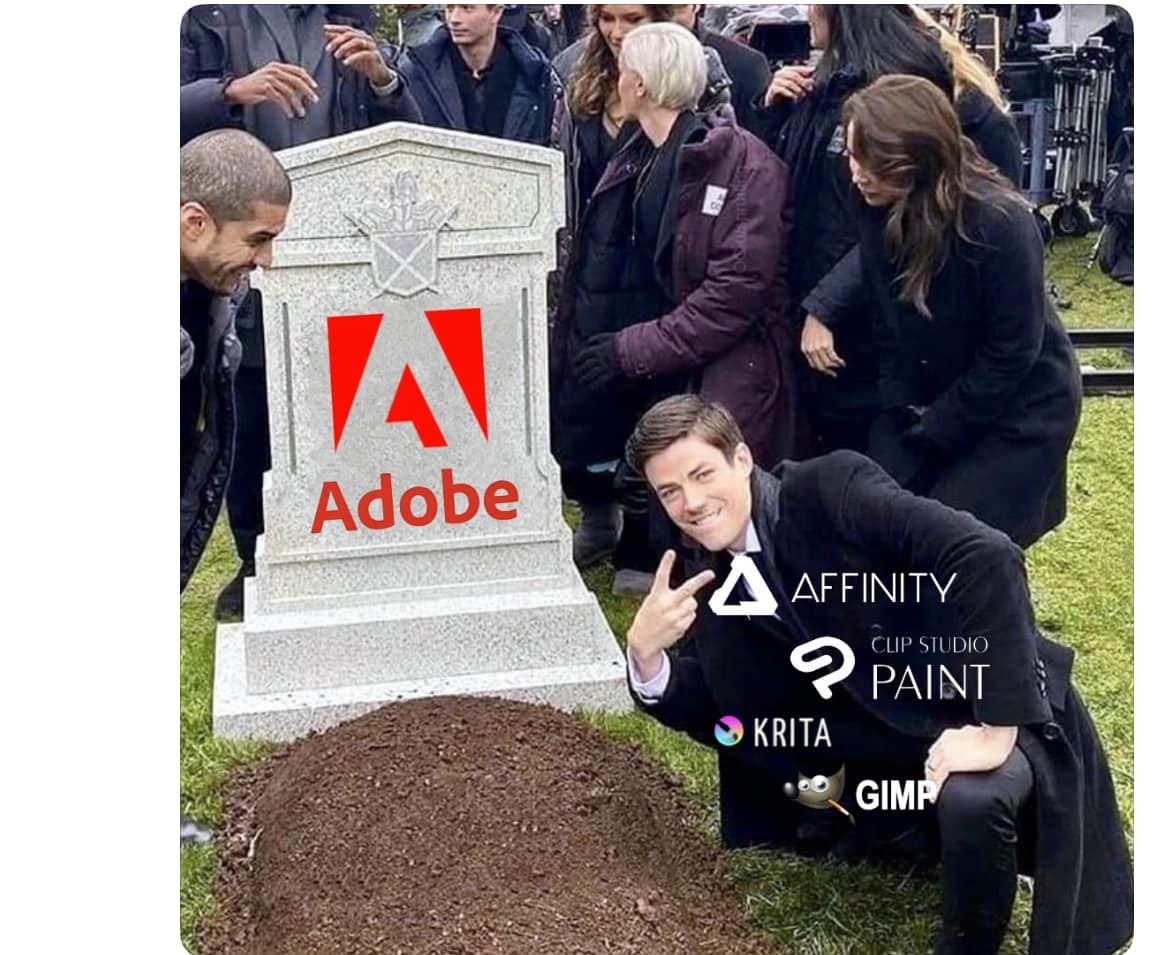
This anti-tech meme humorously portrays Adobe, the dominant company behind software like Photoshop and Illustrator, as the deceased head of a cemetery. It depicts a person standing solemnly next to a grave marked with the red Adobe logo, suggesting the company is fading away and the industry is being superseded. The text on the headstone reads "Adobe," while a group of people looks on in shock. To the right, logos for rival software apps like Affinity, Clip Studio Paint, Krita, and GIMP appear, implying that the industry is shifting away from Adobe's massive, expensive software empire.
simple-description (llama3.2-vision_11b)
The meme depicts a mock funeral for Adobe, with the company's logo on a tombstone. The text "RIP Adobe" is written above the logo, and a list of other companies, including Microsoft, Google, and Facebook, are listed as "surviving" or "still alive". The meme is a humorous way of saying that Adobe is no longer relevant or dominant in the tech industry.
detailed-analysis (gemma3-27b-vision)
Okay, let's break down this image using the requested critical lenses.
Visual Description
The image is a digitally manipulated scene, seemingly based on a photograph of a funeral or memorial. In the foreground, a group of people dressed in black are gathered around a gravestone. The gravestone features the iconic "A" logo of Adobe, a major software company specializing in creative tools. The background shows more figures in dark clothing.
A man in a light blue shirt is kneeling in front of the gravestone, holding a small bouquet of flowers. Scattered around the base of the gravestone are logos of alternative software: Affinity, Clip Studio Paint, Krita, and GIMP – all popular digital art/photo editing programs. The overall composition evokes a sense of mourning or symbolic "death" of Adobe's previously dominant position in the creative software landscape.
Foucauldian Genealogical Discourse Analysis
This image is powerfully suggestive within a Foucauldian framework. The "death" of Adobe, symbolically represented by the gravestone, isn't simply about a company losing market share. It's about a shift in discourse.
Historically, Adobe established a powerful discourse around professional-grade creative tools. Its software became the standard, defining what constituted "professional" work. The company exerted control through its licensing models (subscriptions) and, importantly, through the normalization of specific workflows and practices.
The image disrupts this discourse by presenting alternatives – Affinity, Krita, GIMP, and Clip Studio Paint. These programs represent a counter-discourse, challenging Adobe's hegemony. The fact that they are presented as 'flowers' being laid on the grave suggests a kind of victory over the old discourse. These alternative programs emphasize open source, one-time purchases, and/or different methods of production, thereby challenging the "truth" established by Adobe’s dominance.
The genealogy would trace how Adobe came to be seen as the standard and how these new programs represent a breaking away from those power/knowledge relationships. The image suggests a disruption of the established "episteme" (the underlying rules and assumptions) of the creative field.
Marxist Conflict Theory
From a Marxist perspective, the image is a potent representation of class struggle within the creative industries. Adobe, as a large corporation, embodies capital and the means of production (the software itself). The company's subscription model is a form of extraction of surplus value from artists, designers, and other creatives.
The alternative programs – especially open-source options like GIMP and Krita – represent a challenge to this capitalist system. They offer artists a means to produce creative work without continually enriching a large corporation. The act of "burying" Adobe (symbolically) suggests a rejection of this exploitative dynamic.
The image illustrates a struggle for control over the means of production, with creatives seeking to liberate themselves from the constraints imposed by Adobe’s business model. The small bouquets of flowers are a defiant act of resistance, demonstrating a rejection of the existing power structure.
Postmodernism
The image embodies several key tenets of postmodernism. Primarily, it's an act of pastiche—mixing the solemnity of a funeral with the logos of software brands. This jarring juxtaposition challenges traditional notions of reverence and seriousness.
The image also deconstructs the notion of the "author" or "creator" as a singular, original genius. The act of using software, whether Adobe or its alternatives, is a collaborative process. The software itself shapes the creative output, blurring the lines between creator and tool.
The image's meta-commentary – it’s a picture about software and the changing creative landscape – is distinctly postmodern. It points to the constructed nature of reality and the power of representation. It suggests that "truth" is not objective, but is shaped by discourse and technology.
Critical Theory
The image can be analyzed through the lens of Critical Theory, particularly regarding the concept of cultural hegemony. Adobe established a form of cultural hegemony by becoming the default standard in the creative industries. This wasn’t just about technological superiority; it was about shaping perceptions, controlling the discourse, and making its software seem necessary for professional work.
The image suggests a challenge to this hegemony. The alternative software is presented as a viable alternative, disrupting the idea that Adobe is the only path to creative success. The image can be seen as a call for a more democratic and accessible creative landscape, where artists are not beholden to a single corporation.
Furthermore, the image hints at the potential for technology to be a tool of liberation or oppression. Adobe, with its subscription model and control over the creative workflow, can be seen as oppressive. The alternative programs, with their open-source nature and accessibility, offer a path toward liberation.
I hope this comprehensive breakdown is helpful! Let me know if you'd like me to expand on any particular aspect or analyze the image through a different lens.
tesseract-ocr
gl) ae | a = i VN af an | Cana ‘ Si Sd —< Tel pes 4 Y “y —— | ; % ee py | N - A Es Fe a. 4 NIK CUP STUDIO “ee 2 : Te QD PAINT 3 Se cgi eee By @ KRITA lad e rp oie eee ee exe : : aa Z 5k as i)
simple-description (llama3.2-vision)
This meme is a play on the popular "RIP" (Rest in Peace) meme format, but with a twist. Instead of a person or a pet, the image shows a tombstone with the Adobe logo on it, implying that the company is "dead" or no longer relevant. The text "RIP Adobe" is written above the logo, but the image is actually a joke about Adobe's many acquisitions and how they seem to be "dying" or being "buried" by the company.