First Seen
2023-09-22T04:07:19+00:00
simple-description (qwen3.5_2b-q8_0)
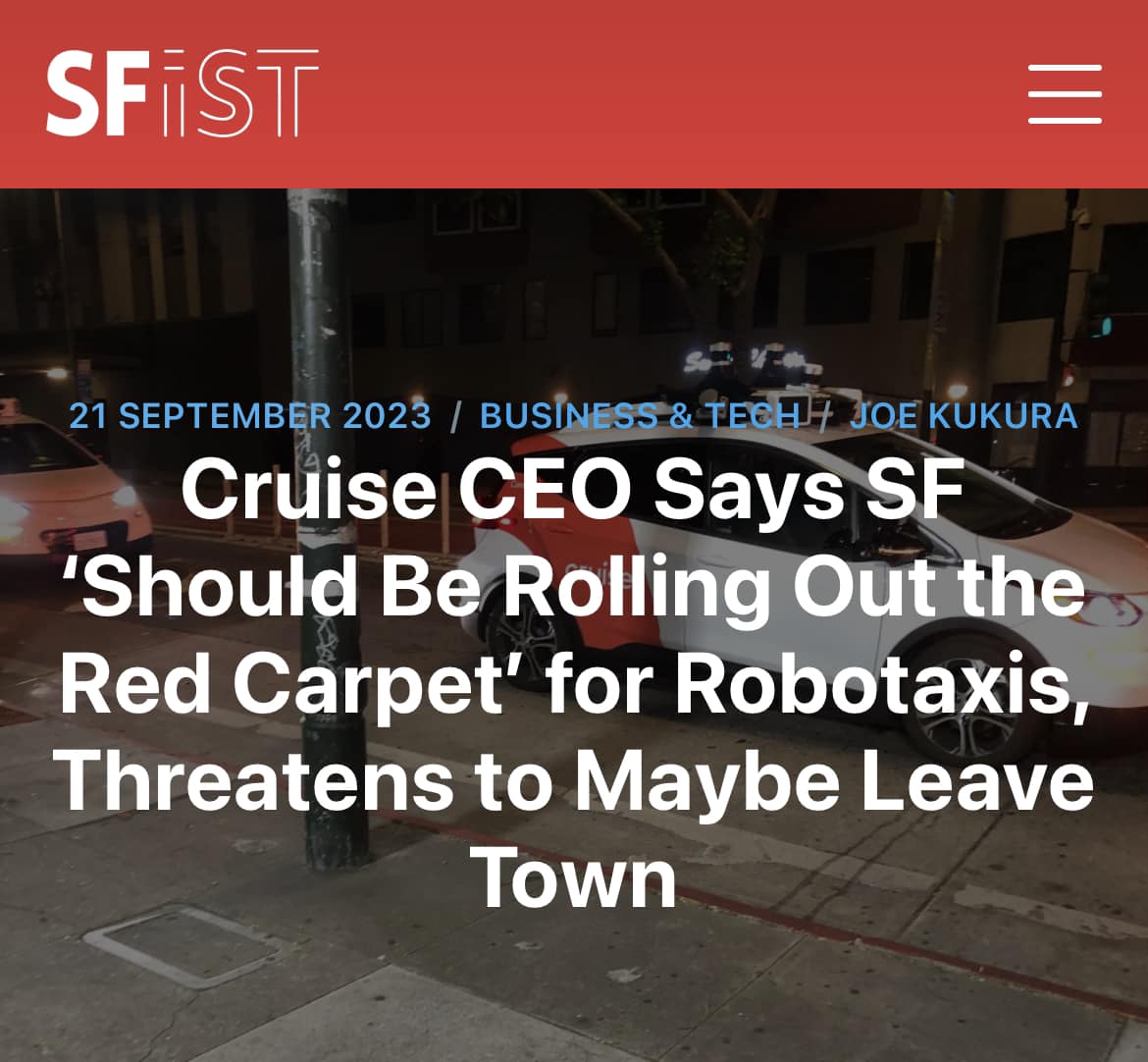
This meme plays on the irony of a corporate announcement about autonomous vehicles. The headline suggests that Cruise is about to officially welcome the future of travel, but it simultaneously threatens to shut down its physical operations if it loses control. Essentially, it's a joke about being replaced by technology without the company itself having to disappear.
simple-description (llama3.2-vision_11b)
The meme is an image of a San Francisco street with a large, red "X" marked through it, with the text "San Francisco is dying" written above it. The image is likely referencing a news article or social media post that has sparked controversy or outrage in the city.
detailed-analysis (gemma3-27b-vision)
Okay, here's a breakdown of the image, analyzed through the lenses you've requested. I’ll indicate where a lens doesn’t really apply, and prioritize deeper dives into the ones that feel most relevant.
1. Visual Description
The image is a screengrab of a news headline from the San Francisco Standard (SFIST). The headline reads: “Cruise CEO Says SF ‘Should Be Rolling Out the Red Carpet’ for Robotaxis, Threatens to Maybe Leave Town.” It's overlaid on a blurred, nighttime urban scene featuring a street with a sidewalk. A red vehicle (presumably a Cruise robotaxi) is visible, blurred and in motion. The lighting is heavily dominated by red, creating a somewhat ominous atmosphere. The text of the headline is white and bold, drawing the immediate attention. There's the logo for SFIST at the top left and a timestamp and author credit below the headline. The background features brick buildings and a blurry streetscape, suggesting an urban center.
2. Foucauldian Genealogical Discourse Analysis
This is a particularly strong lens for this image and headline.
- Discourse of Technological Progress & Control: The headline embodies a discourse that positions robotaxis as an inevitable technological advancement. The phrase “should be rolling out the red carpet” is a powerful claim, establishing a specific framing of acceptance and even welcome towards this technology. It positions resistance to robotaxis as inherently backward or unreasonable.
- Power/Knowledge & Discipline: The CEO’s threat to leave town operates as a subtle exercise of power. It suggests that SF needs Cruise, that its economic vitality is tied to the company’s presence. The implicit discipline is: conform to our vision of the future (automated transportation), or suffer economic consequences. The power dynamic is embedded in the fact that the CEO (a representative of a powerful tech corporation) is making the demand, not the other way around.
- Genealogy of ‘Smart Cities’: This image connects to a larger historical genealogy of the "smart city" concept. Automated transportation is a core component of this vision—a vision that often prioritizes efficiency and data collection over community needs and equitable access. Tracing the historical development of “smart city” initiatives reveals how they've been shaped by corporate interests and the desire for increased surveillance and control.
- The Production of ‘The Future’: The CEO is actively producing a specific narrative of the future. By framing robotaxis as a necessary and inevitable step, they’re attempting to shape public opinion and political decisions. Foucault would argue this is a key function of power—not simply repression, but the construction of reality itself.
3. Marxist Conflict Theory
The image clearly evokes themes of class and economic power.
- Capital vs. Labor: The robotic taxis represent a potential displacement of human labor (taxi drivers, delivery personnel). While framed as progress, it potentially widens the gap between those who benefit from automation (Cruise shareholders, tech investors) and those who are left behind.
- Corporate Power & Urban Space: Cruise's threat to leave underscores the influence of corporations over urban environments. The company is essentially holding the city hostage, demanding favorable conditions for its business. This reflects a broader pattern of corporate capture of public spaces and resources.
- Commodification of Mobility: Robotaxis represent the further commodification of mobility. Transportation is no longer viewed as a public good but as a service to be bought and sold, with profit as the primary motive.
- Class Inequality & Access: Who will ultimately benefit from robotaxis? The affluent? Those with the latest smartphones? Or will it exacerbate existing inequalities in access to transportation? This image invites us to consider the distributional effects of this technology.
4. Critical Theory
The image exemplifies several key themes in Critical Theory.
- The Culture Industry: The narrative surrounding robotaxis can be seen as part of a broader “culture industry” that promotes consumerism, technological determinism, and acceptance of the status quo. The headline presents a polished, positive image that obscures potential downsides.
- Ideology & False Consciousness: The idea that SF “should” welcome robotaxis operates as an ideological claim—an attempt to naturalize a particular vision of the future. This can contribute to a “false consciousness,” where people accept systems that are not in their best interests.
- The Instrumentalization of Reason: The emphasis on efficiency and technological progress at the expense of social and ethical considerations reflects a form of “instrumental reason,” where everything is valued solely for its utility.
5. Postmodernism
While present, postmodern analysis isn't central to this image.
- Simulacra & Simulation: The carefully crafted image of the robotaxi – a sleek, futuristic vehicle – is itself a simulation. The "reality" of automated transportation is presented through mediated images and narratives.
- Deconstruction of Progress Narratives: The image could invite a deconstruction of the traditional "progress narrative." Is technological advancement inherently good? Who defines "progress"?
- Fragmented Reality: The blurred background and fast-paced nature of the image could be seen as representing the fragmented and chaotic nature of contemporary urban life.
6. Queer Feminist Intersectional Analysis
This lens, while not as immediately obvious, offers some important points.
- Spatial Politics & Gendered Mobility: How do robotaxis affect the safety and accessibility of urban spaces for different groups? Who feels most vulnerable in an automated transportation system? The ways cities are designed, and how people move through them, are often deeply gendered.
- Tech Bro Culture: Cruise is a tech company, and the headline evokes a certain "tech bro" attitude – a sense of entitlement and a disregard for community concerns. This can reflect broader patterns of gender and power dynamics within the tech industry.
- Algorithmic Bias: Automated systems (like robotaxis) are susceptible to algorithmic bias. Whose interests are reflected in the programming of these vehicles? Who is most likely to be harmed by potential errors or malfunctions? This analysis requires considering the intersection of gender, race, and other social categories.
I hope this comprehensive analysis is helpful. Let me know if you'd like me to elaborate on any of these points, or explore additional lenses!
tesseract-ocr
SFiSi = Cruise|'\CEO Says’SF ‘Should Be Rolling Outthe Red Carpet’ for Robotaxis, Threatens to Maybe Leave Town
simple-description (llama3.2-vision)
The meme is a screenshot of a news article from SFist, a San Francisco-focused news site. The article's headline reads: "SFist: 'I'm Not Going Anywhere' Says SF Mayor, But He's Not Saying That".