First Seen
2023-09-29T21:04:05+00:00
gemma3-27b-vision
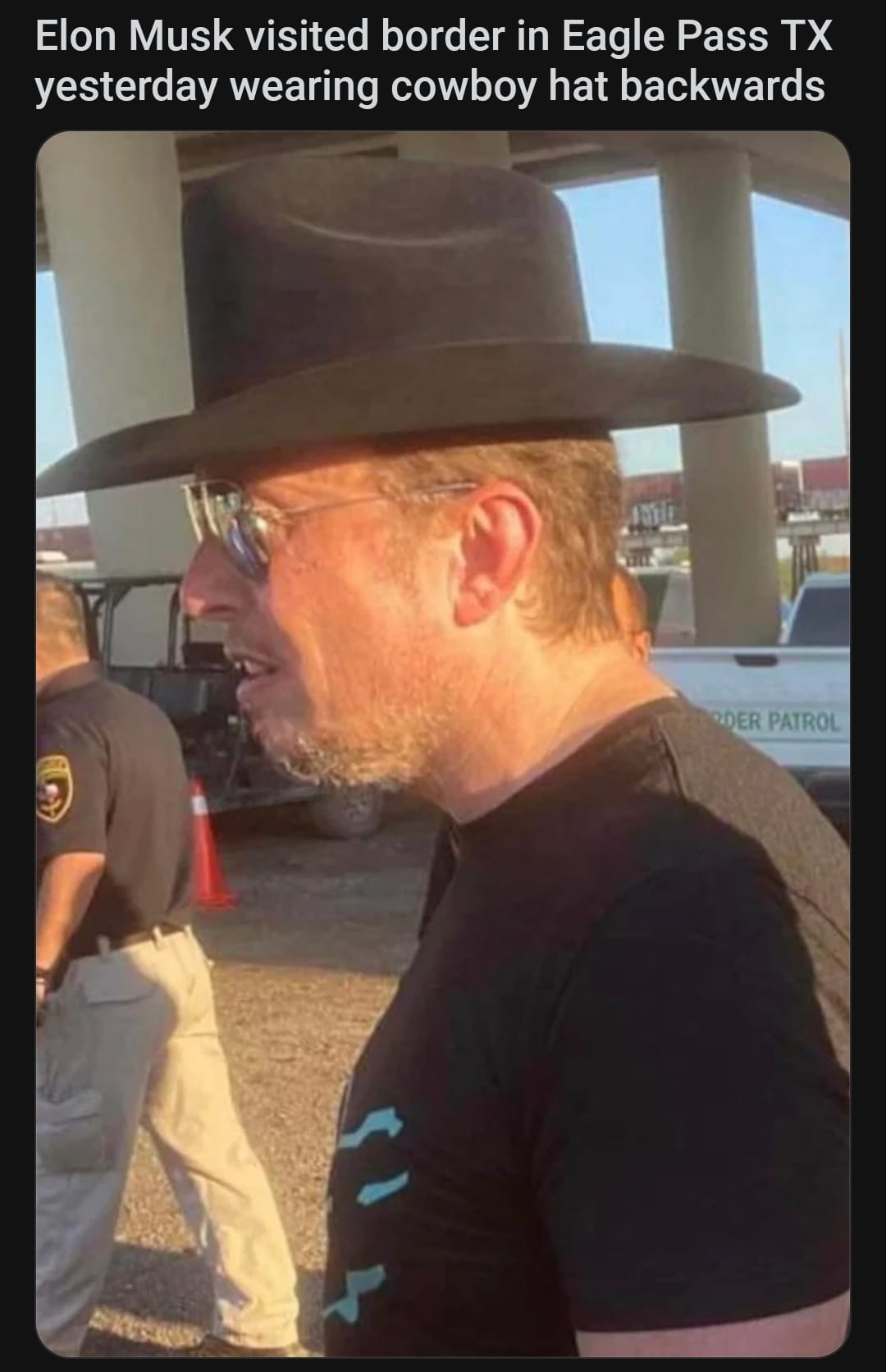
Okay, let's break down this image of Elon Musk at the border in Eagle Pass, Texas, through various theoretical lenses. It's important to note that applying these frameworks can be subjective and open to interpretation, and some may be more relevant than others. **Visual Description** The image is a close-up shot of Elon Musk standing near what appears to be a border patrol vehicle. The framing emphasizes Musk's face and, most strikingly, a large black cowboy hat he is wearing backwards. His expression is difficult to read, appearing somewhat serious. He is wearing a dark shirt with a logo on it, partially obscured, possibly related to border security or a similar organization. A partially visible border patrol vehicle and personnel are visible in the background. The lighting is bright, suggesting outdoor midday conditions. The overall impression is one of deliberate staging and a desire to project a certain image. **Foucauldian Genealogical Discourse Analysis** This image can be interpreted through Foucault's work on power and discourse. The "cowboy" image, historically tied to notions of frontier justice, rugged individualism, and American expansionism, is *discursively constructed.* Musk appropriates this imagery, but by wearing the hat *backwards*, he disrupts its traditional meaning. * **Genealogy:** The history of the cowboy figure is one linked to colonization, land theft, and the subjugation of others (Native Americans, Mexicans, etc.). It's a history interwoven with power dynamics. * **Power/Knowledge:** Musk, as a tech billionaire, wields significant economic and cultural power. This image *performs* a particular understanding of border control and implicitly suggests his support. By adopting the cowboy iconography, he taps into a pre-existing cultural narrative that legitimizes control and vigilance. * **Disruption & Resistance:** The backwards hat *could* be read as a subtle act of resistance – a rejection of traditional authority or an ironic commentary on the situation. However, given Musk's position and resources, this is unlikely. It’s more probable that it is an attempt to *recode* the symbol, imbuing it with a new, personalized meaning that reinforces his brand. * **Surveillance:** The presence near border patrol evokes themes of surveillance and control. It's a visual display of alignment with enforcement mechanisms. **Critical Theory** From a Critical Theory perspective (drawing on the Frankfurt School), the image can be seen as a demonstration of ideology at work. * **Culture Industry:** Musk, as a figure deeply embedded in the "culture industry" (media, technology, entertainment), utilizes imagery to promote a specific worldview. This image contributes to the normalization of increased border security and the demonization of migrants. * **Commodification:** Even the “rebellious” act of wearing the hat backwards can be viewed as commodified – a calculated branding strategy to portray Musk as an outsider, a disruptor, while still maintaining his position of power. * **Hegemony:** The image potentially reinforces a hegemonic narrative—a dominant ideology that presents a particular understanding of national security and immigration—and seeks to gain consent from the public. It taps into existing anxieties and prejudices. * **Instrumental Reason:** Musk’s actions—visiting the border and posting this image—can be interpreted as a demonstration of "instrumental reason"—focusing on efficiency and control without considering the ethical implications. **Marxist Conflict Theory** Through a Marxist lens, the image highlights class dynamics and power imbalances. * **Ruling Class Representation:** Musk represents the billionaire class—the owners of capital. His visit to the border and public display of support for enforcement is a display of class interests, aligning with a system that protects wealth and maintains social hierarchies. * **Exploitation and Control:** The border represents a site of control over labor and the restriction of movement. By aligning with border security, Musk implicitly supports a system that exploits marginalized communities and limits their access to resources. * **Ideological Control:** The image serves as a form of ideological control—reinforcing the narrative that border security is necessary to protect the interests of the wealthy and powerful. * **False Consciousness:** The backwards hat can be interpreted as a calculated gesture to appear relatable to the masses while simultaneously obscuring the material conditions that underpin his power. **Postmodernism** From a Postmodern perspective, the image challenges grand narratives and embraces fragmentation and irony. * **Simulacra and Simulation:** The image could be viewed as a *simulacrum* – a copy without an original. The cowboy hat is a symbol that has lost its original meaning and has become a hyperreality, divorced from its historical context. * **Deconstruction:** The backwards hat *deconstructs* the traditional meaning of the cowboy figure, creating ambiguity and challenging fixed interpretations. * **Irony and Parody:** The image potentially employs irony and parody—subverting the expectations associated with the cowboy archetype. * **Subjectivity and Fragmentation:** The image highlights the subjectivity of experience—emphasizing the fragmented and unstable nature of meaning. **Queer Feminist Intersectional Analysis** (Potentially Applicable, but requires more speculation) This lens is the most tenuous without more information about Musk's specific intent. However, we can explore potential interpretations: * **Performativity:** Drawing on Judith Butler, the image can be seen as an act of performativity—Musk performing a certain masculinity and nationalism through his attire. This performance reinforces dominant power structures and excludes marginalized identities. * **Intersectionality:** The border is a site where multiple forms of oppression intersect—race, class, gender, immigration status, etc. By aligning with border security, Musk implicitly supports a system that disproportionately harms marginalized communities. * **Disruption of Gender Norms:** The backwards hat could be seen as a subtle disruption of traditional gender norms—challenging expectations about how men should present themselves. However, this is a weak interpretation given the context. **Important Considerations:** * **Context:** The meaning of the image is heavily dependent on the context in which it is presented. * **Intent:** We can only speculate about Musk's intent. * **Ambiguity:** The image is open to multiple interpretations. This is just a starting point. The image is rich with potential meanings, and different theoretical lenses can offer unique insights.
tesseract-ocr
Elon Musk visited border in Eagle Pass TX yesterday wearing cowboy hat backwards | n : / Ss) ee Re eee : BR ii 2 a me nt | ry rT a pT ee 7 / ae oy T | a # ‘y ‘ee ie vt as aa 4 ae 4 | i ~ D) rn a , ; eae ’ of . Fie’ ' g . y if = = nae - a oe ‘ ' et oie . ‘ . ewer ' i ; \ ae ; ‘ \ Tae Was \ “a 2 fie Y me, ~
llama3.2-vision
The meme is a photo of Elon Musk wearing a cowboy hat backwards, with the caption "Elon Musk visited the border in Eagle Pass, TX yesterday wearing a cowboy hat backwards". The image is a humorous play on the idea that Musk, known for his eccentric style, would wear a hat in a way that is not typical for a cowboy. The joke is that Musk, who is known for his futuristic and tech-savvy persona, is now wearing a traditional cowboy hat in a way that is not typical for a cowboy.