
First Seen
2023-11-09T22:04:06+00:00
gemma3-27b-vision
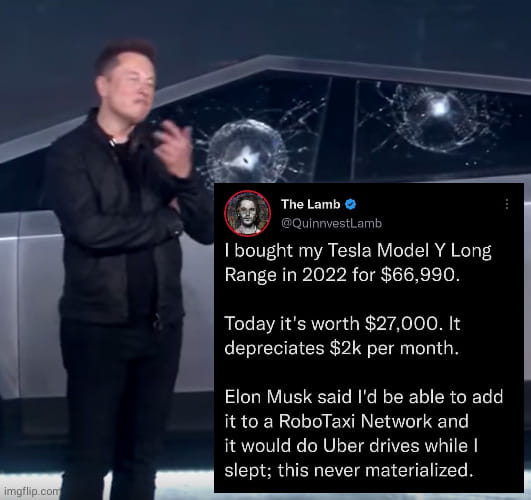
Okay, let's break down this image/text combination with the requested theoretical frameworks. It's a rich piece for analysis, given the convergence of aspirational tech, personal finance, and broken promises. **Visual Description** The image features Elon Musk presenting a spherical object (appears to be a prototype of something, potentially related to neural interfaces or autonomous vehicle technology) with a dramatic, futuristic backdrop. The lighting is stark, almost theatrical. Musk is positioned as a central, almost messianic figure, with hand gestures suggesting a reveal or demonstration of power/innovation. The composition suggests a controlled narrative, a spectacle of technological promise. The text is a social media post (likely from X/Twitter) overlaid on the image. The post contrasts sharply with the grandiosity of the visual; it's a mundane description of financial loss. --- **Foucauldian Genealogical Discourse Analysis** This image and text combination allows for a genealogical exploration of the *discourse of technological promise* and its relation to power/knowledge. * **Genealogy of the “Tech Messiah”:** Musk’s visual presentation is central to this. The image positions him as a figure akin to a technological prophet, someone who *possesses* knowledge that will reshape the future. Foucault would encourage us to look at how this image *constructs* this authority. What historical discourses (scientific progress, entrepreneurial spirit, the "visionary" leader) contribute to this framing? * **Power/Knowledge:** Musk's pronouncements (like the promise of the RoboTaxi network) *become* truth through his position as a tech leader. The social media post then *undercuts* that claim, revealing the gap between promise and reality. This illustrates how power operates through discourse - shaping beliefs and expectations. * **Disciplinary Power:** The promise of the RoboTaxi network subtly disciplines consumers. It encourages a particular mode of consumption (buying a Tesla *for* the future return of rental income) and creates an expectation of "passive income" tied to Musk’s vision. The failure of that vision represents a failure to deliver on a disciplinary model. --- **Critical Theory** From a Critical Theory perspective (drawing on the Frankfurt School), this image/text is a potent example of the “culture industry” and the production of false consciousness. * **Commodification of Dreams:** The image sells *not* a car, but a lifestyle, a future, and an ideological promise. This is a classic function of the culture industry - turning utopian aspirations into consumable commodities. * **Ideology and False Consciousness:** The RoboTaxi promise (and the expectation of future profits) serves to mask the underlying economic realities of capital accumulation. It leads consumers to believe in a system that ultimately benefits those at the top while potentially exploiting those who participate (in this case, Tesla owners who expected a return on their investment). * **The Spectacle:** The image presents a dazzling spectacle (Musk and the futuristic technology), distracting from the mundane and often problematic realities of technological development and consumerism. The text provides a sharp counterpoint, exposing the "spectacle" as a façade. --- **Marxist Conflict Theory** A Marxist reading emphasizes the class dimensions of this situation. * **Capital Accumulation & Exploitation:** The Tesla itself is a product of capitalist production, embodying the extraction of surplus value from labor. The promise of the RoboTaxi network represents an attempt to *further* exploit capital (the cars) and potentially the labor of the owners (by using their vehicles to generate profit for Tesla). * **Alienation:** The owner's financial loss represents a form of alienation – separation from the fruits of their labor and investment. They were led to believe in a system that would provide a return, but the broken promise leads to a loss of capital. * **Class Conflict (subtle):** While not a direct depiction of class conflict, the image highlights the power imbalance between the owner (suffering financial loss) and the corporate/individual leader (Musk, who likely still benefits from the narrative). --- **Postmodernism** A postmodern reading would focus on the deconstruction of grand narratives and the simulation of reality. * **Hyperreality & Simulation:** The image and promise create a hyperreal scenario – a simulation of a future that never fully materializes. The technological spectacle becomes more important than the actual functional value. * **The End of Grand Narratives:** The broken promise of the RoboTaxi network serves as an example of the breakdown of “grand narratives” (like the belief in inevitable technological progress or the promise of endless growth). * **Deconstruction of Authority:** The juxtaposition of the grandiose image and the mundane text *deconstructs* the authority of Musk as a technological visionary. It reveals the gap between rhetoric and reality. --- **Queer Feminist Intersectional Analysis** While not immediately obvious, this analysis can reveal further layers. * **Tech Bro Culture:** The image evokes the aesthetics of “tech bro” culture – a predominantly white, male-dominated space that often promotes disruptive innovation with little regard for its social consequences. This analysis can ask: how does this visual reinforce these power dynamics? * **Financial Vulnerability & Gender/Race:** Financial loss disproportionately affects marginalized communities. A feminist intersectional analysis could explore how gender, race, and class intersect to create greater financial vulnerability, potentially making individuals more susceptible to speculative investments based on empty promises. * **Exclusionary Innovation:** The promise of a “futuristic” solution like a RoboTaxi network can be exclusionary, prioritizing the needs and desires of those with capital and access to technology while ignoring the needs of those who may be excluded or disadvantaged. In conclusion, this seemingly simple image and text combination is a surprisingly complex cultural artifact that can be analyzed through multiple theoretical lenses, revealing layers of power, ideology, and social critique.
tesseract-ocr
[=e gid, | aia Ct ce) . rete ey | bought my Tesla Model Y Long Range in 2022 for $66,990. Today it's worth $27,000. It feet ete) aol Tao Elon Musk said I'd be able to add aoe Belo an Lela) it would do Uber drives while | eal f loam Freeman Mn MTU] -e |
llama3.2-vision
This meme is a screenshot of a tweet from Elon Musk, the CEO of Tesla and SpaceX. The tweet is a response to a user who bought a Tesla Model Y Long Range in 2022 for $66,990, but now it's worth $27,000. The user is complaining that the car's value has depreciated by $39,000 in just two years, and is sarcastically blaming Elon Musk for the decline in value, joking that he's "able to add it to a RoboTaxi Network" and that it would "do Uber drives while I slept; this never materialized."