
First Seen
2024-04-25T04:13:18.938141+00:00
gemma3-27b-vision
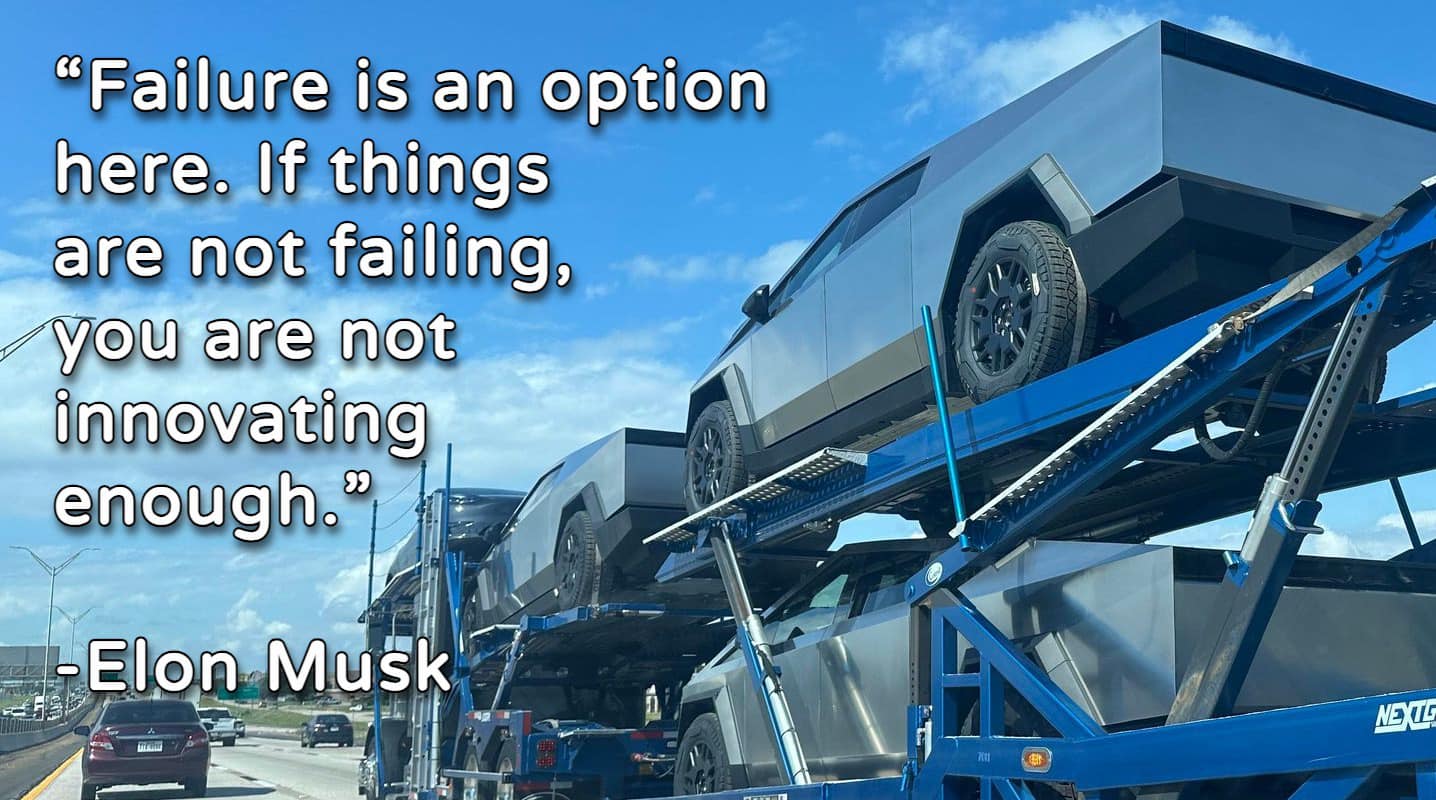
Okay, here's an analysis of the image, broken down into sections as requested. It's a complex image with a loaded quote, so the analyses get quite layered. I'll indicate where a section *doesn't* strongly apply. **Visual Description** The image shows a flatbed truck heavily loaded with what appear to be Tesla Cybertrucks. The trucks are stacked in a somewhat haphazard manner. The lighting suggests a bright, sunny day. A blue sky with some wispy clouds forms the backdrop. The truck appears to be driving on a highway (evident by the blurred vehicles behind it). Overlayed on the image is a white text quote attributed to Elon Musk: “Failure is an option here. If things are not failing, you are not innovating enough.” The text is visually prominent, obscuring part of the image. **Foucauldian Genealogical Discourse Analysis** This image and quote lend themselves well to a Foucauldian analysis. The quote establishes a *discourse* around innovation, risk, and success. Foucault would not be interested in whether Musk's statement is "true" or "false" but rather in how it functions within a *power/knowledge* relationship. * **Power/Knowledge:** The quote constructs a certain idea of "legitimate" innovation. It posits that failure is *necessary* for progress. This isn't a neutral statement; it defines what counts as legitimate experimentation and implicitly devalues approaches that prioritize stability or safety. Musk, as a figure with significant economic and technological power, *produces* this knowledge and influences its dissemination. * **Genealogy of Innovation:** We could trace the genealogy of the concept of "innovation" itself. Historically, innovation hasn't always been celebrated as unequivocally good. The quote constructs it as a moral imperative, linking it to a relentless pursuit of progress. Foucault would ask how this shift in understanding happened, what historical conditions created the need to valorize failure, and what interests are served by this new discourse. * **Disciplinary Power:** The quote subtly disciplines those who attempt innovation. It frames failure not as something to be avoided but as an indicator of meaningful effort. It normalizes a high-risk, high-reward model, potentially pressuring individuals and companies to embrace failure to be seen as truly “innovative”. * **The Truck as a "Document":** The image of the loaded trucks is a visual “document” of this discourse in action. It represents the physical manifestation of this risk-taking innovation. **Critical Theory (Frankfurt School)** The image and quote strongly align with concerns of Critical Theory. * **Instrumental Reason:** The relentless focus on innovation, framed as a positive good, reflects the core concern of the Frankfurt School with *instrumental reason*. Innovation, in this context, isn't about improving human life; it's about technological advancement for its own sake. The quote suggests that the *process* of innovation (even through failure) is more important than the actual outcome or the social consequences. * **Technological Determinism:** There's a subtle element of technological determinism at play. The quote implies that technological progress is inevitable and desirable, and that failure is simply a necessary step along the path. This diminishes the role of human agency and the possibility of consciously shaping technology to serve ethical goals. * **Commodification of Failure:** The acceptance of failure as part of the innovation process can be seen as a form of commodification. Failure becomes a “brand value”, a way to signal audacity and disruptiveness. It's used to attract investment and build a narrative around the company. * **The Illusion of Progress:** Critical theorists would question whether this relentless pursuit of innovation actually leads to genuine progress. They would argue that it often serves to reinforce existing power structures and exacerbate social inequalities. The visual representation of this progress on the truck is a physical indication of the relentless march forward, regardless of the cost. **Marxist Conflict Theory** While less *direct* than the other analyses, a Marxist reading is possible: * **Capital Accumulation:** The innovation emphasized in the quote isn’t about solving social problems but about driving capital accumulation. The failure is acceptable *because* it's within a system where profit is the ultimate goal. Failed experiments can be written off as “research and development” costs, and successful innovations generate even greater profits. * **Class Struggle:** The risks associated with “failing” are not distributed equally. Those with resources (like Elon Musk and Tesla) can absorb the costs of failure much more easily than workers or communities impacted by failed projects. The quote subtly normalizes a system where the wealthy can take risks with other people's livelihoods. * **Alienation:** A relentless focus on innovation can contribute to the alienation of labor. Workers may be treated as expendable resources in the pursuit of technological breakthroughs, rather than as individuals with intrinsic value. The truck and its products serve as a visual indicator of the system's exploitation. **Postmodernism** The image and quote lend themselves to a postmodern reading through several angles: * **Deconstruction of Progress:** The seemingly positive framing of failure subverts traditional notions of “success” and “progress”. It challenges the linear narrative of technological advancement and suggests that failure is an integral part of the process. * **Simulation and Hyperreality:** The image itself is a manufactured representation of innovation. It's a carefully curated visual that presents a particular narrative. The idea that failure is a part of the process is arguably a performative gesture meant to generate publicity and attract investment. * **Loss of Grand Narratives:** The quote can be seen as rejecting the idea of a single, universal path to progress. It embraces ambiguity and acknowledges the inherent unpredictability of innovation. **Queer Feminist Intersectional Analysis** (Least Directly Applicable, But Possible) This is the most tenuous connection, but still worth considering: * **Challenging Normative Success:** The idea that failure is acceptable can be seen as a rejection of traditional norms of success. Queer and feminist thought often challenge these norms, questioning what constitutes “value” and “achievement”. * **Risk and Vulnerability:** The embrace of failure can be linked to the idea of embracing vulnerability. Queer and feminist theorists often emphasize the importance of vulnerability as a source of strength and authenticity. However, it's crucial to note that the risks associated with failure are not evenly distributed. Those who are marginalized (due to gender, race, class, etc.) may face greater consequences for taking risks. * **Intersectionality:** The ability to "fail" and absorb the costs of that failure is deeply intertwined with privilege. Someone with multiple intersecting marginalized identities (e.g., a queer, disabled woman of color) might have significantly less capacity to withstand the consequences of failure than someone with privilege. Let me know if you'd like me to elaborate on any of these analyses!
tesseract-ocr
wc) US Elian) oy ehelKeya i — Tes sare not failing, ss 7 << Fs) y: VOU 2FS NOs A an IMOVEEING), _ pal ac rae {e LA ee ee eX ae : P= re D gg a ai
llama3.2-vision
This meme is a humorous image featuring a large truck carrying multiple Tesla Cybertrucks on a trailer. The image includes a quote from Elon Musk, the CEO of Tesla, that reads, "Failure is an option here. If things are not going well, if you're not getting the results you want, then you're doing something wrong. And you must go back to the drawing board, and you must think about what you are doing wrong, and you must do it faster, and you must get it right, and you must get it right fast. And you must get it right now. And if you don’t get it right, you will be fired. You will be fired. You will be fired." The meme is likely referencing the fact that the Cybertruck was first introduced in 2019 and was expected to be a game-changer in the electric vehicle market, but it has been delayed several times and is still not available to the public.