
First Seen
2024-04-25T03:43:08.135706+00:00
gemma3-27b-vision
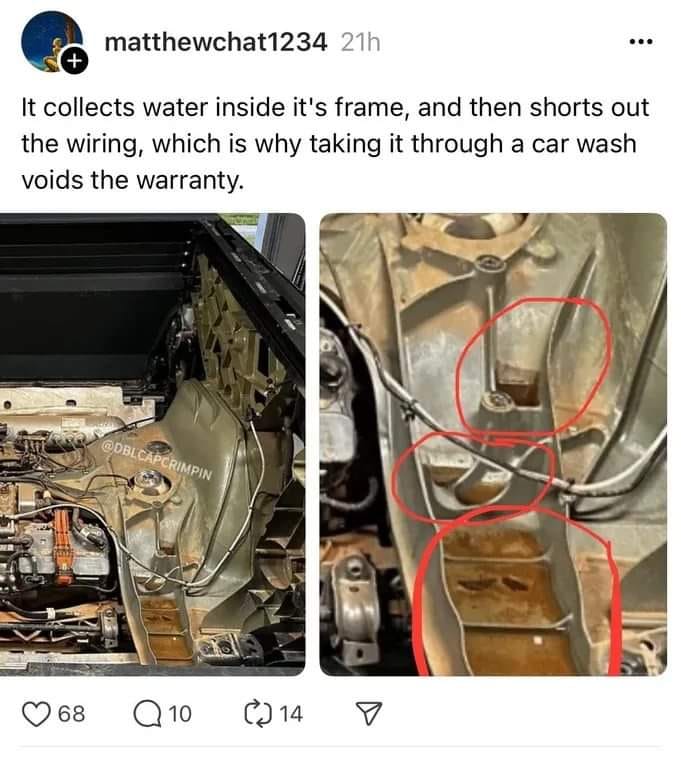
Okay, here's an analysis of the provided image and tweet, broken down into the requested sections. I'll indicate when a section isn't particularly applicable. I'll also emphasize that these analyses, especially when applied to a seemingly mundane image like this, are interpretative and can be approached in multiple ways. **1. Visual Description** The image is a split-panel photograph of the interior of a vehicle's engine compartment. The left panel provides a wider view of the engine bay, showing a significant amount of dirt, grime, and water accumulation. The right panel is a close-up, with red circles highlighting areas where water has collected and potentially caused corrosion or damage. Wiring is visible, running between components. The overall impression is of neglected maintenance and potential mechanical issues. The photograph is clearly taken with a phone. There is a watermark on the left side that says @DBLCAPCRIMPIN. The user posted a tweet saying "It collects water inside it’s frame, and then shorts out the wiring, which is why taking it through a car wash voids the warranty." **2. Foucauldian Genealogical Discourse Analysis** This image and tweet are fertile ground for a Foucauldian analysis. The concept of "warranty" is central. A genealogical approach would investigate the *historical formation* of the warranty as a disciplinary tool. * **Power/Knowledge:** The warranty isn't simply a promise of repair; it’s a power structure. It defines what constitutes acceptable use of the vehicle. The claim that a car wash “voids the warranty” isn’t about preventing damage; it’s about defining the boundaries of acceptability, and asserting control over the consumer. The "knowledge" contained within the warranty terms (often lengthy, dense legalese) *produces* a specific type of driver/owner – one who is cautious, compliant, and willing to accept limitations on their behavior. * **Discipline & Normalization:** The tweet normalizes the idea that a manufacturer can dictate how a vehicle should be used *even after* it's been purchased. The warranty creates a system of surveillance and self-regulation. Owners are implicitly monitored (through potential claims) and encouraged to conform to the manufacturer's rules. The car wash becomes a site where the “normal” behavior (avoiding potential warranty issues) is reinforced. * **Archaeology of the Car Wash:** A deeper analysis could explore the history of the car wash itself. How did this practice emerge? How has it been shaped by technological developments and consumer expectations? And how has the *warranty* interacted with this evolution? The tweet suggests the car wash is an activity that must be regulated to prevent certain consequences. **3. Critical Theory** This image invites a Critical Theory reading centered on the *commodification of the automobile* and the way it shapes our relationship to technology and consumption. * **Instrumental Reason:** The car, as a highly rationalized and technologically advanced product, embodies Max Horkheimer and Theodor Adorno's concept of instrumental reason. The car isn’t meant to be enjoyed; it’s a *means to an end* (transportation, status, etc.). The warranty, then, is a further extension of this rationality—a calculated risk management strategy designed to protect the manufacturer's interests. * **Culture Industry:** The entire process (manufacture, marketing, warranty, maintenance) can be viewed as part of the “culture industry.” This image illustrates how even seemingly simple things like car washes are subjected to the logic of control and commodification. The tweet suggests the car wash is not a simple service, but an activity that must be regulated to prevent potential consequences. * **Alienation:** The warranty contributes to a sense of alienation. The owner doesn’t *fully* own the vehicle. They are subject to the terms and conditions set by the manufacturer. This reinforces the idea that the consumer is not an autonomous agent, but rather a passive recipient of goods and services. **4. Marxist Conflict Theory** From a Marxist perspective, this image highlights the inherent conflict between the *bourgeoisie* (the car manufacturer) and the *proletariat* (the car owner). * **Exploitation:** The warranty is a mechanism for shifting the burden of risk from the manufacturer to the consumer. The manufacturer profits from the sale of the vehicle but avoids liability for defects or malfunctions that might occur under normal use. * **False Consciousness:** The consumer might accept the warranty terms without realizing that they are being exploited. They might believe that the warranty is a benefit, when in reality, it’s a tool for control. * **Class Struggle:** The conflict over warranty claims can be seen as a microcosm of the broader class struggle. The car owner is fighting for their rights, while the manufacturer is defending its profits. **5. Postmodernism** From a Postmodern perspective, this image challenges notions of objective truth and universal standards. * **Simulacra and Simulation:** The warranty itself is a *simulacrum*—a copy without an original. It’s a set of rules that bear little resemblance to the actual complexities of vehicle ownership. * **Deconstruction:** We can *deconstruct* the language of the warranty to reveal its underlying power dynamics. The use of technical jargon and legal disclaimers is designed to obscure the manufacturer's true intentions. * **Fragmentation:** The image of water collecting in the engine bay symbolizes the fragmentation of modern experience. The car is no longer a cohesive, reliable machine; it’s a collection of parts that are prone to failure. **6. Queer Feminist Intersectional Analysis** This is the least directly applicable framework, but a critical reading can still be attempted. * **Control & Bodily Autonomy:** The warranty, as a restrictive contract, can be read as a metaphor for systems that control bodies and limit agency. The manufacturer dictating acceptable use mirrors social constraints placed on marginalized groups. * **Access & Privilege:** The ability to afford a car *and* maintain it in accordance with the warranty terms is a privilege not everyone shares. This ties into issues of class, race, and gender. For example, lower-income communities or people of color may disproportionately bear the burden of vehicle malfunctions due to limited access to quality maintenance. * **Intersectional Oppression:** The tweet could be read as a reflection of systemic inequalities. The car owner, in this scenario, is at the mercy of a powerful institution. The vulnerability is heightened if the owner is already facing other forms of oppression (e.g., based on their gender, race, sexual orientation). I hope this detailed analysis is helpful. It's important to remember that these are just *interpretations*, and other readings are possible. Let me know if you'd like me to elaborate on any of these points.
tesseract-ocr
matthewchat1234 21h ose @ It collects water inside it's frame, and then shorts out the wiring, which is why taking it through a car wash voids the warranty. mp oR Ay B. x ‘ i p = =e 5 4 0 $ re ae ~ Sait ae, eat oy / 1), — Ay | \>) 7 ‘ Ss ase 4 4 Saat a4 f iy oe \ XU Oc6es Qo Ou V7
llama3.2-vision
This meme is an image of a broken car's engine, with a caption explaining that the car's water pump has failed, causing water to leak into the engine. The caption reads: "It collects water inside its frame, and then shorts out the wiring, which is why taking it through a car wash voids the warranty."