
First Seen
2024-04-28T05:16:50.101825+00:00
gemma3-27b-vision
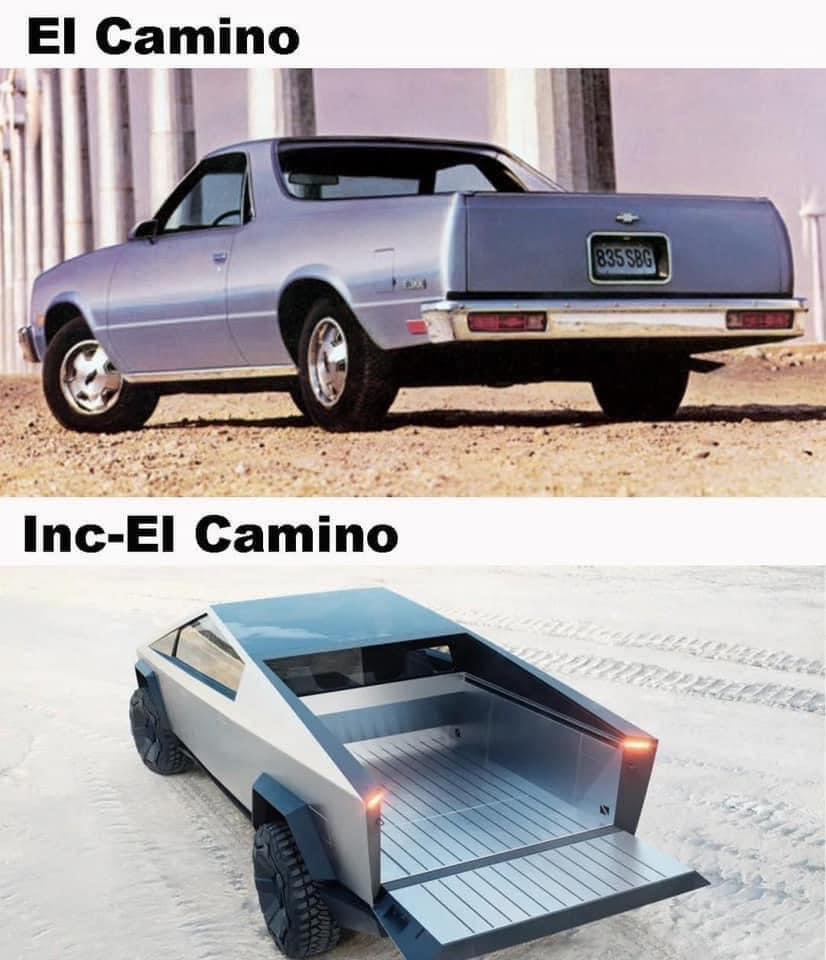
Okay, let's analyze the juxtaposition of the Chevrolet El Camino (1980s model) and a rendering of the Cybertruck (Tesla's envisioned pickup truck) through several theoretical lenses. I'll proceed with headings only for the lenses that truly apply and yield meaningful analysis. ## Visual Description The images present two vehicles, both classified as "coupe utilities" or pickups. The El Camino (top) is a classic example of 1980s American car design: smooth, rounded lines, pastel lavender paint, chrome accents, and a generally “softer” aesthetic. It blends features of a car and a truck, prioritizing comfort and style alongside utility. The wheels are small and the body is close to the ground, further emphasizing its car-like nature. The Cybertruck rendering (bottom) is a dramatic departure. It's sharply angular, constructed from brushed stainless steel, and possesses a deliberately futuristic, even dystopian aesthetic. It's aggressively angular, high-riding, and utilitarian in its appearance. The color is a muted grey. There's a clear visual emphasis on strength and resilience, prioritizing function over form in a way that contrasts sharply with the El Camino. ## Foucauldian Genealogical Discourse Analysis The evolution from the El Camino to the Cybertruck can be understood through a Foucauldian lens examining shifts in *discourses* surrounding masculinity, utility, and societal anxieties. The El Camino represents a discourse of American prosperity and leisure in the 1980s. Its smooth lines and pastel color suggest a focus on comfort and individual expression, mirroring a post-war consumer culture where owning a vehicle wasn't just about transportation, but about *being* something – stylish, successful, and comfortable. The blending of car and truck elements reflects a desire to *have it all*—practicality and luxury. The Cybertruck, conversely, embodies a discourse of anxiety and resilience. Its aggressive, almost militaristic aesthetic speaks to contemporary concerns about environmental disaster, social unrest, and the need for survival. The stainless steel construction and angular form suggest invulnerability, reflecting a desire for vehicles that can withstand extreme conditions. The shift from the sleek, comfortable El Camino to the Cybertruck represents a change in societal priorities – from a celebration of individual comfort to a preoccupation with resilience and survival. It's a genealogy of fear and aspiration for a different kind of future. ## Critical Theory This pairing lends itself to a critique of how technology and design reinforce ideologies. The El Camino, born of a consumerist era, implicitly celebrates a linear progression of “better” vehicles – a focus on superficial updates and style. It’s an embodiment of planned obsolescence. The Cybertruck, while presented as innovative, is still fundamentally a product of capitalist consumption. However, its design *attempts* to disrupt the conventional aesthetic expectations of the automotive industry. It intentionally rejects the streamlining and aerodynamic focus of decades past, opting for a stark, almost brutalist form. This rejection, however, is ultimately packaged as a desirable product, reinforcing the idea that even counter-cultural aesthetics can be commodified. The shift from the El Camino to the Cybertruck thus highlights the complex relationship between technology, design, and ideology. The seemingly “revolutionary” design of the Cybertruck is still ultimately rooted in the same system of production and consumption as its predecessor. ## Marxist Conflict Theory From a Marxist perspective, these vehicles can be seen as embodiments of class and evolving power dynamics. The El Camino, while accessible to a broad range of consumers, represented a middle-class aspiration for upward mobility and leisure. It was a symbol of post-war prosperity. The Cybertruck, with its high price tag and futuristic design, positions itself as a status symbol for the upper classes. It is a vehicle that *demonstrates* wealth and technological privilege. The aggressive aesthetic can be interpreted as a visual assertion of power and dominance, signifying a widening gap between the haves and the have-nots. The shift from the El Camino to the Cybertruck therefore reflects a growing concentration of wealth and the increasing commodification of status symbols. The Cybertruck isn't just a vehicle; it's a statement about economic power. I've refrained from including Queer Feminist Intersectional Analysis as it doesn’t naturally lend itself to the subject matter without a considerable stretch. While these vehicles exist within a social context shaped by gender and power dynamics, those dynamics aren't inherent *in the vehicles themselves* to the degree that they demand analysis through that specific lens. Let me know if you'd like me to elaborate on any of these sections or explore a different theoretical perspective.
tesseract-ocr
El Camino % q \ ) al } ~ betes - - a he \' 5 eae . Eee 5 eel | ee SIRS eC RE imp e e E e a chad ae ae Inc-El Camino xe = a a) ~ wee “I SSS ‘ : <
llama3.2-vision
The meme is a humorous comparison between two vehicles, the Chevrolet El Camino and the Tesla Cybertruck, with a caption that says "El Camino vs. Cybertruck". The image shows a classic 1970s Chevrolet El Camino next to a futuristic, angular Cybertruck, highlighting the stark contrast between the two vehicles' designs.