First Seen
2023-05-10T21:03:34+00:00
simple-description (llama3.2-vision_11b)
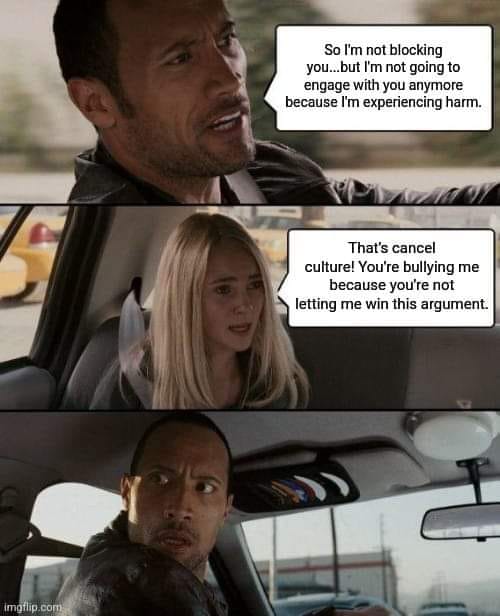
The meme is a screenshot of a scene from the movie "The Rock" where Dwayne Johnson's character is being verbally attacked by a woman. The meme is used to illustrate a situation where someone is being bullied online and the responses they receive are not only unhelpful but also perpetuate toxic masculinity. The text in the image reads: "So I'm not going to engage with you anymore because I'm experiencing harm. That's not a good argument, that's a good reason to leave."
detailed-analysis (gemma3-27b-vision)
Okay, here's an analysis of the meme, broken down into the requested sections, noting where certain frameworks don't particularly apply, and emphasizing where they do.
Visual Description
The meme utilizes a three-panel "Drake Reaction" format. It features images of Dwayne "The Rock" Johnson and Margot Robbie in what appears to be a vehicle (possibly a car chase scene from a film). Each image has text overlaid on it:
- Panel 1 (The Rock): “So I’m not blocking you…but I’m not engaging with you anymore because I’m experiencing harm.”
- Panel 2 (Margot Robbie): “That’s cancel culture! You’re bullying me because you’re not letting me win this argument.”
- Panel 3 (The Rock): The Rock looking somewhat disbelieving/dismissive.
The meme's humour comes from the contrast between a stated desire for disengagement due to personal harm and the immediate labeling of that disengagement as "cancel culture" and "bullying" by the other party, implying a lack of self-awareness or a manipulative framing of the situation.
Foucauldian Genealogical Discourse Analysis
This meme is ripe for a Foucauldian analysis. The core argument revolves around the discourse of harm, bullying, and "cancel culture."
- Power/Knowledge: The Robbie character attempts to reframe disengagement (a form of asserting agency over one's boundaries) as harm done to her. This is an act of power, attempting to define the terms of the interaction and place herself as the victim. "Cancel culture" itself is a discourse - a system of thought, language, and practice - used to delegitimize criticism or accountability. The claim of “bullying” is also a move to claim the moral high ground.
- Genealogy: Examining the history of the terms “bullying” and “cancel culture” shows they have evolved and become increasingly weaponized in online discourse. What was once intended to address real instances of abuse or oppression now often serves as a shield for those facing legitimate critique. The meme highlights this distorted genealogy.
- Discipline & Control: The Robbie character's response implicitly demands that The Rock continue engaging, despite the stated harm. This is a subtle form of control, insisting on a continuation of the power dynamic. The insistence on being allowed to “win the argument” suggests a need to dominate the discourse.
Critical Theory
The meme speaks to themes central to Critical Theory, particularly regarding the manipulation of language and power dynamics.
- Ideology: The Robbie character's response can be interpreted as an example of an ideological maneuver. By framing disengagement as "cancel culture" and "bullying," she attempts to obscure the actual reasons for the disengagement (the harm she caused) and cast herself as the oppressed party. She's attempting to normalize a position of privilege and deflect accountability.
- False Consciousness: There’s an element of false consciousness at play, wherein the Robbie character doesn’t appear to recognize the problematic nature of her framing of the situation. She’s internalizing and reproducing a discourse that serves to maintain power imbalances.
- Hegemony: The widespread acceptance of "cancel culture" as a pejorative term, often used to dismiss legitimate concerns about harmful behaviour, demonstrates the operation of hegemony. The meme is a commentary on this dominant narrative.
Marxist Conflict Theory
While not the primary lens through which to analyze this meme, Marxist ideas can still be applied.
- Power Struggle: The exchange demonstrates a power struggle. The Rock is attempting to exert control over his own boundaries (by disengaging), while Robbie is attempting to wrest control back by framing his action as an act of aggression against her.
- Ideology as a Tool of Domination: The framing of disengagement as "cancel culture" can be seen as a tool used by those in positions of relative power to silence dissent and maintain the status quo.
- Class Dynamics: One could stretch this to see Robbie's insistence on "winning the argument" as a manifestation of a competitive, hierarchical mindset.
Postmodernism
Postmodern ideas are interwoven into the meme’s critique.
- Deconstruction of Meaning: The meme deconstructs the meaning of "harm," "bullying," and "cancel culture." It shows how these terms are used and abused, often stripped of their original meaning to serve particular agendas.
- Meta-Narratives: The meme challenges the meta-narrative of “cancel culture” as inherently oppressive, exposing the way it's used to deflect from real accountability.
- Simulacra and Simulation: The character’s response can be seen as a simulation of victimhood. The focus is on the appearance of being wronged rather than addressing the underlying issue of harm.
Queer Feminist Intersectional Analysis
This is not the strongest framework for analyzing this meme directly. However, it can illuminate certain nuances.
- Silencing & Gaslighting: The Robbie character's response can be read as a form of gaslighting, attempting to deny The Rock's experience of harm and reframe his disengagement as an act of aggression. This is a tactic often used to maintain power dynamics in abusive relationships.
- Emotional Labour: The Rock's attempt to assert his boundaries requires emotional labour, while Robbie deflects and demands continued engagement. This disparity is a relevant feminist point.
- Interlocking Systems of Oppression: While not explicit, the meme touches on the way that privileged individuals can weaponize discourses of victimhood to avoid accountability for harmful behaviour.
In conclusion, this meme is a surprisingly rich text for analysis. It is most effectively approached through Foucauldian discourse analysis and Critical Theory, but also lends itself to interpretations grounded in Postmodernism and, to a lesser extent, Marxist and Queer Feminist perspectives.
simple-description (llama3.2-vision)
This meme is a screenshot from the 2013 movie "Fast & Furious 6" where Dwayne "The Rock" Johnson's character, Luke Hobbs, is driving and his passenger, a woman, is being threatened by a villain. The text in the image is a quote from the movie, but it's been edited to be a humorous and relatable conversation between two people on the internet, where one person is trying to get out of an argument and the other is being stubborn.
tesseract-ocr
Som not blocking \. you...but I'm not going to engage with you anymore SM because I'm experiencing harm. Tad — . = = Ti That's cancel I) culture! You're bullying me y | | because you're not il }) letting me win this argument. “Be ie , A hg = Py . ty oe \ ut