First Seen
2023-08-16T00:24:36+00:00
simple-description (qwen3.5_2b-q8_0)
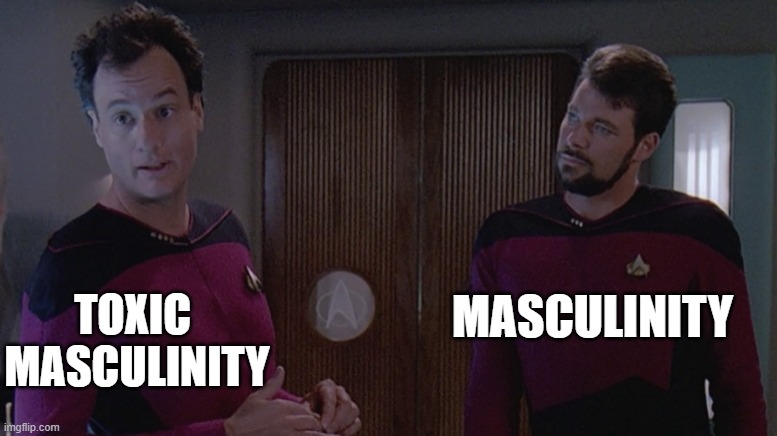
This humorous image contrasts two views of male behavior from the TV show Star Trek to explain the difference between toxic and healthy masculinity.
On the left, a character reacts with shock and is labeled "TOXIC MASCULINITY," implying that this specific type of behavior is harmful or outdated. On the right, a stoic, calm figure is labeled "MASCULINITY," suggesting that the confident and relaxed demeanor on the right is the healthy, positive version of being a man. The joke is that "toxic masculinity" is something that isn't normal masculinity, which is portrayed as the standard in this scene.
simple-description (llama3.2-vision_11b)
This meme is from the category Anti-Toxic-Masculinity, which critiques traditional masculine norms and stereotypes that perpetuate harm and oppression. The meme is likely a humorous or satirical take on the concept of toxic masculinity, poking fun at the idea that masculinity is inherently toxic or that men are inherently flawed. The image is not available, but the text "Toxic Masculinity" is likely overlaid on a humorous or ironic image, highlighting the absurdity of the concept.
detailed-analysis (gemma3-27b-vision)
Okay, let's break down this meme using the requested theoretical lenses.
Visual Description
The image is a meme using a side-by-side comparison of two actors in Star Trek: The Next Generation uniforms. On the left is Brent Spiner as Data (an android), appearing slightly bewildered with a raised eyebrow and a questioning facial expression. On the right is John de Lancie as Q (an omnipotent being), looking stoic and with a slight beard. Text overlays the image, labeling Data with “TOXIC MASCULINITY” and Q with “MASCULINITY”. The format suggests a comparison – a humorous attempt to assign archetypal labels to the characters. The "imgflip.com" watermark is at the bottom, indicating this was created on a meme generator website.
Foucauldian Genealogical Discourse Analysis
This meme subtly engages with Foucault's ideas about power, knowledge, and discourse. The terms "toxic masculinity" and "masculinity" aren’t neutral; they're constructions – categories created through historical and social processes.
- Discourse: The meme participates in the current discourse around masculinity, one heavily laden with critiques of traditional masculine norms. It’s an attempt to define and differentiate between "acceptable" and "unacceptable" forms of masculine expression.
- Genealogy: The meme implicitly acknowledges a history of what is considered "masculinity". It suggests that the characteristics associated with "toxic masculinity" (represented by Data's confused expression) have been historically positioned as the default, dominant form. The meme implies that "masculinity" (Q's presentation) is a different, and potentially more evolved, form.
- Power/Knowledge: The meme's creators, by labeling these characters, are engaging in a power dynamic. They are defining what constitutes "toxic" versus "normal" masculinity. This is a power move to influence how these concepts are understood and discussed.
- Data’s Representation: The depiction of Data as “toxic masculinity” could be because he is an artificial being attempting to understand and perform masculinity, often with awkward or unsettling results. He represents a “performance” of the stereotypes.
Critical Theory
From a Critical Theory perspective, this meme can be analyzed as reflecting and commenting on societal power structures.
- Ideology: The meme suggests a critique of traditional masculine ideology. The labeling of “toxic masculinity” implies that certain aspects of masculinity are harmful, oppressive, and contribute to social inequalities.
- Domination/Oppression: Critical Theory would see this meme as identifying how dominant forms of masculinity contribute to systems of oppression – potentially impacting women, other men, and LGBTQ+ individuals.
- Critique of Norms: The meme’s very existence challenges the naturalness of traditional masculinity. It implicitly questions why certain behaviors are considered "masculine" and argues they aren't necessarily positive.
- Cultural Critique: The use of Star Trek characters is important. Star Trek often presents progressive visions of gender and social roles. The meme leverages that association to reinforce the idea that harmful forms of masculinity are outdated or undesirable.
Marxist Conflict Theory
While not a primary focus, a Marxist reading of the meme can illuminate some aspects.
- Social Control: Traditional masculinity can be seen as a tool of social control, used to maintain class hierarchies and enforce power dynamics. The meme's critique of "toxic masculinity" implicitly challenges these structures.
- Alienation: "Toxic masculinity" can be seen as alienating individuals from their emotions, leading to isolation and potentially contributing to conflict. The meme could be interpreted as a commentary on the ways in which rigid gender roles contribute to social fragmentation.
- Material Conditions: Although the meme doesn't directly address material conditions, it could be argued that harmful forms of masculinity are rooted in societal structures that prioritize competition, domination, and economic gain.
Postmodernism
A postmodern lens sees this meme as a playful deconstruction of categories.
- Deconstruction of Binary Oppositions: The meme sets up a binary opposition ("toxic" vs. "masculinity") but then subtly destabilizes it. It implies that the distinction isn’t clear-cut, and that even “masculinity” itself is a constructed category.
- Playfulness/Irony: The use of Star Trek characters is inherently ironic. The series is known for its exploration of complex social issues, but the meme reduces those issues to a simple comparison.
- Fragmentation and Relativism: The meme contributes to a broader sense of fragmentation and relativism. It suggests that there isn’t one "correct" way to be masculine and that the meaning of masculinity is constantly shifting.
- Simulacra & Simulation: The meme simulates a conversation about masculinity. It's a representation of a representation, divorced from any "real" experience.
Queer Feminist Intersectional Analysis
This perspective provides a nuanced understanding of the meme.
- Challenging Hegemonic Masculinity: The meme explicitly challenges the dominant, often harmful, version of masculinity (“toxic masculinity”).
- Intersectional Approach: The term “toxic masculinity” itself is rooted in feminist and queer scholarship that recognizes how harmful masculine norms intersect with other forms of oppression – sexism, racism, homophobia, etc.
- Performance of Gender: The characters chosen are interesting in this context. Both Data and Q are figures who, in their own ways, are performing gender, highlighting the constructed nature of those roles. Data’s attempts to understand masculinity are awkward and often misfire, while Q embodies a more fluid, non-traditional form of power.
- Subversion of Norms: The meme’s humor and use of fictional characters can be seen as a form of subversion, challenging the status quo and opening up space for alternative ways of being masculine.
- Power Dynamics: The meme implicitly addresses the power dynamics inherent in traditional masculinity and the ways in which those dynamics can harm individuals and communities.
I hope this detailed breakdown is helpful! Let me know if you'd like me to elaborate on any of these theoretical lenses.
simple-description (llama3.2-vision)
This meme is a play on the Star Trek: The Next Generation character Data, who is an android with a lack of understanding of human emotions and behavior. The meme shows Data with the words "TOXIC MASCULINITY" and "MASCU-LINITY" written on either side of him, highlighting the difference between the two. The implication is that "TOXIC MASCULINITY" is a negative and harmful form of masculinity, while "MASCU-LINITY" is a more neutral and positive term.
tesseract-ocr
TOXIC MASCULINITY ATTA