First Seen
2023-09-22T02:44:42+00:00
simple-description (qwen3.5_2b-q8_0)
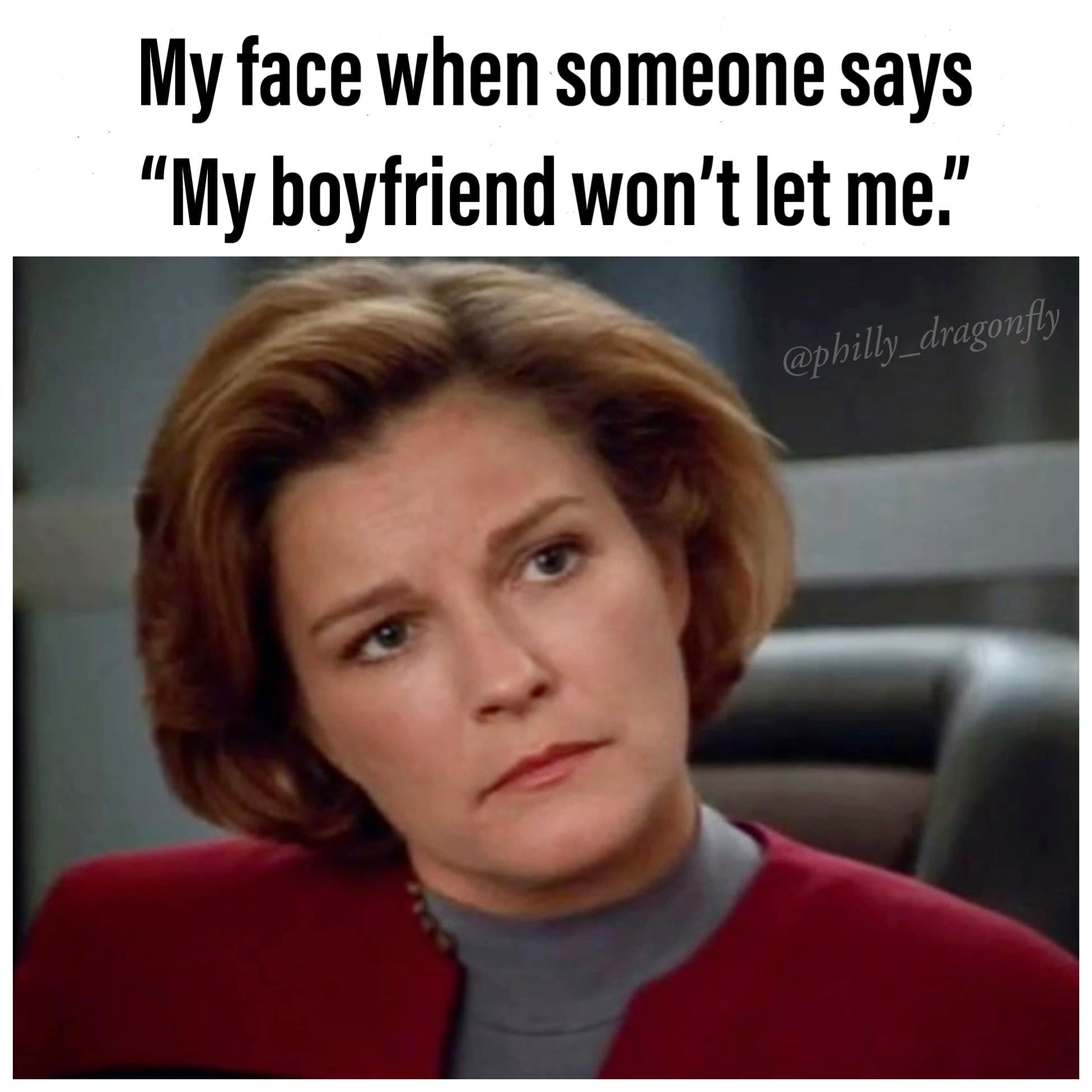
This meme features the character Dr. Who looking confused and resigned as she reads her own caption. The text reads, "My face when someone says 'My boyfriend won't let me.'" In the context of anti-toxic masculinity, this image humorously depicts the awkward reality of a man being rejected by a woman; it portrays a moment of confused silence rather than the aggressive dominance or domination often associated with toxic masculinity.
simple-description (llama3.2-vision_11b)
This meme is part of the Anti-Toxic-Masculinity category, which aims to challenge and subvert traditional masculine norms and behaviors that can be toxic or oppressive. The meme features a screenshot of a character from the TV show "Star Trek: The Next Generation" with a caption that reads: "When someone says 'I'm not a feminist but...'". The image is meant to be humorous and ironic, poking fun at the common trope of someone claiming to be opposed to feminism while still holding sexist or misogynistic views.
detailed-analysis (gemma3-27b-vision)
Okay, here’s an analysis of the image/meme, broken down into the sections you requested, only where those theoretical lenses clearly apply. It's a strong meme with a lot of potential for these readings, so I'll be relatively detailed where appropriate.
Visual Description
The image is a screen capture from Star Trek: The Next Generation, featuring actress Deanna Troi, who plays the ship's counselor. She is a middle-aged Caucasian woman with short, reddish-brown hair styled in a classic 90s bob. She is wearing a burgundy uniform typical of Starfleet officers. Her expression is the focal point. She's looking slightly to the side, with a raised eyebrow and pursed lips. The overall mood conveyed is one of strong disapproval, perhaps tinged with incredulity and condescension. The lighting is soft, and the background is blurred. The meme text reads "My face when someone says 'My boyfriend won't let me'." The account name "@philly_dragonfly" is also included.
Foucauldian Genealogical Discourse Analysis
This meme is strongly suited to a Foucauldian analysis. The phrase “My boyfriend won’t let me” isn't simply about romantic denial. It’s a deployment of power dynamics. Foucault’s work examines how discourse – language and how we speak about things – constructs power relationships. Here, the phrase normalizes a power imbalance within heterosexual relationships. It positions the boyfriend as the authority, the ‘granter’ of permission, and the speaker as someone who requires permission to act.
A genealogical approach would trace the historical development of this discourse. Before modern feminist thought, this type of phrasing was far more common and accepted. It reflected a patriarchal system where women were seen as the property of, or dependent upon, men. The meme’s humor, and Troi’s disapproving expression, function as a challenge to this historically embedded discourse. Troi, as a skilled counselor on a technologically advanced vessel dedicated to exploration, represents a rejection of those patriarchal norms. The meme implicitly deconstructs the idea that anyone should “let” another adult engage in activities. It highlights the absurdity of seeking permission for self-determination.
The meme isn’t simply about individual agency; it’s about how language itself perpetuates systems of control.
Queer Feminist Intersectional Analysis
This meme also lends itself to an intersectional queer-feminist reading. The phrase "My boyfriend won't let me" implicitly assumes a heterosexual relationship. Queer theory challenges the normalization of heterosexuality and explores how power operates within all gender and sexual identities. The meme, while focusing on a heterosexual dynamic, highlights the broader issue of control and domination in relationships, regardless of sexual orientation or gender identity.
An intersectional perspective recognizes that experiences of control and domination are compounded by other forms of oppression, such as race, class, disability, and immigration status. For instance, a woman of color who says "My boyfriend won't let me" may be navigating layers of oppression related to both gender and race.
The meme, by highlighting the problematic nature of the phrase, challenges the assumption that relationships should be built on control. The disapproving look from Troi, a character who frequently deals with the psychological well-being of others, signals that healthy relationships should be based on equality, respect, and mutual consent, not permission.
Critical Theory
Critical Theory, broadly, concerns itself with challenging power structures and ideologies that perpetuate social inequalities. The meme fits within this framework. The seemingly harmless phrase "My boyfriend won't let me" is symptomatic of a larger societal issue: the persistence of patriarchal control over women.
The meme doesn't offer a solution, but it acts as a critique of the status quo. It exposes the underlying power dynamics that normalize this kind of phrasing. It asks us to question why someone would need permission from a partner to make their own choices. Troi's look serves as a signal that this behavior is not acceptable.
I intentionally omitted sections for Marxist Conflict Theory and Postmodernism. While one could force a connection, those frameworks aren’t particularly central to the meme's core meaning. Marxist theory would require a focus on class conflict, which is less relevant here. Postmodernism, while concerned with deconstruction, isn't the most effective lens to understand the meme's challenge to specific power dynamics.
Let me know if you'd like me to elaborate on any of these points!
simple-description (llama3.2-vision)
This meme features a still image of a woman from the TV show "Star Trek: The Next Generation" with a shocked expression. The text at the top reads "My face when someone says 'My boyfriend won't let me...'" and the bottom text says "'...go to the bathroom alone'". The image is a humorous representation of a person's reaction to a ridiculous or absurd situation.
tesseract-ocr
My face when someone says “My boyfriend won't let me.’