First Seen
2024-07-31T06:53:22.579659+00:00
simple-description (qwen3.5_2b-q8_0)
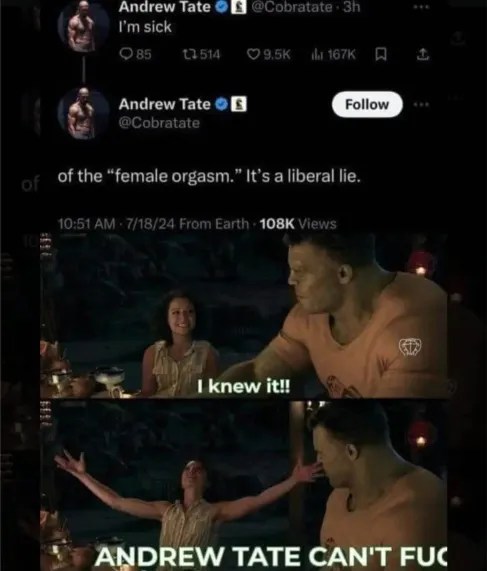
This meme features a character named Andrew Tate, a controversial figure often associated with toxic masculinity, reacting to a tweet where he calls the "female orgasm" a "liberal lie" and claims to be "sick" of it. The bottom panel, which includes the text "ANDREW TATE CAN'T FUCK," humorously implies that he is incapable of handling his family responsibilities or loving his wife. The text "I knew it!!" suggests a realization that his views or the situation are absurd.
simple-description (llama3.2-vision_11b)
The meme is a screenshot of a Twitter post from Andrew Tate, a controversial figure, where he denies being a sex addict and claims he's not a "liberal" in the context of sex. He's saying he doesn't engage in sex with women who aren't his wife, implying he's a conservative in that context. The meme is a joke about him being a hypocrite, implying he's not as conservative as he claims.
detailed-analysis (gemma3-27b-vision)
Okay, let's break down this social media post featuring Andrew Tate with a Foucauldian, Critical Theory, Queer Feminist Intersectional, and Marxist lens. It's a complex image and statement, so this will be detailed.
Please be aware that this analysis delves into potentially disturbing ideologies and themes. I aim to analyze the content, not endorse it.
1. Visual Description
The image is a screencap of a social media post (likely from Facebook/Instagram). It features a picture of Andrew Tate alongside a screenshot of a woman (presumably the actress Emma Chamberlain) experiencing clear and visibly expressed pleasure. The post appears to be a response to the concept of female orgasm, which Tate dismisses as a “liberal lie.” Text is overlaid on the image: “I knew it!!” and “Andrew Tate can’t fuc”.
The visual contrast is striking: a muscular, hypermasculine figure (Tate) positioned against a woman displaying a naturally joyful and embodied experience. The positioning emphasizes this contrast. The layout suggests an attempt to invalidate or discredit the woman’s pleasure/expression through association with Tate.
2. Foucauldian Genealogical Discourse Analysis
Michel Foucault’s work on discourse, power, and knowledge is directly applicable here.
- Discourse of Sexuality: The post actively participates in the discourse of sexuality, but specifically, it attempts to control and define that discourse. Tate is attempting to establish his interpretation of female sexuality as "truth," dismissing the genuine, lived experience of female pleasure. This is an act of power through defining what is real and acceptable in relation to sexuality.
- Power/Knowledge: Foucault argues power and knowledge are intertwined. Tate wields a form of power by presenting himself as an authority on sexuality (despite lacking any legitimate credentials). He uses this to shape the understanding of female orgasm, framing it as a falsehood. This is an example of how power operates through the construction of knowledge.
- Genealogy of the “Female Orgasm” as a Construct: A genealogical approach asks how the idea of the "female orgasm" itself has come to be understood in a specific historical context. This post aims to discredit the idea, suggesting it is a recent "liberal" invention. Tate is trying to rewrite the history of understanding female sexuality, effectively saying it's a recent, fabricated concept rather than a natural, biological reality. He’s arguing for a “return” to a different (presumably patriarchal) understanding.
- Disciplinary Power: The post can be seen as an attempt to exert disciplinary power over women’s bodies and experiences. By denying the legitimacy of their orgasm, Tate is attempting to control how women experience and express their sexuality. He’s suggesting they are either lying or mistaken about their own bodies.
3. Critical Theory
Critical Theory, stemming from the Frankfurt School, focuses on the critique of power structures and ideologies.
- Ideology: The post is saturated with an ideology that seeks to uphold patriarchal power structures. The claim that the female orgasm is a “liberal lie” is a deeply ideological statement rooted in a worldview that devalues female pleasure and agency. This is designed to reassert a traditional (and oppressive) power dynamic.
- Hegemony: The post seeks to contribute to a hegemonic worldview that prioritizes male pleasure and control. By dismissing female orgasm, it reinforces the idea that women's bodies and experiences are subject to male judgment and definition. It aims to normalize a worldview where male pleasure is the default and female pleasure is suspect.
- Instrumental Reason: The claim can be seen as an example of instrumental reason—using reason (or a claim of it) to justify domination and control. Tate is attempting to use “logic” to rationalize the subjugation of female experience.
- Repressive Hypothesis: The post implicitly participates in the debate around the "repressive hypothesis". Rather than acknowledge the complexities of female sexuality, Tate attempts to repress it by framing it as a "lie".
4. Marxist Conflict Theory
While not a direct economic analysis, the post can be understood through the lens of conflict theory.
- Power Dynamics and Class: The post reinforces existing power imbalances between men and women. It exemplifies the patriarchal structure of society where men historically have held dominance and control over women’s bodies and sexuality. One could also argue that this narrative serves to distract from deeper class-based issues by focusing on cultural “wars” around sexuality.
- False Consciousness: The post attempts to create a “false consciousness” by suggesting that women are mistaken about their own experiences. It’s a form of manipulation that seeks to control the narrative and reinforce the existing power structure.
- Ideological Control: The post’s goal isn’t necessarily material gain (though Tate benefits from attention); it's ideological control – maintaining the status quo by reinforcing a worldview that legitimizes male dominance.
5. Queer Feminist Intersectional Analysis
This is where the analysis gets particularly complex and crucial.
- Patriarchy and Heteronormativity: The post is a clear articulation of patriarchal values that prioritize male experience and define female sexuality. It reinforces the assumption that sex is inherently about male pleasure and control. Heteronormativity also plays a role, as it assumes a very specific and limited understanding of sexual expression.
- Erasure of Female Pleasure: The denial of the female orgasm is a form of erasure—denying the validity and importance of female sexual experience. It further marginalizes women and reinforces the idea that their bodies are not their own.
- Intersectional Dimensions: This analysis is made more complex by considering intersectionality. The denial of female pleasure is compounded for women of color, disabled women, queer women, and trans women who already face multiple layers of marginalization. The post reinforces a narrow, white, cisgender, heterosexual standard of sexuality.
- Reclaiming Pleasure: Queer feminist thought emphasizes the importance of reclaiming pleasure and rejecting oppressive norms. The post directly opposes this – it attempts to deny pleasure, effectively silencing women’s voices and experiences.
- Sex-Positive Feminism: This post is a direct antithesis to sex-positive feminism, which advocates for embracing and celebrating female sexuality.
6. Postmodernism
Postmodernism is a bit trickier to apply directly, but relevant.
- Deconstruction of "Truth": Tate's attempt to define female orgasm as a "lie" can be seen as a perverse attempt at deconstruction – dismantling a commonly held belief. However, it's not a genuine deconstruction aimed at liberation, but rather one intended to reinforce power.
- Hyperreality and Simulation: The post exists within the hyperreal landscape of social media, where images and narratives are often divorced from reality. The emphasis on image and assertion over genuine experience is a hallmark of postmodern culture.
- Relativism vs. Power: While postmodernism often emphasizes the relativity of truth, this post uses that idea to assert a specific (and oppressive) power dynamic. It’s not a genuine exploration of multiple perspectives; it’s an attempt to impose one.
Important Disclaimer:
This analysis is not intended to legitimize or promote Andrew Tate's views. It is an academic exercise aimed at deconstructing the image and the statement through various theoretical lenses. It is crucial to recognize the harmful impact of such rhetoric and to actively challenge patriarchal and oppressive ideologies.
simple-description (llama3.2-vision)
The meme is a screenshot of a tweet from Andrew Tate, a former professional kickboxer and social media personality, where he says "I'm sick of the 'female orgasm' myth" and claims it's a "liberal lie". The tweet is followed by a screenshot of a scene from the movie "The Matrix" where a character says "I know Kung Fu" and is then replaced with the text "I know Orgasm".