First Seen
2023-05-10T21:03:34+00:00
simple-description (llama3.2-vision_11b)
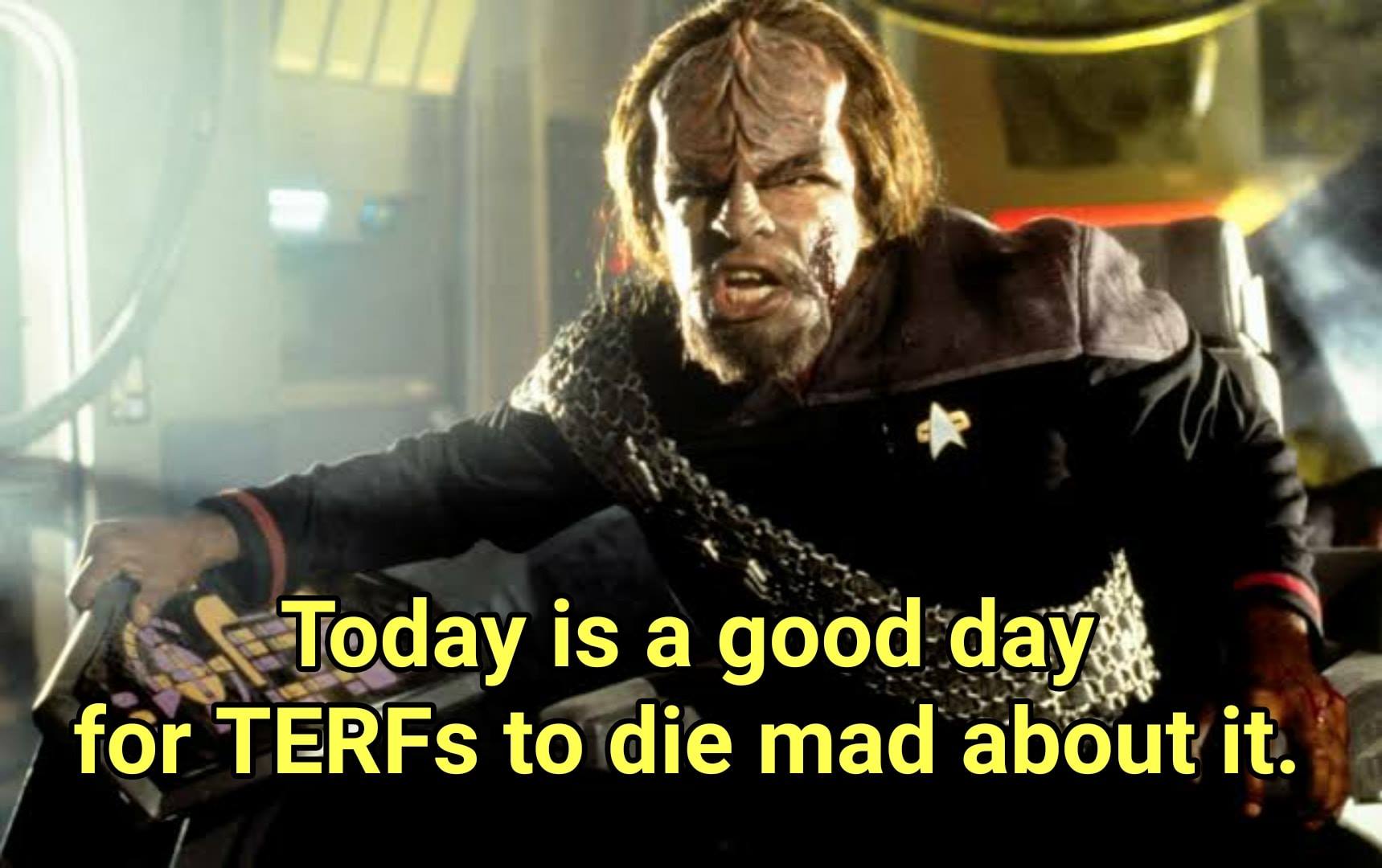
The meme is a screenshot of the Star Trek: Deep Space Nine character Worf, with the text "Today is a good day for TERFs to die" overlaid on top. The image is likely being used to express a sentiment of anger or frustration towards those who identify as Trans Exclusionary Radical Feminists (TERFs), a group that opposes transgender rights. The meme is a darkly humorous way of expressing a desire for the demise of those who are opposed to transgender rights.
detailed-analysis (gemma3-27b-vision)
Okay, here's an analysis of the image and its text, broken down into sections based on the frameworks you requested. Please note that applying all these frameworks to a single meme-like image is a bit of an exercise in theoretical overreach, but I'll do my best to offer a thoughtful response within each section where applicable.
Visual Description
The image features Boromir from The Lord of the Rings: The Fellowship of the Ring. He is in a battle pose, looking forward with a determined (and somewhat manic) expression. He's wearing chainmail, and looks like he is ready to fight. The image is washed with a grey-blue hue, suggesting a tense, dramatic, and possibly chaotic environment. The text “Today is a good day for TERFs to die mad about it.” is superimposed onto the image. The composition utilizes a close-up of his face, heightening the intensity of his expression.
Foucauldian Genealogical Discourse Analysis
This image, with its superimposed text, can be approached through a Foucauldian lens by examining the discourse around gender, sex, and transgender identity.
- Power/Knowledge: The image establishes a power dynamic. Boromir, a figure of strength and resolve, is linked to a declaration of triumph over a specific group (“TERFs” - Trans-Exclusionary Radical Feminists). The statement implicitly positions transgender rights as a struggle against this group, creating a binary.
- Genealogy: To understand the discourse, we might trace the genealogy of the term "TERF." It has emerged in recent years to label feminists who explicitly exclude transgender women from the category of "womanhood" and resist their inclusion in feminist spaces. This label itself is a site of contestation; TERFs often reject the label as derogatory.
- Discursive Formation: The statement isn't simply about individual disagreement. It represents a broader discursive formation where the debate over transgender rights has become increasingly polarized and combative. The use of Boromir, a figure of a last stand, implies a similar intensity in the current discourse.
- Normalization & Exclusion: By associating triumph with the frustration of TERFs, the image normalizes a position that actively excludes a certain feminist ideology and positions it as something to be overcome.
Critical Theory
From a critical theory perspective (drawing from the Frankfurt School), the image presents several points for consideration.
- Ideology: The image is not a neutral statement. It reflects a specific ideological position regarding gender identity and the role of feminists. The implicit message is that transgender rights are right and that those who oppose them are "on the wrong side of history."
- Domination & Resistance: The statement can be seen as a form of symbolic resistance against what is perceived as the oppressive ideology of TERFs, which actively seeks to exclude and marginalize transgender women.
- Mass Culture: The use of a recognizable image from popular culture (Lord of the Rings) is significant. It co-opts a familiar narrative of struggle and applies it to a contemporary social issue. This can be a powerful way to spread a message, but also simplifies complex issues.
- False Consciousness: It's possible to argue that the statement itself contributes to a form of "false consciousness." By framing the issue as a simplistic battle between "us" and "them", it obscures the nuances and complexities of gender identity and feminist thought.
Queer Feminist Intersectional Analysis
This is where the image is particularly potent.
- Transgender Liberation: The statement directly relates to the struggle for transgender liberation and the right to self-determination. It’s a celebration, albeit a somewhat aggressive one, of resisting exclusion and affirming transgender identity.
- Intersectional Conflict: The core of the image represents a conflict within feminism. TERF ideology directly impacts transgender women and other non-binary individuals. An intersectional analysis emphasizes that gender identity is not experienced in isolation; it intersects with other aspects of identity (race, class, sexuality, ability, etc.). TERF beliefs often reinforce existing power imbalances.
- Inclusion/Exclusion: The image centers on the question of who is included within the category of "woman" and who is excluded. TERF ideology inherently excludes transgender women, while the image actively challenges that exclusion.
- Reclaiming Narrative: The use of a heroic figure like Boromir can be seen as a way to reclaim a narrative of struggle and resilience for the transgender community. It suggests that they are engaged in a battle for recognition and rights.
- The Politics of Anger: The somewhat aggressive tone (“die mad about it”) is worth noting. It speaks to the frustration and anger experienced by many transgender individuals who have faced discrimination and violence.
Note: Marxist Conflict Theory and Postmodernism don't fit as well. While you could force a Marxist reading around "class conflict" or a Postmodern reading around the deconstruction of gender, they are less directly relevant than the other frameworks. This is because the primary focus of the image is on identity and power dynamics within a specific social debate, rather than economic structures or the fragmentation of meaning.
I hope this breakdown is helpful! Let me know if you'd like me to elaborate on any specific aspect or explore another theoretical lens.
simple-description (llama3.2-vision)
This meme features a photo of Worf, a character from the Star Trek: The Next Generation TV series, with a stern expression. The text overlayed on the image reads: "Today is a good day for TERFs to die". The meme is likely a commentary on the controversy surrounding the "TERFs" (Trans-Exclusionary Radical Feminists) and their views on trans people, with the image implying that it's a good day for them to pass away.
tesseract-ocr
i &\ — f i => ‘ioe oe (Ry ae | AR a | 5 J on | ha ; j for TERFs to'die mad about it. - a a