First Seen
2023-05-10T21:03:34+00:00
simple-description (llama3.2-vision_11b)
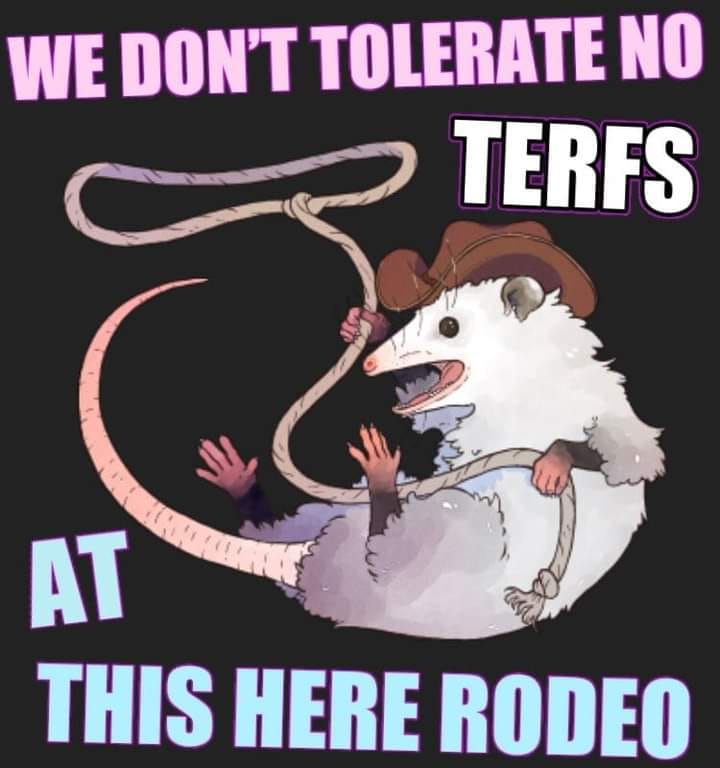
The meme features a cartoon image of a white opossum wearing a cowboy hat and holding a lasso, with the text "We don't tolerate no transphobes at this here rodeo" above it. The image is a playful take on the classic Western phrase "We don't tolerate no [insert group] at this here [location]" and is used to express a commitment to inclusivity and acceptance of the trans community.
detailed-analysis (gemma3-27b-vision)
Here's an analysis of the image, broken down into sections based on the requested theoretical frameworks. Note that some sections are more applicable than others; I'll indicate where a framework doesn't quite fit.
Visual Description
The image depicts a cartoon opossum in a humorous, slightly threatening pose. The opossum is lying on its side, seeming to "play dead" (a natural defense mechanism), but with its mouth open in a somewhat aggressive grimace. It is illustrated in a soft, pastel color palette with pinks, purples, and whites. Above the opossum, there is a cartoon rope, visually suggesting a lasso. The text "WE DON’T TOLERATE TERFS AT THIS HERE RODEO" is overlaid on the image, in a bright pink, western-style font. The background is black. The combination of the opossum, lasso, and western phrasing creates a playful, ironic tone, though the message is explicitly exclusionary.
Queer Feminist Intersectional Analysis
This image is deeply rooted in contemporary queer feminist debates. The acronym "TERF" stands for "Trans-Exclusionary Radical Feminist", referring to individuals identifying as feminists who do not believe transgender women are women. The image’s forceful rejection of TERFs is central to many queer and trans activist spaces.
- Exclusion and Boundaries: The phrase "WE DON'T TOLERATE" establishes a clear boundary and sets a condition for belonging. It asserts a power dynamic, dictating who is deemed acceptable within a specific community.
- Trans Inclusion: The explicit targeting of TERFs signals a commitment to the inclusion of transgender women within feminism. It critiques what is seen as a harmful and exclusionary branch of the movement.
- Intersectional Connection: The use of a slightly comical image challenges the power dynamics surrounding the term and draws attention to the harm caused to trans individuals and their communities.
- "Rodeo" & Western Imagery: The use of the phrase "this here rodeo" adds a layer of ironic hyper-femininity and reclamation, linking inclusivity with a typically masculine space. This could be interpreted as a statement of power, taking control of the narrative.
Marxist Conflict Theory
While not the primary mode of analysis, conflict theory can be applied. The image represents a conflict within feminist discourse, with the rejection of TERFs signifying a power struggle over the definition of feminism and the inclusion of marginalized groups.
- Class/Group Conflict: It represents a struggle for recognition and legitimacy between different factions within the broader feminist movement. TERFs and those who advocate for trans inclusion can be seen as vying for dominance in defining the ideological framework.
- Ideological Struggle: This is an expression of a power struggle to establish the dominant ideology within the feminist movement—one that is inclusive and affirming of trans women versus one that is exclusionary.
Foucauldian Genealogical Discourse Analysis
Foucault’s approach is relevant in understanding the historical emergence and power relations surrounding the terms and concepts within the image.
- Discursive Formation: The term "TERF" itself is a relatively recent discursive formation. Understanding its genealogy—how it emerged, who coined it, and how it’s been used—reveals the power dynamics at play in defining and categorizing feminist positions.
- Power/Knowledge: The image illustrates the interplay of power and knowledge. Those rejecting TERFs are wielding a "knowledge" that defines TERF ideology as harmful and exclusionary, and they’re exercising power by attempting to exclude those deemed to hold those beliefs.
- Normalizing Discourse: The image can be seen as an attempt to normalize inclusive feminist discourse and marginalize exclusionary viewpoints. The assertive tone and clear boundary-setting contribute to this process.
Postmodernism
Postmodernism's applicability is limited, but a few points can be made.
- Deconstruction of Categories: The image implicitly deconstructs the notion of a unified "feminism," highlighting the internal contradictions and disagreements within the movement.
- Irony and Playfulness: The somewhat absurd combination of the opossum, lasso, and western phrasing could be seen as a postmodern embrace of irony and playfulness in political messaging. However, this is less central to the image’s overall message.
Critical Theory
Critical theory can analyze the power dynamics present in the image.
- Ideology Critique: The image can be read as a critique of the ideology underpinning TERF perspectives, which are seen as perpetuating harm and exclusion.
- Domination and Resistance: The rejection of TERFs can be viewed as a form of resistance against ideologies that reinforce cisnormative and exclusionary social norms.
- Power Relations: The image illustrates the power relations at play in shaping discourse around gender, sexuality, and feminism. Those creating and sharing the image are asserting their power to define what constitutes acceptable feminist thought.
It's important to note that these are not mutually exclusive interpretations. Several theoretical frameworks can overlap and enrich our understanding of the image and its underlying message.
simple-description (llama3.2-vision)
This meme features a cartoon image of a mouse wearing a cowboy hat and holding a lasso. The text above the image reads "WE DON'T TOLERATE NO TERFS AT THIS HERE RODEO" in a playful, western-inspired font. The image and text are a humorous commentary on the idea of a "rodeo" being a place where tolerance for certain types of people is not allowed.
tesseract-ocr
TS MEL Sa at MSP a TL