First Seen
2023-05-10T21:03:34+00:00
simple-description (llama3.2-vision_11b)
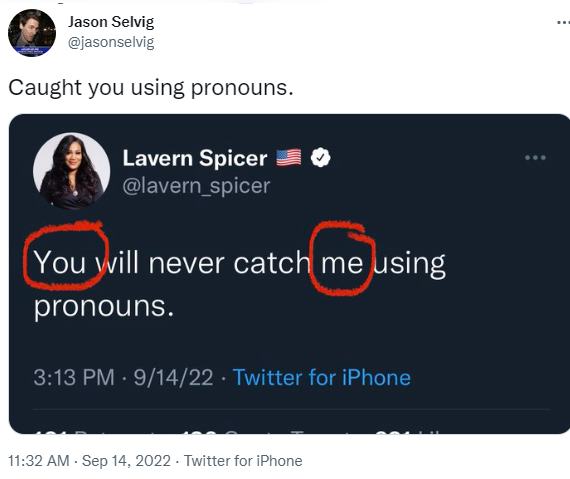
The meme is a screenshot of a tweet where a user is criticizing a person for using pronouns incorrectly. The text in the image reads: "You will never catch me using pronouns." The meme is a humorous commentary on the importance of using correct pronouns, especially for those who identify as transgender or non-binary. The tweet is likely a response to a situation where someone is being "caught" using incorrect pronouns, and the user is jokingly saying they will never be caught using them.
detailed-analysis (gemma3-27b-vision)
Okay, here's an analysis of the provided Twitter exchange, broken down by the headings you've requested. I will indicate if a heading doesn't entirely apply to the situation. I'll also attempt to keep it focused on the image itself and the brief exchange, rather than getting lost in broader theoretical tangents.
1. Visual Description
The image is a screenshot of a Twitter exchange between two accounts.
- Jason Selvig (@jasonselvig): His account is represented by a circular profile picture with a person in it. The text reads, "Caught you using pronouns."
- Lavern Spicer (@lavern_spicer) (verified): Her account is represented by a circular profile picture with a person in it. Her name is followed by a blue verified checkmark. The text reads, “You will never catch me using pronouns.”
- Highlights: Red circles emphasize the words "You will never catch me using" within Lavern Spicer’s text.
- Metadata: Below the text, Twitter metadata is visible: the time (1:13 PM) and date (Sep 14/22) of the post, and the app used to post it ("Twitter for iPhone").
The visual presentation is stark – black background, white text. The highlighted text emphasizes a defiant tone.
2. Foucauldian Genealogical Discourse Analysis
This exchange is ripe for a Foucauldian analysis. Foucault focused on how discourses (ways of speaking and thinking) create power relations and shape our understanding of the world.
- Discourse of Pronouns: Pronouns are not just linguistic tools. They've become the center of a political and cultural debate about identity, recognition, and inclusion. This exchange highlights how talking about pronouns – and specifically, refusing to use them – can become a way of asserting dominance or resisting perceived norms.
- Power/Knowledge: The "catching" metaphor in Jason Selvig's tweet implies a surveillance and a policing of language. The refusal to be “caught” is a refusal to submit to that power. Lavern Spicer is positioning herself as resisting a perceived system of control through language. The tweet suggests that there is a surveillance aspect to it and that adhering to norms is seen as a sort of 'capture'.
- Genealogy of Pronoun Use: A genealogical approach would look at how the debate around pronouns emerged. It wouldn't ask why people use or refuse pronouns, but rather how the practice of using pronouns as a means of self-identification became widespread and contested. The history of pronoun usage itself (even within queer communities) would be important.
3. Critical Theory
This exchange touches on elements of Critical Theory, particularly in its focus on challenging dominant norms.
- Ideology: The conflict revolves around a challenge to the “natural” assumption of assigned gender at birth. The refusal to use pronouns signals a rejection of the ideology that gender is binary and fixed.
- Emancipation: The exchange frames pronoun usage as a potentially oppressive act. From the perspective of the tweeter, embracing pronouns can be seen as affirming personal identity and resisting societal pressures.
- Hegemony: The use of pronouns, particularly in contexts where they are expected, has become a hegemonic norm. This means that it's so widely accepted it appears natural. The refusal to use them represents an attempt to disrupt that norm.
4. Marxist Conflict Theory
This exchange can be viewed through a Marxist lens, though it's a less direct application.
- Power Dynamics: While not strictly about economic class, the exchange reveals a power struggle. The exchange shows a resistance to conforming to certain social expectations which is an exercise of agency.
- Ideological Struggle: The exchange is a manifestation of an ideological battle – a conflict over values, beliefs, and worldviews. The disagreement is over the meaning of gender and identity.
5. Postmodernism
This exchange demonstrates several key elements of Postmodern thought.
- Deconstruction: The exchange inherently deconstructs the assumed stability of language. The exchange demonstrates a denial of expected norms surrounding pronoun use.
- Rejection of Metanarratives: The exchange challenges the grand narrative of a binary gender and assigned identity.
- Subjectivity: Pronoun usage (or refusal thereof) is a claim of individual subjectivity. The tweeter emphasizes personal agency in how they choose to express themselves.
6. Queer Feminist Intersectional Analysis
This is the most relevant and robust theoretical lens for analyzing this exchange.
- Gender Performativity: From a queer feminist perspective, the refusal to use pronouns can be seen as a rejection of the performativity of gender. Pronouns are often seen as reinforcing gender roles and expectations.
- Intersectionality: Gender identity is never isolated. It intersects with other aspects of identity (race, class, sexuality, etc.).
- Resistance: The exchange represents a form of resistance against dominant norms. The exchange highlights an individual asserting their identity in a way that challenges expectations.
- Political Act: The refusal to use pronouns can be a political act.
Let me know if you'd like me to elaborate on any of these analyses or explore other theoretical frameworks!
simple-description (llama3.2-vision)
The meme is a screenshot of a Twitter post where a user, Lavern Spicer, is making a joke about a person using the pronoun "you" instead of "I". The post reads: "You will never catch me using pronouns."
tesseract-ocr
° Jason Selvig “ @jasonselvig Caught you using pronouns. ( ees) \x-lae ) { @lavern_spicer You will never catch me using pronouns. 3:13 PM - 9/14/22 - Twitter for iPhor 11:32 AM - Sep 14, 2022 - Twitter for iPhone