First Seen
2023-05-10T21:03:34+00:00
simple-description (llama3.2-vision_11b)
The meme is a humorous response to a person asking if they are male or female, with the person responding with a list of various names, including some that are traditionally male or female, implying that they don't identify with either gender.
The text in the image is "I am a list of names" and "I don't identify as male or female."
detailed-analysis (gemma3-27b-vision)
Okay, here's a breakdown of the comic strip, addressing the requested theoretical lenses where applicable.
Visual Description
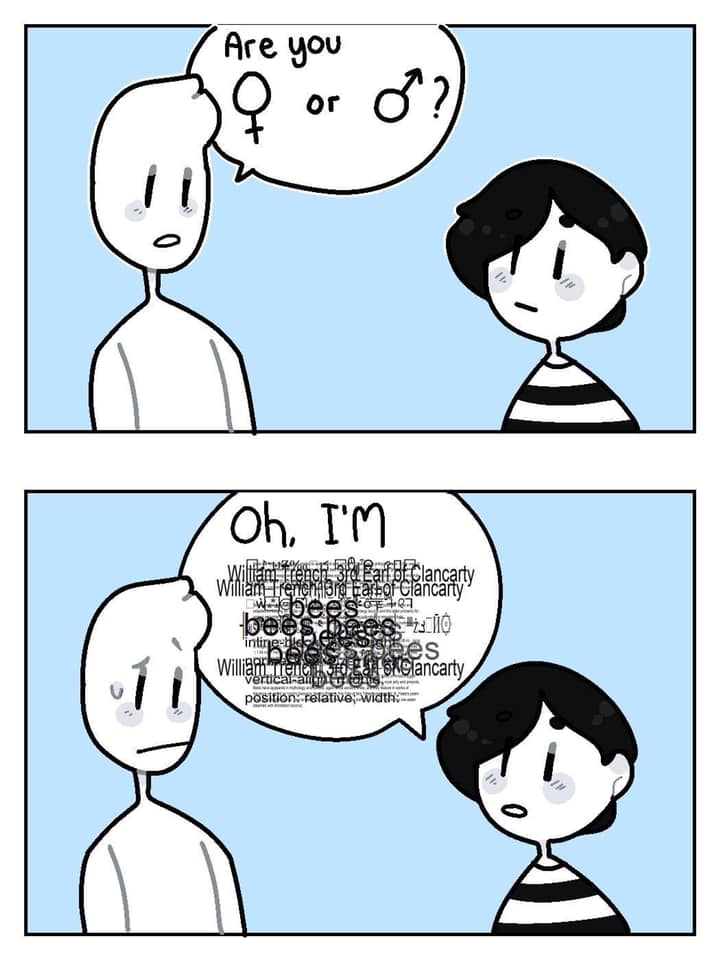
The comic is a two-panel illustration in a simple, slightly minimalist style. Each panel features two figures: one with pale skin and short, spiky hair (presumably presenting as male), and another with darker skin and long hair (presumably presenting as female). The style is cartoonish with simple lines and limited shading.
- Panel 1: The pale-skinned figure is asking the dark-skinned figure, "Are you ♀ or ♂?". Bubble letters are used for the icons of female and male symbols. The characters both have a somewhat somber facial expression.
- Panel 2: The dark-skinned figure replies "Oh, I'm..." while their thought bubble is overflowing with a chaotic jumble of text, primarily the name "William Trench, 3rd Earl of Clancarty". It seems like a nonsensical and overwhelming response. The character is depicted with a slightly frustrated and overwhelmed expression.
Foucauldian Genealogical Discourse Analysis
This comic is highly relevant to a Foucauldian analysis. The act of asking "Are you ♀ or ♂?" is a prime example of discourse in operation. The question isn't simply seeking information; it’s enacting a binary framework that constitutes gender as a category, and demands a categorization.
- Power/Knowledge: The question is underpinned by the power/knowledge regime that historically defined gender as a fixed binary. This binary became a tool for social control and categorization. The questioner is operating within this discourse, assuming its truth.
- Genealogy: The bizarre response—the Earl of Clancarty—can be seen as disrupting the linear and seemingly natural history of the binary. The Earl is a historical figure (a British aristocrat) and pulling such a random name is a way to create a rupture in the discourse. It represents a rejection of the expected answer. It highlights the constructed nature of gender categories by responding with something unrelated, almost nonsensical.
- Disruption of Normativity: The overwhelming text in the second panel symbolizes the multitude of experiences, identities, and possibilities that fall outside the binary. It suggests that the simplistic question cannot contain the complexity of lived experience. It’s a refusal to be confined by the question's parameters.
Queer Feminist Intersectional Analysis
This comic powerfully speaks to key concerns within queer feminist intersectional thought.
- Deconstructing the Binary: The very act of asking "Are you ♀ or ♂?" embodies the problem of the gender binary. The comic then visually rejects the constraints of the binary.
- Rejecting Categorization: The response (the Earl of Clancarty) is a forceful rejection of being defined by a gender category. It's a refusal to conform to expectations.
- Embodied Experience & Complexity: The overflowing thought bubble, filled with arbitrary text, symbolizes the messy, multifaceted, and often unarticulatable nature of gender identity. It acknowledges that gender goes far beyond the simplistic binary.
- Intersectionality (implied): While not explicitly stated, the differing skin tones of the figures subtly hint at the ways gender intersects with race. This brings up the idea of how gender is experienced differently based on other aspects of identity. The question itself may carry different weight for someone marginalized by race or other factors.
Postmodernism
The comic aligns with some core tenets of Postmodern thought:
- Deconstruction of Grand Narratives: The binary gender system is a "grand narrative" that attempts to impose order and meaning onto a complex reality. The comic actively challenges this.
- Rejection of Essentialism: The Earl of Clancarty response embodies a rejection of the idea that gender has a fixed, essential meaning.
- Emphasis on Subjectivity & Fragmentation: The chaotic thought bubble represents a fragmented, subjective experience, highlighting that there isn’t one coherent, unified gender identity.
- Playfulness and Irony: The absurdity of the Earl of Clancarty response is a playful, ironic subversion of expectation.
Notably: Marxist Conflict Theory isn't particularly relevant here, as the comic doesn't focus on class struggle or economic relationships. The focus is on power dynamics related to identity and representation, rather than material conditions.
Let me know if you'd like me to elaborate on any of these analyses or explore other theoretical perspectives.
simple-description (llama3.2-vision)
This meme is a humorous exchange between two individuals. The first person asks "Are you a man or a woman?" and the second person responds with a cryptic message that reads "I am a collection of words that describe a person". The image is likely a visual representation of a person's identity being replaced with a list of words that describe them, such as "human", "mortal", "living", etc.
tesseract-ocr
Are you (i Q or CS ? \ \ \ | a | \ (ee Oh, qT?" >, Seen? { bees ees e810 4, Wie OE Per rear 7 ee py \ \ || =