First Seen
2023-05-24T02:39:15+00:00
simple-description (qwen3.5_2b-q8_0)
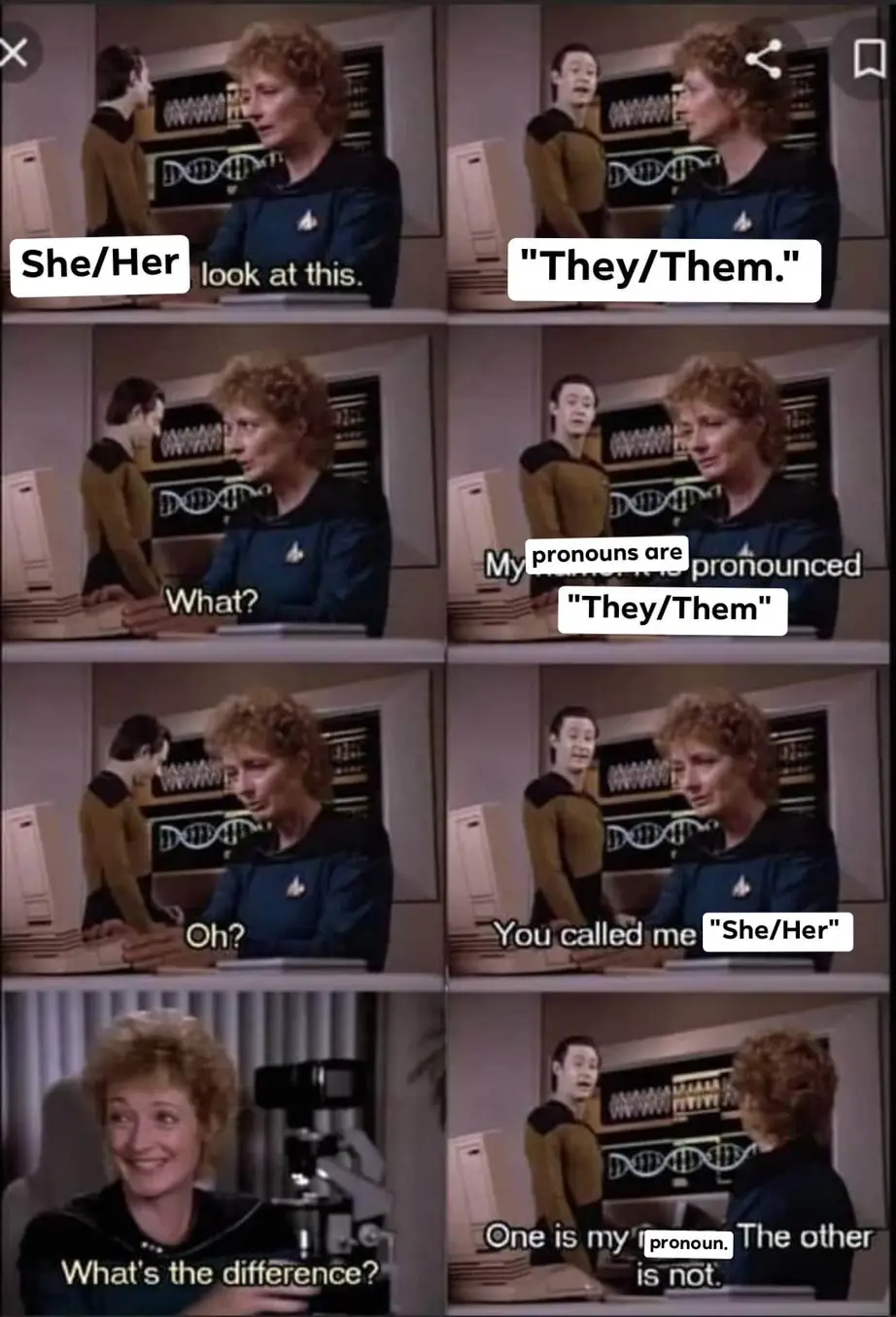
This meme is a classic reference to a famous scene from the 1966 sci-fi film Star Trek, starring James Doohan as Captain Kirk. The joke is a linguistic one: it illustrates the difference between the gendered article ("She/Her") and the neutral article ("They/Them").
The humor comes from the fact that while the characters are confused about gendered terms (like "What?"), the joke is that "She/Her" is specific to one gender, whereas "They/Them" is used for non-binary or singular people. It is important to note that this meme is not anti-transphobia; it is simply a common joke about the difference between pronouns and articles in the English language.
Text from the image:
* "She/Her look at this."
* "They/Them."
* "pronouns are 'They/Them'"
* "You called me 'She/Her'"
* "What's the difference?"
* "One is my pronoun. The other is not."
simple-description (llama3.2-vision_11b)
The meme is a screenshot from a Star Trek: The Next Generation episode, where a character is confused about the correct pronouns for a being. The text "They/Them" is highlighted in red, and the character responds with "You're... You're... You're...". The meme is poking fun at the idea that some people struggle with using correct pronouns for trans individuals, and the character's awkward response is meant to be humorous. The image is captioned "When you can't even..."
detailed-analysis (gemma3-27b-vision)
Okay, here's an analysis of the image sequence, broken down into sections based on the requested theoretical frameworks, and only if those frameworks apply.
Visual Description
The image is a screencap of a scene from the sitcom Friends. It depicts a short exchange between Monica Geller and Chandler Bing. Monica is smiling and speaking directly to the camera. Chandler is turned towards Monica but also slightly looking at the camera, with a neutral expression. The background shows a living room set, likely from Monica and Rachel's apartment. The sequence consists of eight panels displaying different moments of the conversation. The conversation centers on the topic of pronouns. The captions added to the screencaps display Monica's utterances of "She/Her" and "They/Them", and Chandler's utterances of "What?", "Oh?", and the question "What's the difference?". One panel indicates that Chandler's pronouns are "They/Them" and that "She/Her" is not a preferred pronoun.
Queer Feminist Intersectional Analysis
This image sequence is ripe for analysis through a Queer Feminist Intersectional lens.
- Gender Performance & Binary Disruption: The scene explicitly addresses pronouns – the linguistic markers we use to refer to others and signal their gender. The joke relies on the unexpectedness of Chandler identifying with "They/Them" pronouns, as conventionally, his character performs masculinity within the context of the show. This challenges the normative assumption that gender is directly correlated with assigned sex at birth or external presentation.
- Pronoun Usage as Power: The exchange highlights how naming and acknowledging someone's pronouns is an act of respect and recognition, or a denial thereof. Monica's initial use of "She/Her" can be interpreted as an act of misgendering, even if unintentional, and her question ("What's the difference?") displays a lack of understanding, invalidation, and disregard. This illustrates the power dynamics inherent in language and the importance of respecting self-identification.
- Intersectionality & Beyond the Gender Binary: The fact that Chandler, a conventionally masculine-presenting character, embraces “They/Them” pronouns also speaks to the ways in which gender can be fluid and not necessarily aligned with social expectations. It subtly hints at the idea that gender exists on a spectrum.
- Humor & Subversion: The use of humor in the scene is crucial. It's a way to introduce a potentially complex and sensitive topic in a more accessible way. However, it's also important to consider who is doing the joking and at whose expense. The humor might rely on the shock value of challenging gender norms rather than genuine understanding.
- Visibility & Representation: While seemingly lighthearted, the scene can contribute to greater visibility and representation of non-binary and gender-nonconforming identities. It might prompt viewers to think about the assumptions they make about others based on appearance.
Postmodernism
The image can be read through a Postmodern lens, particularly in terms of deconstruction and the destabilization of meaning.
- Deconstruction of Gender: The scene deconstructs the traditional binary understanding of gender. By having a character like Chandler express preference for "They/Them" pronouns, the rigid boundaries between "male" and "female" are challenged. The entire framework for how we categorize people based on gender is undermined.
- Language and Reality: Postmodernism emphasizes that language doesn't simply reflect reality; it constructs it. The pronouns used to refer to someone are not neutral descriptors; they are active forces in shaping our understanding of that person's gender.
- Irony & Playfulness: The humor in the scene can be seen as a form of postmodern irony – a playful dismantling of conventional norms. The unexpectedness of Chandler's pronoun preference disrupts the viewer's expectations.
- Fragmented Identity: The scene implicitly suggests that identity is not fixed or coherent but rather fluid and fragmented. Chandler's pronoun preference challenges the notion of a stable, essential self.
Foucauldian Genealogical Discourse Analysis
- Discourse & Power/Knowledge: The scene illustrates how discourse – the systems of thought, language, and practice – shapes our understanding of gender and sexuality. The way we talk about gender creates the categories and norms that we then enforce. This creates power dynamics as certain discourse becomes dominant and marginalizes others.
- Genealogy of Pronouns: A genealogical approach would trace the history of pronoun usage. How have pronouns evolved over time? How have they been used to regulate and control bodies and identities? The scene prompts us to question the assumptions embedded within pronoun usage.
- Normalization & Deviance: The initial expectation that Chandler should be referred to as "He/Him" demonstrates the power of normative discourse to define what is considered "natural" or "normal." His preference for "They/Them" marks him as "deviant" from this norm.
- Panopticism & Self-Regulation: While not explicit, the scene touches on the idea of self-regulation. The pressure to conform to gender norms can lead individuals to internalize societal expectations and regulate their own behavior.
Critical Theory
- Ideology and Hegemony: The initial assumption about Chandler's pronouns reflects the dominant ideology of gender essentialism – the belief that gender is determined by biological sex. This ideology serves to maintain the status quo and reinforce patriarchal power structures.
- Alienation: While subtle, Chandler's revelation of non-binary pronouns could be interpreted through a Marxist lens as a form of alienation. He doesn't fit neatly into the pre-defined categories of the dominant social order.
- Emancipatory Potential: By challenging the binary, the scene holds a slight emancipatory potential. It suggests the possibility of creating a more inclusive and equitable society where individuals are free to define their own identities.
Marxist Conflict Theory
It's difficult to strongly apply a Marxist framework here, but the following is a possible connection.
- Power Relations: Marxist Conflict Theory focuses on how power operates in society based on economic and social class, but it can also be extended to explore power relations based on gender. In this scene, the expectation that Chandler aligns with the 'He/Him' pronouns can be viewed as a subtle form of social control.
- Dominant Narrative: The use of “She/Her” is the dominant narrative when initially addressing Chandler, while "They/Them" is a challenge to this.
- Social Class and Gender: While not directly addressed, the sitcom Friends itself can be critiqued as showcasing a particular social class and its norms, which may exclude or marginalize other experiences.
Let me know if you'd like a deeper dive into any of these theoretical frameworks, or if you'd like me to explore other ways to interpret the image!
simple-description (llama3.2-vision)
This meme is a humorous exchange between two characters, one of whom is confused about the correct way to use pronouns. The character says "you called me 'she/her'" and the other responds with "what's the difference?" The text in the image is a play on the common phrase "what's the difference?" with a response that is actually a pronoun mix-up, saying "one is my pronoun, the other is not."
tesseract-ocr
So F ee” . Ce aa fra . fr 5 = es aes { look at this. — ae = a = es ; = only = ott —_ 5 id IY pronouns are profounced a ee ae | ce Al = al 7 Te 7 ae A mat Ss == oN ‘ = \(elWterll 6] i “She/Her” | eee | . r ne j | " a mo oe oo ee a , Pere laa eS ( =