First Seen
2023-05-10T21:03:34+00:00
simple-description (llama3.2-vision_11b)
The meme is a play on the classic Winnie the Pooh story, where Winnie the Pooh and Piglet have a conversation about Pooh's love for honey. In this version, the conversation is altered to discuss Pooh's love for someone, with the text "I love you" replaced with "I love you, but you know what I don't love?" The punchline is a joke about Pooh's love for someone being replaced with a transphobic insult, "I love you, but you know what I don't love? Your gender identity".
detailed-analysis (gemma3-27b-vision)
Okay, let's break down this meme using the requested theoretical frameworks. It's important to acknowledge this meme is making a potentially sensitive statement, and this analysis aims to understand its implications through these lenses.
Visual Description
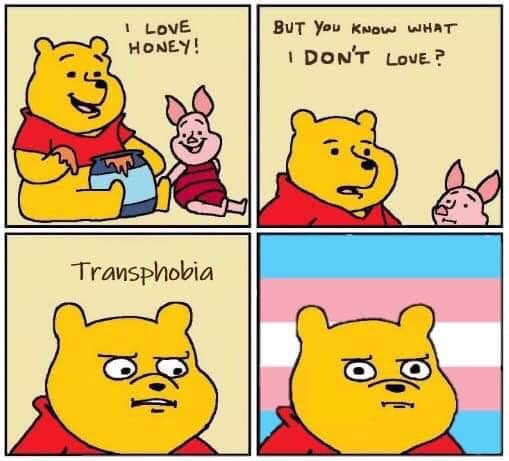
The meme is a four-panel adaptation of a classic Winnie-the-Pooh comic strip.
- Panel 1: Winnie-the-Pooh gleefully holds a jar of honey, exclaiming "I LOVE HONEY!" Piglet is also present, looking upward.
- Panel 2: Pooh adopts a serious expression and poses the question, “But you know what I don’t love?” Piglet looks concerned.
- Panel 3: A close-up of Pooh with a scowling expression and the text "Transphobia."
- Panel 4: Pooh is still scowling in front of a pink, light blue, and white striped background, representing the transgender pride flag.
The use of a familiar, nostalgic cartoon character is particularly significant, as it juxtaposes childlike innocence with a politically charged statement. The visual shift from happy expression to scowl is a key aspect of the meme's delivery.
Queer Feminist Intersectional Analysis
This meme is most directly analyzed through a Queer Feminist Intersectional lens.
- The Core Statement: The meme implicitly equates not liking transgender people ("Transphobia") with something comparable to not liking honey—something Pooh clearly loves. This attempts to normalize dislike toward trans people as an unacceptable feeling, as the lack of love for honey is something the character would never express.
- Transphobia & Dislike: The meme’s implicit assertion is that transphobia is a personal “dislike” or “preference” akin to enjoying certain foods. However, this minimizes the systemic harm of transphobia. Transphobia is not simply a dislike; it is a deeply rooted prejudice with real-world consequences like discrimination, violence, denial of healthcare, and erasure.
- Intersectional Dimensions: While the meme focuses on transphobia, an intersectional analysis acknowledges how transphobia intersects with other forms of oppression. Transgender people of color, disabled transgender people, or transgender people from marginalized socioeconomic backgrounds face compounded layers of discrimination.
- Normalizing Acceptance: The meme intends to assert that transgender individuals deserve the same level of acceptance as anything else Pooh loves. However, the message is simplistic and could be viewed as invalidating the lived experiences of transgender people, or even framing it as "just a preference."
- Subversion and Humor: The use of a lighthearted character and format attempts to make a serious point in a more accessible way. It's a form of political humor that aims to challenge norms and encourage empathy.
Foucauldian Genealogical Discourse Analysis
This meme offers a point of entry for Foucauldian analysis, though it's not central.
- Power/Knowledge: The meme operates within a discourse surrounding gender identity and acceptance. Foucault would examine how the idea of "transphobia" has been constructed as a negative category, and how that construction shapes our understanding of gender. It points to how power operates through definitions—who gets to define what is acceptable or unacceptable.
- Discursive Formations: The meme itself is a discursive formation – a system of thoughts, ideas, and practices that produce a particular understanding of transphobia. It attempts to establish a new "truth" – that disliking trans people is analogous to disliking honey.
- Normalization and Discipline: The meme implicitly attempts to normalize acceptance of transgender people by framing transphobia as an unacceptable deviation from a positive emotion (loving honey). The meme's intention is a form of social discipline, encouraging individuals to conform to a pro-transgender acceptance narrative.
- Genealogical Trace: A genealogical approach might trace the historical development of the term "transphobia" and how its meaning has evolved over time, revealing the power dynamics that have shaped its current understanding.
Critical Theory
This meme can be examined through the lens of Critical Theory, particularly in terms of ideological critique.
- Ideology and Hegemony: The meme attempts to challenge the dominant ideology surrounding gender and sexuality. It opposes the hegemonic (dominant) views that may marginalize transgender people. By framing transphobia as comparable to disliking honey, it pushes back against prejudiced attitudes.
- Critique of Power Structures: The meme implies that power structures perpetuate transphobia, and seeks to subvert these structures by promoting acceptance and inclusion.
- False Consciousness: Critical Theory suggests that individuals who hold transphobic views may be suffering from a form of “false consciousness” – a distorted understanding of reality that serves to maintain the status quo. This meme attempts to break through this false consciousness by highlighting the absurdity of transphobia.
- Emancipatory Potential: The meme, by promoting acceptance, holds a degree of emancipatory potential—the possibility of liberating marginalized groups from oppression.
Marxist Conflict Theory
While not the primary lens, Marxist Conflict Theory can provide some insight.
- Social Conflict: This meme highlights a social conflict—the tension between those who accept transgender people and those who do not. The meme attempts to position itself on the side of the oppressed (transgender people) and challenge the dominant group (those who harbor transphobic attitudes).
- Ideological Struggle: It is part of an ideological struggle over how gender and sexuality are understood. The meme promotes a particular ideology (acceptance and inclusion) and challenges competing ideologies (transphobia).
- Power Dynamics: The meme implies that power dynamics contribute to transphobia, and that those in positions of power may perpetuate discriminatory practices.
- Limited Application: It's important to note that the conflict presented in the meme is not strictly economic or class-based. This is primarily a cultural and social conflict, which makes a purely Marxist interpretation less effective.
Postmodernism
A Postmodern reading of this meme would focus on the following:
- Deconstruction of Meaning: The meme deliberately juxtaposes a simplistic cartoon character with a complex social issue. This juxtaposition deconstructs the "naturalness" of both the cartoon world and our assumptions about gender identity.
- Irony and Playfulness: The meme employs irony and playfulness to challenge conventional norms. The comparison between disliking honey and disliking transgender people is absurd, which forces viewers to question their own assumptions.
- Relativism and Subjectivity: The meme suggests that attitudes towards gender identity are subjective and relative. It challenges the notion of a universal "truth" about gender.
- Fragmentation: The meme is a fragmented piece of information, a snippet of a larger conversation. This fragmentation reflects the postmodern emphasis on the breakdown of grand narratives and the proliferation of localized perspectives.
Disclaimer: This analysis is based on the provided information and theoretical frameworks. Interpretations may vary depending on individual perspectives and contextual understanding. It's important to approach complex social issues with sensitivity and nuance.
simple-description (llama3.2-vision)
The meme is a four-panel comic featuring Winnie the Pooh and Piglet from the classic children's book series. The first panel shows Pooh holding a jar of honey and saying "I love honey!" The second panel shows Piglet looking at Pooh with a concerned expression, saying "But you know what I don't love?" The third panel shows Pooh looking confused, and the fourth panel shows him with a trans flag behind him, implying he's transphobic.
tesseract-ocr
BUT You know WHAT (3) 1 DON'T Love? DO oN NO eS (\ se. a EY Transphobia _ SS