First Seen
2023-05-10T21:03:34+00:00
simple-description (llama3.2-vision_11b)
The meme is a play on the infamous "Area 51" conspiracy theory, but with a humorous twist. The image depicts a scene from "The Simpsons" where Lisa's "I found Area 51" sign is replaced with "I found Area 51 - Total Landscaping" and Lisa's response is "No ma'am, this is Area 51 - Total Landscaping". The meme is a joke about the 2020 US presidential election, where the "Total Landscaping" company (a real company) was a joke name used by Donald Trump's campaign to describe a fake company that was supposed to be a real company to make Trump's campaign look like it was more popular than it was. The meme is poking fun at the idea that the company was a joke and that the campaign was a joke.
detailed-analysis (gemma3-27b-vision)
Okay, let's break down this meme with a bit of academic analysis, covering the headings where relevant.
Visual Description
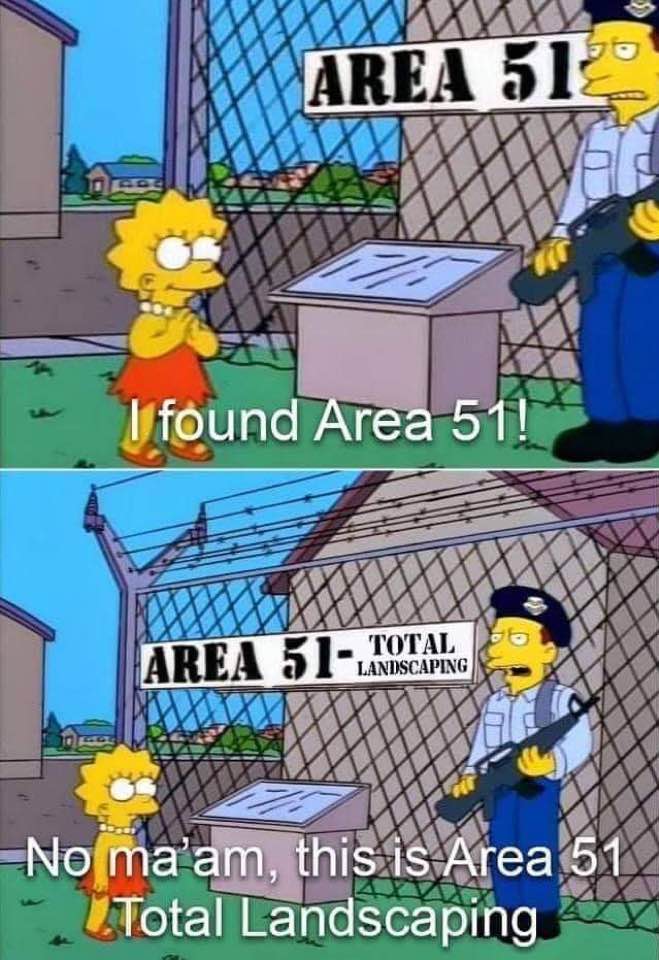
The image is a two-panel meme derived from a scene in The Simpsons. The first panel depicts Lisa Simpson excitedly pointing at a sign labeled “AREA 51,” positioned over a chain-link fence. A uniformed security guard stands beside the sign. Text above the panel reads "I found Area 51!"
The second panel shows a closer shot. The sign has been digitally altered to read “AREA 51 – TOTAL LANDSCAPING.” Lisa is still pointing, and the security guard has an exasperated expression. Text below the panel reads “No ma’am, this is total landscaping.”
The humor relies on the subversion of expectation. The initial excitement around "finding" the legendary, secretive Area 51 is undercut by the mundanity of the reality – it's simply a landscaping company.
Foucauldian Genealogical Discourse Analysis
This meme lends itself well to a Foucault-inspired analysis. The "Area 51" sign, even the altered one, represents a discourse – a system of thought, knowledge, and practice. Initially, the discourse is one of secrecy, conspiracy, and government cover-ups surrounding the rumored extraterrestrial research at Area 51. This discourse is produced by media narratives, popular culture, and (often unsubstantiated) claims.
The alteration of the sign to "Total Landscaping" disrupts this established discourse. It’s a genealogical move because it excavates a "hidden" truth beneath the layers of conspiracy. The seemingly fantastical is revealed to be rather banal – a business operating with a tongue-in-cheek (or accidental) connection to a famed location.
Foucault would likely be interested in how power operates through this discourse. The original discourse of Area 51 establishes a sense of awe and mystique, potentially reinforcing government authority and discouraging questioning. The disruption of this discourse, while humorous, also reveals the constructed nature of power and the way it can be maintained through manufactured mysteries. The landscaping company becomes a new discourse – the mundane, the everyday, a direct challenge to the exceptional.
Critical Theory
From a Critical Theory perspective, the meme highlights the ways in which ideologies are constructed and reinforced. The initial association with Area 51 is loaded with cultural baggage – government secrets, alien encounters, the suppression of knowledge. It is a myth that has gained power through repetition and acceptance, masking underlying social and political realities.
The subversion of the sign is a critique of this constructed reality. It’s an ironic commentary on the way we latch onto fantastical narratives to avoid confronting more complex, mundane, but potentially more important truths. It’s a deconstruction of the “myth” of Area 51, exposing its potential emptiness and questioning the sources of authority that perpetuate it.
The meme can also be seen as a commentary on the spectacle of belief. We are so eager to believe in the extraordinary that we are willing to overlook the ordinary. This mirrors the larger way in which societies are often distracted by sensationalism while systemic issues remain unaddressed.
Marxist Conflict Theory
While not a central focus, a Marxist reading can be applied. The "Area 51" discourse can be seen as a distraction from material conditions and class conflict. The focus on the fantastical (aliens, government conspiracies) deflects attention from the real power dynamics that shape society.
The "Total Landscaping" reveals this distraction. Landscaping, as a service industry, is often performed by workers within a capitalist system. By grounding the image in this practical, labor-based reality, the meme subtly highlights the economic forces at play. The myth of Area 51 becomes a "superstructure" – an ideological construct that serves to obscure the underlying "base" of economic relations.
Postmodernism
This meme is thoroughly postmodern. It embodies several key tenets of the movement:
- Irony and Parody: The humor relies on the ironic subversion of a well-known cultural symbol.
- Deconstruction: It dismantles the established meaning of "Area 51" and exposes the constructed nature of reality.
- Simulacra and Simulation: The sign itself becomes a simulacrum – a copy without an original. The "Area 51" sign is a symbol that has lost its connection to any real referent. It’s a representation of a representation, divorced from the reality it purports to depict.
- Hyperreality: The meme suggests that the sign representing the idea of Area 51 is more "real" than the Area 51 itself, creating a condition of hyperreality.
- Fragmentation: The alteration of the sign represents a fragmentation of meaning and a rejection of grand narratives.
Queer Feminist Intersectional Analysis
This is the least applicable framework here, but some connections can be drawn. The meme's subversion of expectations and deconstruction of a powerful symbol can be read through a queer lens. Challenging established narratives and disrupting dominant ideologies are common themes in queer theory.
It's a stretch, but we can consider how "Area 51" represents a space of assumed authority and control, traditionally associated with patriarchal structures. The dismantling of this symbol can be seen as a reclaiming of space and a challenging of hierarchical power dynamics. An intersectional reading would be strengthened by considering the ways in which marginalized communities have been excluded from these narratives of power and control.
I hope this breakdown is helpful! Let me know if you'd like me to focus on any specific theoretical framework in more detail.
simple-description (llama3.2-vision)
This meme is a play on the 2021 incident where the US military accidentally shot down a Chinese spy balloon, which was mistaken for a UFO. The meme features a scene from The Simpsons, with the character Lisa saying "I found Area 51" and then correcting herself to say "I found Area 51, no ma'am, this is Area 51, total landscaping". The text is a humorous reference to the military's mistake, implying that the area is actually a landscaping project.
tesseract-ocr
XN XXX YE | KX ot ROCAREA 51 ? YUL by eal MIO ee EY XN" : mY \W\¢ ; <A t= y ze LX c} Ban | 4 found Area 5 H o> z Ax Pen = DIO ra) ] AREA 51-0228. Ate eal WIN. PRS a OX, ( % Oe OX) te Uy otal Ber eclelt g AV